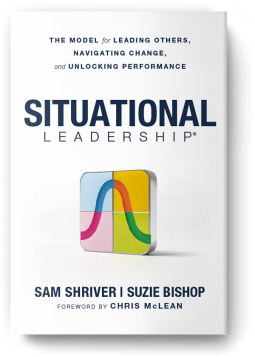
Situational Leadership®
The Model for Leading Others, Navigating Change, and Unlocking Performance
This title was previously available on NetGalley and is now archived.
Send NetGalley books directly to your Kindle or Kindle app
1
To read on a Kindle or Kindle app, please add kindle@netgalley.com as an approved email address to receive files in your Amazon account. Click here for step-by-step instructions.
2
Also find your Kindle email address within your Amazon account, and enter it here.
Pub Date 23 Jun 2026 | Archive Date 10 Aug 2026
Talking about this book? Use #SituationalLeadership #NetGalley. More hashtag tips!
Description
Every leader has been there. You give clear direction, and people still hesitate. You try to empower, but performance drops. You ask questions and try to collaborate, yet confidence and engagement don’t grow. What works in one moment somehow falls completely flat in another.
These frustrations point to a costly assumption many leaders make: that your natural leadership approach is always effective.
The Situational Leadership® Model challenges this assumption, demonstrating how leaders are successful when they adapt their approach to the specific situation and the person in it.
Drawing on more than fifty years of research and real-world application, the Situational Leadership® Model offers a practical, human-centered framework for navigating that gap. The framework concentrates on the two areas where leaders have the greatest opportunity to make an impact: the situation and the follower.
By clarifying the task, assessing an individual’s ability and willingness, and adapting leadership behavior accordingly, leaders can respond with the right style at the right time.
This book brings the enduring effectiveness of the Situational Leadership® Model into today’s complex, fast-moving workplace. Through clear explanations and actionable guidance, the book serves as a practical guide to everyday leadership moments: leading others, navigating change, and increasing performance.
The result is intentional, adaptable leadership that meets people where they are, helps them take the next step, and creates lasting impact.
Advance Praise
“The Situational Leadership® Model just makes sense. You can’t argue with it. The objective leadership framework looks at the readiness of an individual for a particular task and teaches leaders how to take this approach versus placing value judgments on their workforce. It’s a winning combination.”
—Marshall Goldsmith, Thinkers50 #1 Executive Coach and New York Times bestselling author of The Earned Life, Triggers, and What Got You Here Won’t Get You There
“After more than ten years of working closely with The Center for Leadership Studies and applying the Situational Leadership® Model in a global organization, I’ve seen firsthand how powerful this framework can be. This book brings the model to life in a way that is clear, practical, and deeply human. It helps leaders remove the ambiguity of ‘How should I lead right now?’ and replaces it with intentional choices that drive performance and growth.”
—Terry Copley, head of learning and development, Hilti
“No matter if you lead an organization, a department, a team, a nonprofit, or a family, this book is essential reading. It will teach you how to eliminate the guesswork about leadership through a proven, intentional model that empowers you to improve others and yourself to achieve immediate and sustainable results.”
—Marty Davis, director of global field training (retired), Dairy Queen
“The most effective leadership frameworks are those that connect learning to business outcomes. The Situational Leadership® Model has stood the test of time because it does exactly that. Its practical application and adaptability continue to make it relevant for organizations focused on performance. This book brings that connection into clear focus.”
—Ken Taylor, CEO, Training Industry, Inc.
Available Editions
| EDITION | Hardcover |
| ISBN | 9798891388383 |
| PRICE | $28.00 (USD) |
| PAGES | 224 |
Available on NetGalley
Available to Buy
Buy on Bookshop.org Buy on WaterstonesAverage rating from 5 members
Featured Reviews
 Demetris P, Reviewer
The Wrong Help, Given Confidently
Sam Shriver and Suzie Bishop’s “Situational Leadership®” argues that bad leadership often begins not with cruelty or incompetence, but with a leader misreading the moment.
By Demetris Papadimitropoulos | May 22nd, 2026
A manager is rarely swifter than while offering the wrong help with confidence. Offer autonomy too soon, and trust becomes abandonment. Offer direction too late, and clarity arrives wearing a small emergency helmet. Ask questions of someone who has no map, and you are not empowering them so much as inviting them to wander handsomely in the fog. The premise of “Situational Leadership®: The Model for Leading Others, Navigating Change, and Unlocking Performance,” by Sam Shriver and Suzie Bishop, is that leadership failure often begins not with malice, laziness, or incompetence, but with misdiagnosis.
The quieter premise is the better one. “Situational Leadership®” does not knock the leadership shelf sideways. It is a careful re-presentation of a framework with decades of workshop dust on its shoes, written from inside The Center for Leadership Studies, the institutional keeper of the model. The result bears the marks of that origin: fluency, squarely built structure, insider command, rehearsed recurrence, and the occasional sense that the framework has arrived already wearing its workshop name badge. At its sharpest, though, the guide slows the hand before it points. It asks leaders to look at the assignment, the person, and the moment before reaching for their favorite kind of help.
Shriver and Bishop define leadership as influence, then argue that influence depends on power. Not power as cartoon command, but power as the potential to affect behavior, morale, and results: legitimate authority, expert credibility, and referent trust. The guide then builds a grammar for the next difficult conversation. A leader first identifies the particular task, then assesses the follower’s current “Performance Readiness®,” meaning demonstrated ability and willingness for that task. Ability is not potential. Willingness is not virtue. One person can be skilled and hesitant, eager and unprepared, confident and not yet competent, or ready to act with little interference. The leader must match the moment with the right measure of guardrails, reassurance, and room to move.
The framework translates those moments into four readiness levels, each paired with a response the leader can practice. R1 means unable and insecure or unwilling; R2 means unable but confident or willing; R3 means able but insecure or unwilling; R4 means able, confident, and willing. These correspond to S1 directing, S2 coaching or explaining, S3 supporting or problem-solving, and S4 delegating. On paper, it can sound suspiciously tidy, like a color-coded grid for the weather people bring into the room. Yet the refrain is almost comic in its plainness: it depends. In the stronger passages, “it depends” is not evasion. It is discipline. It depends on the assignment. It depends on what the person is demonstrating now. It depends on confidence, commitment, motivation, and whatever private weather trails into the meeting.
Margot supplies the opening test. A newly promoted sales manager, she has one reliable style and a talent for unintended damage. She gives her team a flood of detail, mistakes silence for comprehension, does not check in, and grows visibly annoyed when people ask for clarity. Her newest hires receive close attention, though she sometimes takes over rather than develops them. Her most seasoned salesperson does well with autonomy. The middle of the team, meanwhile, feels abandoned. Performance slips. Several people leave. Margot is not treated as a villain, which matters. She is more usefully familiar than that: a competent person with a narrow repertoire.
The case gives the book its cleanest moral shape. Margot’s behaviors are not wrong in the abstract. Direction helps some people. Autonomy helps others. Coaching can build confidence. Support can restore willingness. The problem is not style but mismatch. “Situational Leadership®” lands when it keeps one hand on the assignment and the other on the person, resisting the managerial shortcut of labeling in place of looking. The employee is difficult. The employee lacks initiative. The employee is a natural. The employee is not ready. The model interrupts that little courtroom with a small question with teeth: ready for what?
That question is likely the part of the book most likely to make it out of the workshop and arrive in Tuesday’s check-in. In one of its sharpest examples, Hana, a director of product innovation, works with Michael, a talented senior developer assigned to build an app with input from several stakeholders. At first glance, Michael looks capable. He is creative, experienced, excited. Then colleagues offer feedback in a meeting, and he shuts down: pushing back physically, stopping his notes, growing defensive, questioning whether the team is ready for the project. Hana’s useful insight is that “build the app” is not one assignment. Michael may be R2 for the larger app work, because he is willing but has not yet demonstrated competence at this scope. He may be R1 for receiving live feedback, because he has shown neither ability nor willingness to do that part well. The distinction is the guide’s argument in miniature. It lets a leader become more precise without becoming cold.
The prose is designed to move such distinctions from page to meeting table. It is plainspoken, patient, and lit by a steady workshop glow. The sentences often proceed in a teaching cadence: define, explain, apply, repeat. Shriver and Bishop favor short declarative lines that could sit comfortably on a workshop slide: “Leadership is influence.” “Power is the battery of leadership.” “Readiness is always moving.” “The most inconsistent thing a leader can do is treat everyone the same.” The best of these lines are memorable because they are plain. The weaker ones drift into the climate-controlled diction of corporate reassurance: impact, growth, performance, trust, clarity, transformation. One can respect the usefulness while occasionally wishing the prose would loosen its badge lanyard.
The images are made for quick retrieval, not lingering admiration. Power becomes a flashlight battery. Task definition becomes a forest → tree → leaf exercise, moving from role, to objective, to specific behavior. Misdiagnosis is compared to a doctor treating the wrong problem. Assessing readiness is compared to blind auditions on “The Voice,” minus the swivel chairs and theatrical lighting. These images do not decorate the book; they put handles on the tool drawers. They help the reader remember where the tools go.
Structurally, the guide proceeds with laminated orderliness: tidy, yes, but also useful. The book begins with praise and a foreword, establishes influence and power, introduces Performance Readiness®, pauses for historical grounding, then moves through the four-step process: identify the task, assess readiness, match and communicate the leadership response, manage the movement. Later chapters apply the framework to performance and disruption. The conclusion returns to Margot, now altered by practice. The appendix supplies conversation starters, diagnostic questions, prompts for assessing trust, and questions to ask one’s own leader during change. This is not a book that wants to be admired from the shelf. It wants to be dragged into a one-on-one with coffee stains on the page.
The design does more than arrange material; it rehearses the very sequence the authors want leaders to practice. First see the task. Then see the person. Then choose the response. Then keep watching, because people move. The Hana and Michael thread gives the middle chapters momentum, letting the framework unfold across an actual working relationship rather than as a laminated chart. The circular return to Margot also matters. Opening Margot shows leadership by habit; closing Margot shows leadership by attention. For Shriver and Bishop, leadership really lives not in the keynote or the off-site, but in the next live conversation.
The historical chapters earn their keep, though they advance dutifully rather than dramatically. Shriver and Bishop trace the model through Frederick Taylor’s task behavior, Elton Mayo’s human relations work, Ralph Stogdill and the Ohio State studies, Douglas McGregor’s Theory X and Theory Y, Chris Argyris’s development continuum, Abraham Maslow’s hierarchy of needs, and Frederick Herzberg’s motivation-hygiene theory. The lineage is tidily legible, almost handrail-smooth. Each thinker arrives to place one brick in the foundation, and the foundation leads, with minimal suspense, to the framework waiting at the end of the corridor. The book is not uninterested in research, but it is more invested in ancestry than argument.
Here the guide shows its most telling constraint. “Situational Leadership®” is written from within the house it describes. Its insider position gives it fluency and command, but also a tendency to treat the framework as the answer the room has been moving toward all along. The model is repeatedly presented as cleanly objective, because it asks leaders to rely on observable behavior rather than emotion, preference, or favoritism. That aspiration is valuable. It is also incomplete. Observation is never free from the observer. A leader can misread willingness because of bias, impatience, cultural assumptions, fear, loyalty to a bad plan, or the deeply human wish to make irritation sound like data.
A person who appears unwilling may simply be overloaded. Or underpaid. Or poorly resourced, misled, alienated, or quite reasonably resistant to foolish work. The book warns against typecasting, which is no small virtue, but it does not stay long enough with the leader who uses diagnostic language as a managerial alibi. Nor does it dwell with organizations whose systems make even good leadership feel like trying to tune a violin inside a leaf blower.
Reach is the other strain. The book has most authority when it narrows attention: this person, this assignment, this moment. Yet the later chapters widen the framework to performance, change, engagement, retention, talent development, family life, classrooms, communities, even governments. Some of this expansion earns its place, especially when the book treats disruption as a sequence of new tasks rather than a mood. The average manager now seems expected to be coach, translator, smoke alarm, and deliverer of results, preferably before the next video call. Change fatigue is real. So is the need for leaders who can distinguish between autonomy and abandonment. Still, the book is strongest as a disciplined instrument, not a universal solvent.
Repetition is part of the bargain. “Task-specific,” “ability and willingness,” “direction and support,” “meet people where they are,” “no one style fits all”: these motifs recur until the reader could probably recite the model while rinsing a coffee mug. For a manager seeking usable language, this reinforcement is a feature. For a reader moving straight through, it can feel overinsured. The repetition is not careless. It is pedagogical. But it does flatten the music.
The illuminating comparisons are not to grand theory but to practical management guides such as “The Coaching Habit” by Michael Bungay Stanier and “Radical Candor” by Kim Scott. Like Stanier, Shriver and Bishop want leaders to improve everyday conversations. Like Scott, they understand that care without clarity can become mush, while clarity without care can become weather. But “Situational Leadership®” is more schematic than either, less interested in a leader’s personal voice than in the fit between behavior and readiness. It also sits near “The Leadership Challenge” by James M. Kouzes and Barry Z. Posner as a durable, teachable leadership framework with an ecosystem around it. The difference is that Shriver and Bishop are narrower and more diagnostic. Their question is not “What do exemplary leaders do?” but “What influence does this person need from me now?”
This is why the book works when it works. Its most convincing passages are not the most inspirational ones. They are the most specific: Liam learning to break “professionalism” into teachable behaviors; Hana realizing that Michael’s technical competence does not transfer automatically to stakeholder collaboration; Priya using different styles with four nonprofit employees; the sections on overleading and underleading, which show how good intentions arrive in the wrong size. These scenes are plain, but they carry the book’s intelligence. They understand that help has to be timed. Too much structure can insult competence. Too little can strand a beginner. Listening can be generous, or it can be a polished way to avoid giving needed direction.
The chapter on change works best when it stays close to people rather than trends. Organizations often treat disruption as a strategy problem, the authors argue, when it is also a human one. Change creates new tasks; new tasks reset readiness. Even strong performers may need more structure when the ground shifts. This is a useful corrective to organizations that announce transformation as if the memo itself were a bridge. People need facts, context, next steps, and enough trust to admit what they do not yet know how to do. Here the framework’s practicality becomes timely without straining for relevance.
The appendix proves the book means to leave the chair and enter the one-on-one. Its questions are not dazzling, but many are good: “What do you need to perform at your best?” “Do we have same-page status on the task?” “What don’t I know about your day-to-day that would help me lead you better?” These are not ornate inquiries. They are serviceable doors. The book’s wager is that leaders improve by opening such doors more often, and at better moments.
Still, a few locked doors would make it stronger. What if the leader is the obstacle? What if low Performance Readiness® reflects not a follower’s deficit but a chaotic strategy, impossible workload, or broken promise? What if a follower’s reluctance is not insecurity but discernment? “Situational Leadership®” has room for these questions, but it tends to pass them briskly, clipboard in hand.
None of this undoes the book; it shows where its map begins to thin. This is a well-built field guide for one-on-ones, not a book that overturns the furniture in the leadership aisle. Its excellence lives in the hand rather than the ear: method before music, use before revelation. Its emotional force is the relief of finding the right name for a familiar failure. Its style is not sonorous; it is clean enough to carry into work. Its structure is not daring, but sound. Its real accomplishment is considerable: it turns adaptability from a virtue into a sequence.
I would rate “Situational Leadership®” 82/100, which translates under my scale to 4/5 Goodreads stars. That rating reflects a book of genuine value: coherent, applicable, occasionally repetitive, sometimes overextended, and consistently best when it trusts the modesty of its own strongest idea.
The closing Margot remains the right emblem. She is not suddenly visionary, magnetic, or grand. She has simply learned to pause before reaching for her favorite tool. A nervous rep gets structure. A developing rep gets coaching. A top performer gets space. A child at the kitchen table gets guidance, then room. The leader’s hand moves closer, then farther away, not from indecision but from attention. That is the image the book leaves behind: not the heroic leader at the front of the room, but a person finally alert to the small, difficult measurement of how much help is enough.
 Melanie G, Reviewer
As someone who has managed projects, led teams, and worked with people at very different stages of experience, I found Situational Leadership to be a practical and easy-to-follow read. The core idea is straightforward. Different people need different types of support depending on their skills, confidence, and the situation they are facing. While that may sound like common sense, the book does a good job of putting a clear framework around it and explaining how to apply it in real-world settings.
I appreciated that the authors focused on flexibility rather than a one-size-fits-all approach to leadership. Some of the concepts were familiar to me, but the examples helped reinforce why adapting your leadership style can make such a difference.
 Dora Archie O, Reviewer
The book is just as the title depicts and for anyone who has ever been at the helm of a project or team, or closer home in terms of the self- you'd know that it's never a one size fits all and often you have to adapt to different situations while navigating complexities and people's personalities and motivation.
It was refreshing to read this book because at it's core the authors truly know that we are never the same person- and that life is non-linear, so the practical approach in handling team dynamics was very welcome.
Thanks Netgalley for the eARC.
 Loree S, Reviewer
Situational Leadership® by Sam Shriver and Suzie Bishop was a practical read that reinforced why effective leadership isn’t one size fits all. I’d give it 4 out of 5 stars.
What I appreciated most was the reminder that good leaders adapt. Different people need different levels of direction and support depending on their experience, confidence, and the situation they’re in. It’s a simple concept, but one that’s easy to forget when you’re leading a team.
As someone who teaches the Situational Leadership model in my own leadership development work, I appreciated that this book didn’t just explain the framework again. It brought it to life with relevant, modern examples that showed what the model looks like in practice. That made it feel fresh, even though I was already familiar with the concepts.
I found myself reflecting on how I coach leaders and where I can apply some of the examples in my own facilitation. It’s always valuable when a book reinforces what you know while also giving you new ways to think about and teach it.
This isn’t a book that’s trying to reinvent leadership. Instead, it takes a well established model and makes it practical, approachable, and relevant to today’s workplace.
If you’re leading a team, coaching others, or developing leaders, this is a solid resource. Whether you’re new to the Situational Leadership model or have been using it for years, there are practical takeaways that you can put into practice right away.
Readers who liked this book also liked:





Kate Sustersic Gawlik; Bernadette Mazurek Melnyk
Health, Mind & Body, Parenting, Families, Relationships, Self-Help






Nina Mack
Health, Mind & Body, Nonfiction (Adult), Science
Verne Harnish; Kevin Daum
Biographies & Memoirs, Nonfiction (Adult), Professional & Technical

Katie-Rose Fischer-Price
Children's Fiction, Health, Mind & Body, Parenting, Families, Relationships


Jonathan Spitz
Health, Mind & Body, Nonfiction (Adult), Self-Help