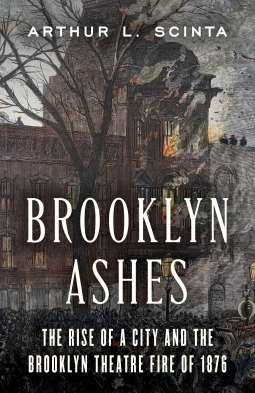
Brooklyn Ashes
The Rise of a City and the Brooklyn Theatre Fire of 1876
Sign In or Register Now to see if this title is available for request.
Buy on Bookshop.org Buy on WaterstonesSend NetGalley books directly to your Kindle or Kindle app
1
To read on a Kindle or Kindle app, please add kindle@netgalley.com as an approved email address to receive files in your Amazon account. Click here for step-by-step instructions.
2
Also find your Kindle email address within your Amazon account, and enter it here.
Pub Date 5 Jan 2027 | Archive Date 1 Dec 2026
Globe Pequot | Prometheus
Talking about this book? Use #BrooklynAshes #NetGalley. More hashtag tips!
Description
Brooklyn Ashes is the gripping story of the Brooklyn Theatre Fire of 1876, a catastrophe that has been largely forgotten but made headlines across the globe as then one of the world’s greatest tragedies. In this moving and meticulously researched book, Arthur Scinta introduces a cast of characters that act as paradigms of a changing city. Meet Charles Lott, a cop descended from a Dutch Family that first settled Brooklyn in the 1600s; Charles Lund, a first-generation American who represents the future, displaying ambition and an eagerness to work and save; and Charles Vine, a recent immigrant who puts his bare knuckles to work for the corrupt political ring that controlled the local media, rigged elections, and was ultimately responsible for the deadly inferno. Meet also the actors and actresses putting on a show they would never forget while the fire sparked backstage. At the center of it all is William C. Kingsley, the corrupt developer in charge of building the Theater in the shadow of another, much bigger project at the same time: the Brooklyn Bridge, a venture that would have fatal implications for theater goers.
Based on intense investigation of primary sources and using details from a treasure-trove of seemingly forgotten archives, Brooklyn Ashes is a moving and landmark history. With more than 300 lives lost, and heralding major building reforms for New York City, the Brooklyn Theatre Fire remains one of the deadliest fires in modern history. Through touching storytelling and trenchant analysis, Scinta gives justice to the victims and provides a stark reminder of the cost of political corruption.
Marketing Plan
Positioning Statement
Erik Larson meets Russell Shorto in this meticulously researched, character-driven narrative of one of America’s most devastating and forgotten disasters. Brooklyn Ashes is at once a landmark history of the Brooklyn Theatre Fire of 1876—which killed more than 300 people and made headlines around the world—and a sweeping biography of a city in transformation. Set against the backdrop of the Gilded Age, Arthur Scinta’s debut book traces how Brooklyn evolved from peaceful Dutch settlements to a teeming urban center riven by political corruption, religious upheaval, and unchecked development, culminating in a catastrophe that changed American building codes and urban safety forever. Scinta draws on a treasure-trove of primary sources and forgotten archives to restore justice to the victims and deliver a stark, urgent warning about the price of putting profit before public safety.
Market
Market Opportunity and Audience
Comparable titles with strong sales records: The Devil in the White City by Erik Larson (10M+ copies sold); The Island at the Center of the World by Russell Shorto (200,000+ copies sold); Triangle: The Fire That Changed America by David Von Drehle (100,000+ copies sold); Gangs of New York by Herbert Asbury—all demonstrate sustained commercial appetite for narrative American history rooted in New York City.
Gilded Age resurgence: Scholarly and popular interest in the Gilded Age is at a modern peak, with HBO’s The Gilded Age averaging over 3 million viewers per episode in its first season (2022) and a third season confirmed for 2025, creating a primed audience eager for non-fiction counterparts.
Brooklyn as cultural touchstone: Brooklyn’s population now exceeds 2.6 million, making it larger than 15 U.S. states; it is among the top five most-visited New York City destinations for domestic and international tourists, with a highly literate readership base and passionate local pride in its history.
Disaster history is a proven category: Narrative nonfiction centered on historical American disasters consistently performs: The Great Fire of London, Isaac’s Storm, and Destiny of the Republic all became bestsellers. The Brooklyn Theatre Fire, with 300+ fatalities, remains one of the deadliest theater fires in U.S. history and one of the most under-documented—a wide-open commercial opportunity
NYC building code and urban safety relevance: The fire directly led to sweeping building code reforms in New York City and nationally; with ongoing public conversation about infrastructure, safety, and political accountability in cities, the story has clear contemporary resonance.
Political corruption as evergreen theme: Readers who devoured Boss Tweed histories, Liar’s Poker, and Dark Money will find the book’s investigation of the corrupt Tammany-adjacent political ring that controlled Brooklyn’s media, rigged elections, and was complicit in the fire deeply compelling and disturbingly familiar
Brooklyn Bridge tie-in: The Brooklyn Bridge is arguably the most iconic American engineering project of the 19th century; the book’s direct connection—developer William C. Kingsley was simultaneously building both the theater and the bridge—gives the story immediate name recognition and a built-in marketing hook
Immigration and American identity: The book’s immigrant characters reflect America’s ongoing conversation about immigration; first-generation Americans and descendants of Dutch settlers both feature prominently, broadening the book’s demographic reach across multiple ethnic communities
History education market: The book’s rich primary-source foundation, footnoted research, and focus on local and urban history make it an ideal text for university courses in American history, urban studies, and New York history—a supplementary academic market beyond trade sales.
150th anniversary: The Brooklyn Theatre Fire occurred on December 5, 1876; the book will publish near or during the 150th–151th anniversary window (2026–2027), a powerful hook for anniversary coverage in media and local institutions
Author Credentials
Town Historian of Pelham, New York: Official designation provides institutional credibility and access to archives, historical societies, and academic networks across the New York metropolitan region.
Former Mayor of Pelham, New York: Political experience and public profile give Scinta credibility with both civic and general audiences; he understands how community and governance intersect, directly relevant to the book’s themes.
Litigator: Scinta’s dual expertise in architecture and law gives him unique authority to analyze the structural failures of the Brooklyn Theatre and the legal and regulatory aftermath of the fire—a perspective no other author brings to this story
Founder, Hendrick I. Lott House Preservation Association and Pelham Preservation Society, Ltd.: Demonstrates decades of hands-on commitment to preservation, community organizing, and stewarding New York history
Pro bono board member, Historic House Trust of NYC: Provides connections to the NYC preservation and museum community, a natural promotional network
Active speaker: Regularly invited to speak at organizations, churches, and schools on local and New York history; existing speaking platform can be leveraged for a book tour and promotional appearances in the NYC metro area
Primary-source researcher: Scinta’s access to and command of seemingly forgotten archives and local historical collections gives the book unimpeachable scholarly authority while remaining entirely narrative and accessible
Publicity
Print, Broadcast & Major Media
Major trade reviewers: Publishers Weekly, Kirkus Reviews, Library Journal, Booklist, and others
National newspapers: The New York Times (Arts section, Sunday Review, Metropolitan section), USA Today, Los Angeles Times, The Wall Street Journal, The Guardian (U.S. edition)
Literary outlets: The Village Voice, New York Magazine, and Air Mail among others (Scinta's research and prose style is especially strong)
New York City & regional press: New York Daily News, New York Post, AM New York, Brooklyn Eagle, Brooklyn Paper, Gothamist, The City, Curbed NY—strong local hook with Brooklyn setting and NYC building code legacy
History & culture: Smithsonian Magazine, American Heritage, American History Magazine, Lapham’s Quarterly, Civil War Times, Humanities (NEH publication)
Architecture & preservation: Architectural Record, Preservation (National Trust for Historic Preservation), Old-House Journal, Metropolis Magazine—Scinta’s architectural background is a strong pitch angle
Legal & policy: The National Law Journal, City Journal, Governing Magazine—building code reform and political corruption angles resonate with legal and policy audiences
General interest: TIME, Newsweek, The Atlantic, The New Yorker (Talk of the Town potential), Harper’s Magazine, Slate, VOX
Fire service & safety trade press: Firehouse Magazine, Fire Engineering, NFPA Journal (National Fire Protection Association)—Brooklyn Theatre Fire directly influenced modern fire codes; strong trade angle for excerpt or feature
NPR: Fresh Air with Terry Gross, Morning Edition, All Things Considered, 1A, Throughline (historical context), To the Best of Our Knowledge
Broadcast: PBS NewsHour, C-SPAN Book TV, CBS Sunday Morning, NY1 (NYC’s 24-hour local news channel, strong Brooklyn constituency)
Op-ed strategy: Bylined pieces in The New York Times and The Daily Beast on topics such as: political corruption and urban infrastructure, the forgotten victims of the Brooklyn Theatre Fire, what the Gilded Age can teach us about today’s New York
Podcasts
History & narrative nonfiction: Throughline (NPR), American History Tellers, Revolutions (Mike Duncan), Revisionist History (Malcolm Gladwell), You’re Wrong About, The Bowery Boys (NYC history—400,000+ downloads/month), New York City History Podcast, Past Present, BackStory
True crime & disaster: Casefile, American Scandal, Gangster Capitalism, Scam Goddess, American History Tellers, Unobscured (Aaron Mahnke)—fire, corruption, and cover-up angles play directly into true crime’s enormous audience (U.S. true crime podcast listeners: 50M+ monthly)
Architecture & cities: 99% Invisible (Roman Mars, 650,000+ weekly listeners), The Urban Planning Podcast, Strong Towns, CityLab Radio—Scinta’s architecture background and building code legacy of the fire make this a strong fit
Political corruption & accountability: American Scandal (Wondery), Drilled, Gangster Capitalism, The Daily (NYT, 3M+ daily listeners)—corrupt ring controlling Brooklyn media and elections resonates strongly
Books & author interviews: Book Club for Masochists, Literary Friction, New Books Network, Longform Podcast, The Readout, KCRW’s Bookworm
Institutional & Events Outreach
Brooklyn Historical Society: A natural flagship partnership—co-presentation of a book launch event or panel discussion in Brooklyn; the BHS has 2,000+ members and significant social media following
New York Historical Society: Strong programming relationship with narrative nonfiction authors; the society’s exhibition space and lecture series reach an engaged historical readership in NYC
Museum of the City of New York: Programming partner for New York history titles; MCNY’s audience of 200,000+ annual visitors is an ideal readership for this book
Brooklyn Public Library: Community events, author readings, and the library’s borough-wide promotional network; 58 branches across Brooklyn
New York City Landmarks Preservation Commission: Given Scinta’s preservation background and the book’s architectural themes, outreach to the LPC for co-branded events or newsletter promotion
Fire Museum of New York: The 278 Spring Street museum is an ideal venue partner for a launch event or signing, with a membership base keenly interested in fire history
Pelham, NY community: As former mayor, Scinta has deep local ties; launch events at Pelham Public Library and historical societies in Westchester County can seed word of mouth
Dutch American community organizations: The Holland Society of New York, founded 1885, with 1,000+ members; the New Netherland Institute—both have direct interest in the book’s Dutch-heritage storylines
Architecture and bar association speaking: AIA New York Chapter (3,000+ members) and NYC Bar Association can host Scinta as a speaker, leveraging his dual credentials as architect and litigator
Anniversary commemoration: Coordinate with Brooklyn civic groups for a December 5, 2026 commemoration of the fire’s 150th anniversary; pitch local and national media on the milestone
Social Media & Digital Marketing
Author Platform & Built-In Demand
Author social media: Arthur Scinta’s existing profile as town historian, former mayor, and preservation advocate provides a credible base; recommend building Instagram and Facebook presence focused on historical photos of Brooklyn, archival images, and Gilded Age New York in the months ahead of publication
Publisher social channels: Leverage publisher’s social media presence across Instagram, Facebook, and X/Twitter for teaser campaigns using archival images of the Brooklyn Theater Fire, period photographs of Brooklyn, and pull quotes from the book
BookTok (TikTok): True crime and narrative nonfiction are among BookTok’s fastest-growing genres; the Brooklyn Theater Fire has strong visual and storytelling potential for short-form video. Target BookTok creators specializing in historical true crime and American history (accounts with 100K–1M+ followers include @historyofthenow, @booktokhistory, and similar)
Bookstagram: Outreach to historical nonfiction Bookstagram accounts with 50,000–500,000 followers; provide ARC copies and period imagery for aesthetically driven coverage
Archival image strategy: The Brooklyn Theatre Fire was extensively photographed and illustrated by newspapers including Harper’s Weekly and Frank Leslie’s Illustrated Newspaper; these public-domain images can fuel a robust social media campaign that is visually striking and historically compelling
Newsletter outreach: Pitch to history-focused Substack newsletters with large followings, including Historicity, The Atavist, and Heather Cox Richardson’s Letters from an American (1M+ subscribers)—the political corruption and Gilded Age themes align with her editorial focus
Local digital media: Bklyner, Brownstoner, Brooklyn Magazine, and Gothamist all have engaged Brooklyn-focused digital audiences; targeted pitches for features, Q&As, or excerpts.
Available Editions
| EDITION | Other Format |
| ISBN | 9781493098682 |
| PRICE | $34.95 (USD) |
| PAGES | 346 |