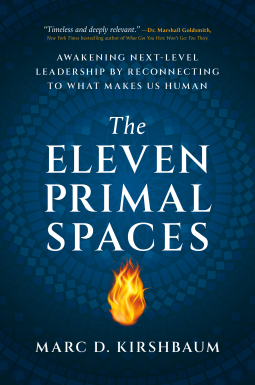
The Eleven Primal Spaces
Awakening Next-Level Leadership by Reconnecting to What Makes Us Human
This title was previously available on NetGalley and is now archived.
Send NetGalley books directly to your Kindle or Kindle app
1
To read on a Kindle or Kindle app, please add kindle@netgalley.com as an approved email address to receive files in your Amazon account. Click here for step-by-step instructions.
2
Also find your Kindle email address within your Amazon account, and enter it here.
Pub Date 4 Aug 2026 | Archive Date 13 Sep 2026
Talking about this book? Use #ThePrimalSpaces #NetGalley. More hashtag tips!
Description
Stand Upright. Walk Boldly. Awaken the Eleven Primal Spaces.
We stand at the edge of the next great expansion. The foundations that once shaped us are crumbling and fading away. In their place rises a new frontier where new methods, strategies, and competencies are being driven by rapid innovation and constant disruption.
To successfully navigate this accelerating transformation, today’s leaders must turn to the most enduring tools we’ve ever known: the fundamentally human “spaces” that enabled our evolutionary ascent in the first place.
The Eleven Primal Spaces explores the individual, communal, and transcendent spaces that have shaped us from the very beginning. Blending anthropology, storytelling, breakthrough leadership theory, and opportunities for personal reflection and discovery, this book empowers leaders to breathe new life into these primal spaces—reigniting connection, inspiration, and energy in work and life.
Whether you’re a CEO, educator, community builder, or anyone striving to lead with lasting impact, The Eleven Primal Spaces offers a compelling synthesis of ancient wisdom and contemporary relevance, merging evolutionary insights with actionable strategies for success in today’s complex and rapidly changing world.
Advance Praise
“The Eleven Primal Spaces is a thoughtful invitation to slow down and remember what we often overlook: meaningful change begins within. Marc Kirshbaum blends neuroscience, anthropology, and lived experience into an exploration of awareness that feels both timeless and deeply relevant.”
—Dr. Marshall Goldsmith, Thinkers50 #1 executive coach and New York Times bestselling author of The Earned Life, Triggers, and What Got You Here Won’t Get You There
“The Eleven Primal Spaces is both a wake-up call and a road map for leading in our hyperconnected, fast-changing world. Ignore its wisdom at your own peril. Embrace it to unlock lasting success, trust, and impact.”
—Ram Charan, global business advisor, board director, and coauthor of the #1 New York Times bestseller Execution: The Discipline of Getting Things Done
“In boxing, as in life, true greatness comes not just from strength or skill, but from resilience, belief, and the ability to rise after every setback. The Eleven Primal Spaces captures the essence of what it takes to lead, persevere, and inspire. Marc’s approach and efforts directly helped shape the League of Champions Foundation, empowering impoverished young people to be resilient and believe that anything is possible. This book is a powerful reminder that true champions are built from the inside out and that awakening the eleven primal spaces is essential to staying on top, even when you get knocked down.”
—Lennox Lewis, former undisputed and three-time heavyweight champion of the world; founder of the Lennox Lewis League of Champions Foundation
“Over my decades in the business press, it became utterly clear to me that the most effective leaders connect on a human level. MBA theories aside, what mattered most was the real stuff—like sharing purpose and collective meaning, winning trust with integrity, and communicating momentum. Marc Kirshbaum’s genius in Eleven Primal Spaces is not just identifying these markers of authentic leadership but also tying them back to the most elemental drivers of human behavior. I love his reasoning and coming away from a book thinking, ‘Of course that’s true, and now I understand why.’”
—Eric Schurenberg, former CEO, Inc. and Fast Company, and founder of the Alliance for Trust in Media
“The Eleven Primal Spaces offers a compelling reminder that the future of leadership depends not on more technology but on a return to what makes us human. Drawing on evolutionary insights, deep leadership experience, and thoughtful reflection, this book reveals how renewing our deepest sources of connection restores purpose, energy, and happiness. An important guide for anyone seeking to make a meaningful difference in a rapidly changing world.”
—Tal Ben-Shahar, New York Times bestselling author of Happier
“This book engages the mind and lifts up the spirit. Marc provides real-life illustrations of transcendent principles, driving us to rise beyond the present and embrace the infinite. He combines practical advice on management and interpersonal relations with a focus farther out than any immediate crisis—indeed, a focus on no less than humankind’s evolutionary future. Anthropology, psychology, business sense, and spirituality entwine in every vignette. The lessons of this volume will be treasured for decades to come.”
—Hon. Tom Campbell, former US congressman and former dean of Haas School of Business at UC Berkeley and Fowler School of Law at Chapman University
“Rooted in both evidence and compassion, this book is a powerful guide to rediscovering the foundational spaces that allow individuals and communities to thrive. Marc’s work honors the science of transformation while never losing sight of the human heart at its core. For anyone seeking to inspire real growth and lasting impact, these insights are both timely and timeless.”
—Doreen Granpeesheh, PhD, BCBA-D, founder and CEO, Center for Autism and Related Disorders (CARD)
“In today’s rapidly shifting landscape, this book cuts through the clutter with actionable wisdom and creative clarity. It’s a master class in leading with vision—essential reading for anyone looking to build not just a brand but a legacy.”
—Marc Rosen, CEO, Catalyst Brands LLC (parent of Brooks Brothers, Aeropostale, Nautica, Lucky Brand, and JCPenney)
“This book is a thoughtful, actionable, and deeply inspiring blueprint for principled leadership in a complex world. It’s a must-read for anyone committed to making a positive impact in the boardroom or the community—and written by a person who walks the walk every day.”
—Harley Rouda, entrepreneur and former US congressman
“Marc’s approach invites readers to reach beyond the ordinary to connect with what truly elevates teams, leaders, and lives. As someone whose career is focused on building great teams on the basketball court, I was especially struck by Marc’s discussion of The Sublime as one of the eleven primal spaces, capturing perfectly how teams can perform at levels beyond the talents of any individual.”
—Jim Tanner, executive director/general manager, UNC men’s basketball, and founder/former president, Tandem Sports + Entertainment
“In my twenty years of knowing Marc, he has always led with clarity and care. In The Eleven Primal Spaces, he offers both in abundance—inviting us to rethink how we engage, lead, and live with purpose. This book offers a pathway to making more intentional choices that amplify engagement in both work and life, and I have already seen the positive impact on my executive clients with whom I have shared Marc’s wisdom.”
—John Bowling, PhD, managing director, Sustainable Leadership Consultants, LLC
“The very title of this book opens your mind to intriguing possibilities. This is not a book you read once and put away. I find myself returning time and again to one or another Primal Space to help me address a challenge I may be facing that day or just to be inspired by one of Marc’s personal experiences. Lyrically written, the tenets of this book are timeless and universal. Having worked closely with Dr. Norman Vincent Peale, I recognize in The Eleven Primal Spaces an enduring wisdom with a fresh relevance. It is the most impactful book I have read since The Power of Positive Thinking—a beacon for readers throughout their lifetime.”
—Shari Thorell, president, ST Enterprises, Inc.; chair, board of councilors, USC Leonard Davis School of Gerontology; former senior vice president, alumni relations, University of Southern California
“In a world hungry for authentic leadership, this book is a powerful reminder that real change begins with the courage to reconnect to what matters most. Marc’s work is both a call to action and a practical guide grounded in wisdom, service, and a deep understanding of what it means to lead with heart. I’ve seen firsthand the impact of Marc’s commitment to purpose-driven collaboration, and I believe this book will inspire leaders to serve boldly and build organizations and communities that thrive.”
—Rick Matros, chairman and CEO, Sabra Health Care REIT, and chair, IsraAID (US) board
“The Eleven Primal Spaces weaves an elaborate, intricate narrative that moves from humanity’s earliest evolutionary steps—when we first stood upright and learned to look beyond the horizon—to the social, legal, and moral structures that shape modern societies. Tapping into the author’s own life experiences as well as lessons from history with practical exercises and mindful inquiry, the book bridges methodology and philosophy, science and self-awareness. By the end, readers feel they have traveled through time and into themselves and emerged with the emotional, social, and ethical tools needed to live with clarity, authenticity, and truth.”
—Neena Haider, PhD, founder, Shifa Precision, Inc.; key contributor to the Human Genome Project; and former professor, Harvard Medical School
Available Editions
| EDITION | Hardcover |
| ISBN | 9798900260624 |
| PRICE | $30.00 (USD) |
| PAGES | 240 |
Links
Available on NetGalley
Available to Buy
Buy on Bookshop.org Buy on WaterstonesAverage rating from 2 members
Featured Reviews
 Vitória L, Reviewer
Wrapped it up this week, all in one go. The blend of the author’s personal experiences with the 11 primal spaces worked incredibly well. The quotes and the exercise section were highlights for me. A strong, thoughtful read, wishing it all the success ahead.
 Demetris P, Reviewer
harpened Tools, Fewer Candles? Not Here
“The Eleven Primal Spaces” Wants Leaders to Stop Optimizing and Start Making Room
By Demetris Papadimitropoulos | July 16th, 2026
Devices have made the dashboarded executive class instrumented to the hilt and oddly homeless. A leader can summon forecasts, pulse dashboards, decks, transcripts, workflows, productivity maps, and machine summaries polished into instant certainty before lunch. Still, none of them can make a room. None can create the place teams need when the deck has ended and the risk begins: somewhere thought does not have to perform usefulness immediately, trust can be tested without turning naïve, disagreement can happen without pyrotechnics, and people can mean what they say. Marc D. Kirshbaum’s “The Eleven Primal Spaces” is most persuasive when it treats leadership not as a set of upgraded techniques, traits, or tools, but as the deliberate making of habitable spaces. Its favorite verb is not manage. It is awaken.
Early on, Kirshbaum reaches for posture as prophecy. Humanity once stood upright, looked toward the horizon, freed its hands, made tools, gathered in groups, and built civilization; now those same descendants hunch over devices, necks bent, attention splintered into alerts, connection outsourced to screens. The picture can be theatrical – “Digital Man” enters with the slightly alarming posture of speculative anthropology – but the dread beneath it is recognizable. This is not a scolding pamphlet against the phone. It is a book worried that people have built tools faster than they have preserved the rooms needed to use them wisely.
Much of “The Eleven Primal Spaces” builds outward from that worry. Kirshbaum arranges the book in three movements: Personal Spaces, Shared Spaces, and Transcendent Spaces. The first looks inward, toward awareness, belief, and resilience; the second turns to law, community, trust, and conflict; the third reaches for empathy, creativity, death, and the sublime. The climb is the point: mirror, commons, horizon. Before awe can matter, the room has to be able to hold it. For a leadership book, this is willing, almost defiantly, to be uncool. It would rather talk about awe than optimize the meeting invite.
Each chapter follows a pattern that soon becomes familiar: an evolutionary or historical frame, a contemporary pressure, a leadership case, a personal anecdote or public episode, quoted “Words to Live By,” and an exercise meant to be carried back into work. The design gives readers rooms to revisit: trust before a hard conversation, conflict before a negotiation, death before mistaking speed for seriousness. It also makes the book legible to the point of ritual. After a few chapters, one knows the furniture: the ancestral doorway, the executive table, the reflective prompt, the lamp already glowing in the corner. Sometimes the light is welcome. Sometimes one wishes for a dimmer switch.
The phrase “architectural intelligence” sounds grand until one sees how practical Kirshbaum’s best idea is. He recasts overhandled leadership virtues as made conditions rather than private ornaments. Awareness is not simply an internal quality; it requires quiet, self-observation, and shelter from the theater of constant reaction. Trust is not a word lacquered onto a values slide; it is a risky space built through repeated proof. Conflict is not a malfunction; it is a room that needs form, rules, and courage. Community is not culture copy; it is a commons. Death is not a gloomy detour; it is the room where urgency is stripped of vanity. The sublime is not decoration; it is the window work sometimes needs if it is not to become only transaction.
Read this way, the most persuasive chapters are those in which the metaphor touches wood and floor. In the chapter on awareness, Kirshbaum tells the story of a failed acquisition of Attica Software, a deal he pursued with conviction but lost after internal opposition delayed the board vote past the exclusivity window. The lesson is not the usual executive fable about grit. It is more diagnostic: he had enough belief in the deal, but not enough awareness of how colleagues were reading his ambition. Leadership, in this telling, requires more than knowing one’s values. It requires noticing how those values enter a room already crowded with fear, status, and private arithmetic.
In the chapter on trust, Gina Schaefer’s Logan Hardware gives the book a place where the metaphor earns its keep. Schaefer hires Shane, a man in addiction recovery who keeps asking for work, and the store becomes more than a retail operation. It becomes an ecology of second chances, competence, neighborhood memory, and earned continuance. Here Kirshbaum does not need to inflate the moral. The counter, the customers, the inventory, and the daily return of trust do the work. Trust is not gauze. It is someone being allowed to become useful in public, then proving worthy of the space.
Practicality returns in the chapter on conflict. Kirshbaum resists the pleasant corporate fiction that communities worth belonging to are harmonious ones. He draws on structured public dialogue, school town halls, negotiation practice, Montessori conflict rituals, and his own failure to confront a mentor before making a wrong career move. The chapter understands that conflict avoided does not become peace; it becomes residue. Leaders are not responsible for preventing disagreement. They are responsible for making disagreement less stupid, less theatrical, and more likely to produce usable truth.
As the book moves into its final section, it becomes stranger, riskier, and more revealing. Empathy and creativity have long had badges at the leadership conference. Death does not. Kirshbaum’s chapter on death ranges through ancient rituals, Pericles, Lincoln, Jewish mourning practices, October 7, career loss, and the way mortality can force value into focus. That is a lot of freight for one chapter to carry, and some of the turns are abrupt. Yet the chapter earns its place by refusing to let leadership remain untouched by grief. It insists that leadership without an account of loss is merely administration with better shoes.
Pushed to the edge of its register, the book arrives at the sublime, a subject executive prose approaches at its peril. Beethoven’s Ninth Symphony, Tommy Lasorda’s 1988 Dodgers, purpose-driven brand promises, and the language of “yes, if” rather than “no, because” gather around Kirshbaum’s conviction that leaders must create moments in which people feel lifted beyond assignment. The sublime is dangerous territory for this register; one false note and everyone is trapped in a leadership offsite with a fog machine. Yet the claim survives the altitude. People rarely give their best to work that feels merely assigned. They give it when the work touches energy, story, pride, and shared possibility.
A toll arrives whenever Kirshbaum asks the ancestral frame to prove too much. He wants to connect evolutionary history, anthropology, brain science, spirituality, civic life, business reconstruction, memoir, public tragedy, and practical leadership into one continuous theory. That sweep distinguishes “The Eleven Primal Spaces” from toolbox-sized management books, but it also creates drift. The journey from savannah to boardroom can feel too smooth, as if human history exists to authorize a set of well-thumbed executive virtues: listen closely, define values, build trust, serve others, manage conflict, honor grief, make room for imagination.
Done as metaphor, the book’s “primal” language holds weight. It reminds readers that leadership is not only a technical function but the stewardship of conditions: time, attention, rules, rituals, permissions, thresholds. Done as proof, it is less persuasive. The evolutionary and historical material often gives the chapters atmosphere, scale, and moral weather; it does not always deepen the claim it is meant to support. The ancestral scaffolding sometimes operates like a handsome colonnade in front of a familiar building. The view improves; the foundation is not always new.
In prose, Kirshbaum favors long arcs and ceremonial cadences, sentences that move from ancient bodies to modern devices, from temples to teams, from sacred ground to shareholder value. His diction favors “purpose,” “connection,” “mission,” “trust,” “awakening,” “future,” and “legacy.” These words belong to the book’s moral climate, but they are also well-traveled guests in the leadership genre. At times they arrive with luggage.
More effective are the passages where abstraction puts a shoe on the floor. A negotiation changes because someone steps outside for a cigarette break. A company loses a deal because internal rivals read ambition as threat. A hardware-store employee earns trust one customer at a time. A leader listens long enough to discover that the supposed obstacle is the person who understands the broken system best. In these moments, Kirshbaum’s prose relaxes. The leadership lesson stops wearing a ceremonial sash and starts doing its job.
If the writing has a weakness, it is floodlight, not fog. The prose rarely confuses; it overexplains, overwarms, overlights. Institutional mistrust, remote work, employee disengagement, digital overload, polarization, grief, and artificial intelligence are pressures the book registers, but its default answer is restorative: recover the space, listen harder, reconnect to meaning, stand upright again. This is humane and often useful. It is not always sufficient. Systems are also made of budgets, titles, layoffs, compliance offices, incentives, punishments, hierarchy, money, fear, fatigue, law, and power. A beautiful room can still have a locked door, and someone usually has the key.
The nearby shelves help mainly by showing what Kirshbaum refuses to narrow. “Primal Leadership” by Daniel Goleman, Richard E. Boyatzis, and Annie McKee connects leadership to emotional resonance with more managerial discipline. “The 7 Habits of Highly Effective People” by Stephen R. Covey offers a more compressed architecture of inward formation and public effectiveness. “Start with Why” by Simon Sinek hovers near Kirshbaum’s chapters on belief and purpose. Kirshbaum is broader than all three and less exacting than the best parts of each. He wants not a framework alone, but a house with a chapel, a conference table, a commons, a studio, and a window facing the infinite.
Rather than a failure, that abundance is part of the book’s honor. Many business books are secretly articles in hardback clothing. “The Eleven Primal Spaces” has the opposite problem: it wants to be a leadership theory, a civilizational survey, a workbook, an executive memoir, a civic sermon, and a pocket creed for the next phase of humanity. It refuses the modern business book’s favorite trick of calling an article a universe. It also occasionally mistakes its own universe for a map. Eleven spaces may be primal; they are not all equally disciplined tenants.
On structure, though, the book earns respect. The three-part movement from self to society to transcendence gives the material an ethical sequence. A leader must know himself before he can build community; a community needs law and trust before conflict can become generative; only then can creativity, mortality, and awe be more than decorative. The design deepens the meaning more than it merely holds the material in place. Still, the chapter pattern becomes repetitive. The reader begins to anticipate the motion from origin story to business case to reflective exercise, and anticipation is not always discovery’s friend.
Proportionally, “The Eleven Primal Spaces” is honorable, humane, and overreaching in nearly equal measure. My rating is 78/100, which corresponds to 3/5 stars. That score reflects a book with a strong governing metaphor and useful architecture, but also one whose prose, evidence, and originality do not always match the altitude of its claims. This is a high three-star reading experience: serious, worthwhile, sometimes stirring, sometimes crowded with noble furniture, rarely cynical, and never mean-spirited or small.
One idea remains after the uplift has thinned. Leadership is not only what a person says from the head of the table. It is the table, the room, the light, the rules for speaking, the permission to disagree, the memory of the dead, the joke that lets people breathe, the promise that survives the meeting. Kirshbaum’s book is best read not as proof that every boardroom problem began on the savannah, but as an invitation to ask a quieter, more stubborn question: what kind of space are people being asked to become human in?
Underneath its framework, that is the book’s finest provocation. It asks leaders to consider not only what they demand from people, but what conditions they leave people inside. A team can be praised and still be starved; consulted and still unheard; gathered and still alone. Kirshbaum’s vocabulary can grow overbright, but his instinct here is exact: before people can act with purpose, they need a place where purpose is more than a word on the wall.
Looked at this way, the book is less a doctrine than a set of rooms to test. Some rooms have air; others feel furnished from a familiar executive catalog. Awareness, trust, conflict, death, and the sublime breathe most freely, while other spaces feel sturdier than they are surprising. But even the weaker rooms belong to an architecture that knows why it was built. It wants to shelter attention from noise, relationship from transaction, disagreement from performance, and ambition from its own appetite.
Other leadership books arrive with sharper tools and fewer candles. This one asks whether the people holding the tools still know how to stand near one another. That question gives “The Eleven Primal Spaces” its dignity, and also its most useful limit. It is not the final word on leadership in a technologized age, nor the most rigorous account of how human systems change. It is something warmer and less tidy: a reminder that the future may depend not only on what we invent, but on what we remember how to make room for.
Still, the image that remains is not the savannah, not the boardroom, not even the campfire Kirshbaum so clearly loves. It is a door left open after a difficult meeting – the light still on, the chairs not quite pushed in, the room waiting to see whether the people who used it have become more honest, or only better rehearsed.