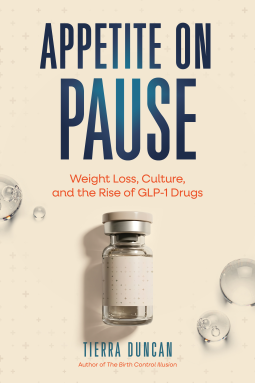
Appetite on Pause
Weight Loss, Culture, and the Rise of GLP-1 Drugs
Sign In or Register Now to see if this title is available for request.
Buy on Amazon Buy on Bookshop.org Buy on Kobo Buy on WaterstonesSend NetGalley books directly to your Kindle or Kindle app
1
To read on a Kindle or Kindle app, please add kindle@netgalley.com as an approved email address to receive files in your Amazon account. Click here for step-by-step instructions.
2
Also find your Kindle email address within your Amazon account, and enter it here.
Pub Date 14 Oct 2026 | Archive Date Not set
Talking about this book? Use #AppetiteonPause #NetGalley. More hashtag tips!
Description
The Science, Trade-Offs, and Long-Term Questions Behind GLP-1 Weight-Loss Drugs
GLP-1 medications like Ozempic, Wegovy, Mounjaro, and Zepbound have transformed the conversation around weight loss.
For many people, these medications reduce hunger, quiet food noise, and make weight loss feel possible for the first time. But beyond the dramatic before-and-after photos lies a more important question: What happens to your hormones, appetite, and overall health along the way?
In Appetite on Pause, health educator Tierra Duncan offers a balanced, evidence-based exploration of the science and culture behind GLP-1 drugs. This book moves past the hype and fear to help you understand how these medications work, what they may change in the body, and the trade-offs worth considering before starting—or while continuing—treatment.
Inside, you’ll learn:
- How GLP-1 medications affect appetite, cravings, and food noise.
- How the body adapts to weight loss and why those changes matter.
- Why body composition is about more than the number on the scale.
- Common side effects and important unanswered questions.
- What often happens when the medication is stopped.
Whether you are considering a GLP-1 medication, currently taking one, or trying to understand the broader implications, Appetite on Pause will help you ask better questions and make more informed decisions about your health—because weight loss is only part of the story.
A Note From the Publisher
ebook: 979-8-9936712-3-9
Hardcover: 979-8-9936712-5-3
Audiobook: 979-8-9936712-6-0
Price:
Paperback $17.99
ebook $9.99
Hardcover $27.99
Paperback: 979-8-9936712-4-6
ebook: 979-8-9936712-3-9
Hardcover: 979-8-9936712-5-3
Audiobook: 979-8-9936712-6-0
Price:
Paperback $17.99
ebook $9.99
Hardcover $27.99
Marketing Plan
MARKETING & PUBLICITY
- Podcast tour
- GoodReads giveaway
- Social media promotion
- Book release announcement to 3,600 journalists
- Local bookstore signings
- Available on BookSirens.com for review
MARKETING & PUBLICITY
- Podcast tour
- GoodReads giveaway
- Social media promotion
- Book release announcement to 3,600 journalists
- Local bookstore signings
- Available on BookSirens.com for review
Available Editions
| EDITION | Ebook |
| ISBN | 9798993671239 |
| PRICE | $9.99 (USD) |
| PAGES | 241 |
Links
Available on NetGalley
Available to Buy
Buy on Amazon Buy on Bookshop.org Buy on Kobo Buy on WaterstonesAverage rating from 25 members
Featured Reviews
 Harves75!! B, Reviewer
Appetite on Pause offers a clear, timely, and engaging introduction to GLP-1 medications. I especially enjoyed the author’s conversational tone and her talent for breaking down complex topics without making them feel dry or overwhelming.
I would have liked more detail on suggested eating plans and ways to maximize results while taking these medications, but overall, this is an approachable and informative resource. It’s an excellent starting point for anyone considering GLP-1s—or hoping to avoid common pitfalls and get the best possible results.
I received an advance review copy from the publisher through NetGalley. All opinions are my own.
 Edie M, Reviewer
I’ll always welcome a new book on GLP-1 medication because while these drugs have been among us for decades, too many feel as though they are flying solo when taking it for weight loss. I only wish this book had been available when I started.
The author is an established medical educator with plenty of knowledge & real-time experience. While some sections are quite detailed, you can’t open this book & not learn something new. I would even go so far as to recommend this book to nurses, pharmacists, physicians & their medical support staff as part of their ongoing continuing education.
GLP-1s for weight loss remind me of when medical marijuana was legalized in certain states. It was every man for himself. I personally know medical/pharmacy schools that tried to lobby against the proposal because it was not part of their curriculum yet. The physicians & pharmacists that were in the field had never studied it so consider how confused patients were. I think GLP-1s are exactly the same. I believe anything a patient can do to educate themselves will only benefit the medication’s success.
If GLP-1s are in your refrigerator (or something you are undecided about), you should be reading this book & consider having it as part of your personal library.
Thank you to NetGalley, the author (Tierra Duncan) & the publisher (Duncan Milam) for the opportunity to read this book in exchange for a fair & honest review.
 Ruthie W, Reviewer
In a cultural conversation crowded with miracle claims, horror stories, and moral judgment, Tierra Duncan’s Appetite on Pause offers something rarer: a serious invitation to slow down and ask better questions.
GLP-1 medications have become one of the defining medical stories of the decade—and for good reason. For thousands of people, they have meant lower blood pressure, improved cholesterol, quieter “food noise,” and real protection against diabetes, heart attacks, and the long-term toll of obesity. Given how quickly this conversation has moved, I wanted to understand the science before forming an opinion, and Duncan’s book turned out to be exactly the kind of grounded, science-first resource I was looking for.
Duncan opens with the basics and does so without condescension. GLP-1, or glucagon-like peptide-1, is a hormone the body already produces. She describes it as the body’s traffic controller for energy: It prompts the pancreas to release insulin, slows digestion, and signals fullness. The catch is that natural GLP-1 breaks down within minutes. GLP-1 agonist drugs were engineered to mimic that effect while lasting far longer, transforming what was once a niche metabolic therapy into what Duncan calls a cultural movement. She is careful not to frame that shift as inherently good or bad, presenting it instead as a predictable response to an obesity epidemic that costs health-care systems billions.
Before reading Duncan, I understood GLP-1s primarily as appetite-suppressing drugs. Her discussion of the hypothalamus and the gut-brain axis made me see them instead as medications that intervene in a much larger system of motivation, pleasure, and self-regulation. The most compelling section of the book, for me, is Duncan’s argument that GLP-1’s most profound effects may occur not in the gut but in the brain—specifically, the hypothalamus, the body’s command center for appetite and energy regulation. This is where food noise gets quieted and overeating gets curbed; food begins to register as fuel rather than comfort.
Duncan traces this process further into the gut-brain axis, explaining how GLP-1 signals travel along the vagus nerve—the communication line between the stomach and the brain—to register satiety. It is here that the book earns its subtitle, A Thoughtful Consideration: Duncan does not stop at explaining how these drugs suppress appetite; she also asks what else might be touched along the way. Because GLP-1 interacts with dopamine and serotonin pathways, some people experience it as simply turning down cravings, while others find that it changes how they experience pleasure altogether. If food has been a source of comfort, she notes, having that response interrupted can be genuinely destabilizing—not only physically, but emotionally.
Duncan’s greatest stylistic strength is her ability to move between biology and lived experience without making either one feel secondary. Appetite on Pause is grounded in science, but it never loses sight of the patients living inside that science—their fears, hopes, frustrations, and complicated relationships with food and their bodies. That balance feels especially important at a moment when the “heroin chic” aesthetic of the early 2000s has resurfaced and the cultural pressure to become thinner has once again been repackaged as aspiration. Against that backdrop, the popularity of GLP-1 medications can seem like more than a medical development; it becomes part of a broader cultural demand to lose weight, often quickly and at almost any cost.
To her credit, Duncan does not bury the caveats. She covers mood changes, electrolyte imbalances, and dehydration as real possibilities, and dedicates space to tirzepatide, a dual agonist that acts on both GLP-1 and GIP rather than on a single pathway. Her point is nuanced: Dual-action mechanisms may improve efficacy, but they may also add to the body’s overall biological burden. She is equally direct about dosing. The same mechanism that quiets binge or emotional eating can, if pushed too far, dull the drive to eat at all—a survival instinct worth taking seriously.
Duncan also addresses concerns about changes in body composition, noting that weight loss can include both fat and lean mass. Her emphasis on resistance or strength training and adequate nutrition is one of the book’s most practical contributions. She also stresses that what you eat still matters. Her discussion of ultra-processed foods examines the way they overstimulate the brain’s reward circuitry, making the case that GLP-1 medications alone cannot undo a food environment engineered to encourage overconsumption.
The book is strongest when explaining the science and asking ethical questions. It is somewhat less definitive when it moves from established evidence into broader claims about pleasure, emotional eating, and the psychological effects of appetite suppression. But even where Duncan raises questions she cannot fully answer, she does something valuable: She makes uncertainty part of the conversation rather than hiding it behind easy conclusions.
What makes Appetite on Pause more than a science primer is its recurring, almost interview-style question: Why are you taking this? Duncan presents GLP-1 use as a confluence of medicine, media, and morality, and she pushes readers to sit with the implications. Is the goal aesthetic or medical? What else has been tried? What is the root cause? What are the actual health risks of not losing weight? Her implicit litmus test is simple: If you and your medical team have already had these conversations, you are likely approaching the decision thoughtfully.
Ultimately, Appetite on Pause is less interested in telling readers what to do than in asking whether they understand what they are asking a medication to change. Duncan does not reduce GLP-1 use to either personal choice or cultural coercion; she shows how the two can exist together. That makes the book valuable not only as an introduction to GLP-1s, but also as a thoughtful examination of what our desire to lose weight reveals about the moment we are living through.
I recommend it to anyone weighing GLP-1 therapy, clinicians looking for a patient-friendly explainer, and readers who want to understand the “why” behind the headlines.
Note: This review reflects a reading of the book’s content and general GLP-1 science. It is not medical advice. Decisions about these medications should be made with a doctor who knows your health history.
 Kelly P, Reviewer
I've been taking a GLP-1 for over two years, and I'm trying to keep up with as much information as I can about the long-term effects of the drug. This new book is a helpful resource that outlines what GLP-1s are and how they work. It also goes into detail about how our bodies react the longer we take them. I enjoyed the information presented and found it to be helpful. Thanks to NetGalley for the ARC.
 Reviewer 1764704
Appetite on Pause: Weight Loss, Culture, and the Rise of GLP-1 Drugs by Tierra Duncan is a valuable resource for anyone taking, considering, or preparing to stop a GLP-1—which feels like 75% of America these days. We all know someone using one, yet most of us know very little about how these medications actually work.
Are they safe? Are they helpful or harmful? How do you successfully stop taking them? The answers are complicated, and there is no one-size-fits-all solution. What this book does is arm readers with the information needed to better understand GLP-1 medications and perhaps have a fighting chance of maintaining their benefits long after stopping them.
There is no doubt that these drugs have been life-changing for many people by helping them address serious weight-related health concerns. But at the end of the day, they are still medications—and nothing comes without potential consequences.
I found this book incredibly enlightening. It answered many of my questions about what GLP-1 medications actually do, how they affect other functions of the body, and why they are so effective at quieting food noise and reducing cravings. This is an excellent resource for anyone using a GLP-1 who wants to better understand both its benefits and concerns.
Thank you so much to Tierra Duncan, Duncan Milam LLC, and NetGalley for the ARC.
 Donna M, Reviewer
As someone who is currently taking GLP1, I was excited to read this. I liked the tone of the writing, it didn't feel like a science textbook, but did lay out a researched and in depth informational study. I feel like I now know more about what's going on in my body. Highly recommended.
 Faith B, Reviewer
This was a very informative read. Before taking the new trend of weight loss medications this is a great book. It answers questions that might not even be thought about before requesting the medication. Very informative.
 Kara R, Reviewer
The conversation around GLP-1 medications has come to the forefront recently, which is why I wanted to read this book. The author explains how these drugs affect appetite and enjoyment of food, and walks through the science in plain language.
The benefits are discussed as well as some of the trade-offs, including how the body adapts to weight loss, what the research says about body composition and, of course, side effects. Nothing here reads like judgment one way or the other.
As someone who incorporates intermittent fasting into my lifestyle and keeps lifelong health on my radar, I found this interesting.
Reviewer 2118753
First of all, thanks to the author for providing me with this ARC!
I’ll be sharing a post on my Instagram (@bookishlunn) with more details about my honest thoughts.
Appetite on Pause is a book I believe everyone should read, if possible. In an era where taking these medications seems to be becoming the norm, I think it’s important to have books like this readily available to help spread key information about their side effects and what people considering this kind of treatment should keep in mind.
I really enjoyed this book because the author doesn’t push any of her views on the reader, nor does she judge those who choose to take these medications. It’s a pretty comprehensive guide to what we know so far, and there’s one thing I especially appreciate and 100% agree with: we need to be well-informed before deciding to start any kind of treatment.
If you or someone you know has started taking or is considering taking one of these medications, I think this book should definitely be on your radar because it covers the topic so thoroughly.
Personally, this isn’t something I’m considering for myself, but I love being able to learn more about something that, in today’s world, could be considered a social phenomenon largely driven by social media.
 Stephanie V, Reviewer
What is a GLP-1? What are the benefits? What are the drawbacks? Author Tierra Duncan walks readers through a wealth of information about glucagon-like peptide-1 (GLP-1) medications in this helpful and insightful book.
The first few chapters explain what GLP-1 medications are, how they were discovered, and the various drugs and brand names that have been available over the years, including those currently on the market. The author also explores how GLP-1 medications can affect a person’s daily life, both emotionally and physically.
The next few chapters delve into hormones and how GLP-1 medications can influence the delicate balance of the body’s hormonal systems, in both male and female patients.
The next section explores the potential drawbacks of these medications, including the risk of disordered eating, and discusses how to practice body neutrality.
The final chapters address what happens when someone discontinues GLP-1 medications, including what to expect regarding weight changes, how to support the body through the transition, and how to shift one’s mindset to maintain a healthy lifestyle.
I particularly appreciated the chapter summaries and self-reflection exercises at the end of each chapter. The book concludes with a helpful list of questions to ask your doctor for those considering moving forward with GLP-1 treatment.
Dulshi P, Reviewer
An informative and insightful read about the growing popularity of GLP-1 drugs and their place in modern society. I appreciated how the book explored a topic that has become increasingly relevant, particularly with the ongoing conversations surrounding weight loss, body image, and health. It was an interesting opportunity to learn more about the subject and reflect on the wider discussions surrounding these medications. Overall, an educational and worthwhile read.
 Olivia C, Reviewer
Thank you to NetGalley and Duncan Millam LLC for this ARC. All opinions are my own.
Appetite on Pause is a look at the origin and culture surrounding GLP-1 drugs, such as Ozempic and how it impacts both the body and brain. It takes a balanced, science-based approach to a complicated topic, and the tone came across as very nonjudgmental. I was also pleasantly surprised by how accessible the book was--the science-y terms were defined in ways easy for the non-scientists or doctors amongst us (myself included), while not talking down on the reader, and the citations list at the end of each chapter was lengthy. As someone who has had questions about medication, and sometimes felt as if doctors and insurance companies were giving me the run-around, I would definitely recommend this as a resource, especially if you're wanting to learn more. I'd like to see a little more focus on some of the newer medications, such as Zepbound, and a discussion of the pricing, and discussion of how future generics, and patents may impact this, but otherwise, I found it to be a both informative, and empathetic read.
 Alexandra A, Reviewer
This was such an informative and well-researched book, and honestly, I think it is an incredibly valuable read given how popular GLP-1 medications have become.
What I appreciated most was how Duncan breaks down the science behind GLP-1 medications in a way that is actually understandable. She explains what these medications are doing in the body, how they affect appetite and hunger, and the changes that can happen with weight loss and body composition without making the information feel overly complicated.
I also really appreciated that this book doesn't approach GLP-1s as simply a good thing or a bad thing. Instead, it gives you information so you can understand what you're actually getting into. With medications like Ozempic, Wegovy, Mounjaro, and Zepbound becoming such a huge part of the weight-loss conversation, I think it's incredibly important that people understand the science, potential side effects, nutritional considerations, and what can happen when treatment is stopped.
We live in a culture where everyone seems to be looking for the next “miracle cure” for weight loss, and I think that's exactly why a book like this is so important. Before jumping on the latest trend, people should have the information they need to make an educated decision about their own health.
Duncan does a great job making a complicated and sometimes controversial topic approachable. I finished this book feeling like I had a much better understanding of GLP-1s and the bigger picture surrounding them not just the number on the scale.
Definitely a book I would recommend to anyone considering a GLP-1, currently taking one, or simply wanting to understand what all the hype is about.
Readers who liked this book also liked:

Reese Minshew
Health, Mind & Body, Nonfiction (Adult), Professional & Technical


Rosemary Esehagu
Biographies & Memoirs, Poetry & Verse, Self-Help

Marit Weisenberg
General Fiction (Adult), Mystery & Thrillers, Women's Fiction


Mark McClain
Business, Leadership, Finance, Computers & Technology, Nonfiction (Adult)

KJ Charles
Arts & Photography, Nonfiction (Adult), Professional & Technical

Megan Brown
Comics & Graphic Novels, Entertainment & Pop Culture, Horror

Céline Fitzmaurice
Biographies & Memoirs, Mystery & Thrillers, True Crime



Nina Mack
Health, Mind & Body, Nonfiction (Adult), Science

Roland O'Leary
General Fiction (Adult), History, True Crime