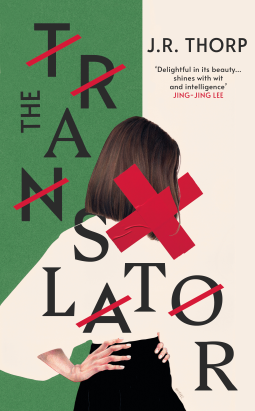
The Translator
Sign In or Register Now to see if this title is available for request.
Buy on Bookshop.org Buy on WaterstonesSend NetGalley books directly to your Kindle or Kindle app
1
To read on a Kindle or Kindle app, please add kindle@netgalley.com as an approved email address to receive files in your Amazon account. Click here for step-by-step instructions.
2
Also find your Kindle email address within your Amazon account, and enter it here.
Pub Date 18 Mar 2027 | Archive Date 17 Apr 2027
Random House UK, Vintage | Chatto & Windus
Talking about this book? Use #TheTranslator #NetGalley. More hashtag tips!
Description
A fiercely intelligent and thought-provoking literary exploration of the refugee crisis and the power of resistance by the highly acclaimed author of Learwife
Anne is a quiet, respectable translator and polyglot in an unnamed modern European city who receives word that she will be arrested in twenty-four hours. The right-wing government has discovered her secret: she's been translating the letters of a young activist known as Pytheas who finds refugees safe passage over the mountains. His letters have become widespread symbols of political resistance, and the government is intent on finding their author. She is equally intent on protecting him.
On her final day of freedom, Anne walks her beloved city, makes her last preparations, and hunts desperately for the person who has betrayed her secret. Since her reckoning is upon her, how best can she use the time she has left?
The Translator focuses on a less-studied aspect of refugee journeys: the experiences of helpers, translators, couriers, and activists along the migrant route. In distinctively beautiful and stylistically inventive prose, interspersed with the Pytheas letters, J.R. Thorp asks: what might compel someone whose life has been a model of bourgeois respectability to commit an act of radical political tenderness.
Available Editions
| EDITION | Other Format |
| ISBN | 9781784746841 |
| PRICE | £16.99 (GBP) |
| PAGES | 320 |
Available on NetGalley
Available to Buy
Buy on Bookshop.org Buy on WaterstonesAverage rating from 5 members
Featured Reviews
 Media/Journalist 1098280
Told across two timelines, The Translator is a winding, character driven take on the dystopia genre and the 'migrant crisis'. Thorp's mastery and love of language is evident throughout, with Anne's role as a translator aligning perfectly to the form as we follow her for her final day of freedom before she is to be arrested for the crime of proliferating the letters of refugee courier Pytheas. Literary, moving, and poetic, Pytheas' letters are interspersed with Anne's stream of consciousness to unveil a story often untold about resistance and its motivators between two very different people.
Thanks to Net Galley and the publisher for access to this ARC
 martifo ., Reviewer
I found The Translator hard to read: the story, the style, all of it. But by the end, I couldn't imagine it told any other way.
The novel follows Anne, a translator and university lecturer, through the last twenty-four hours before her arrest. She's been found out: she's been translating and circulating the letters of a young activist who guides refugees across the mountains to safety, a story grounded in an ongoing reality in which migrants have long crossed the Alps on foot between Italy and France, often in dangerous winter conditions. Thorp takes this reality and pushes it further, imagining an unnamed European country where an increasingly anti-migrant government treats such letters as a threat to national security, and where fear reaches well beyond the people it's actually targeting. Even Anne's own comfortable world isn't safe from it anymore. Intellectuals are being silenced and imprisoned, and suspicion of anyone different has quietly become normal.
What struck me most is the question underneath it all: what pushes this woman, with an unremarkable and settled life, to give up everything for someone else's safety? We get to the answer page by page, following her mind as it slips constantly between past and present, on her last day of freedom, as she searches for whoever gave her up and circles back to the decision that brought her here. In a way, this is a book about the cost of words: the young man endangering his life by writing his letters while staying with the refugees he helps, and Anne taking on just as much danger simply by carrying his words across a border. Her belief in language, as a form of truth and a tool of identity, is what answers it. Nothing about language is neutral here; it carries memory and experience. So translating someone else's words stops being just an intellectual task. It becomes a choice. Eventually, an act of resistance.
The form matches the unease the character is living through. That constant slipping between past and present isn't just how the story is told; it's demanding to read. Chapters alternate between Anne's own story and the young man's letters, which makes the fragmented timeline and restless thinking even harder to follow, and adds to the sheer weight of what's happening. But I don't think a neat, straightforward narrative would have suited a story like this.
None of this feels like classic dystopia, with its invented regimes and reimagined worlds. It reads more like our own world, with one thread, already present, pulled a little further than we've allowed it to go. And yet, strangely, I came away from it feeling something like hope. I don't think the book is arguing for that hope outright; it reads more like a diagnosis of where fear leads than a case for its opposite. But by pushing today's divisions, its fear of difference, its hostility towards those seeking safety, to their extreme, it made something clearer to me: this is not the only way forward. It strengthened my hope for the opposite, a world built on openness rather than fear, where difference of race, gender or ability is met with curiosity instead of suspicion, and seen as a strength rather than a threat. That's what's stayed with me most since finishing it: watching one possible path taken all the way made me want the other one more.
Thank you to Random House UK, Vintage/ Chatto & Windus and NetGalley for providing an advance copy of this book in exchange for an honest review. All opinions are my own.
 Madeleine F, Reviewer
The Translator is a powerful meditation on the modern-day refugee crisis, and of Europe's concurrent slide towards barbaric far-right politics. Thorp's prose is light-touch, atmospheric, heartfelt and quietly devastating. An urgent and stirring read that will surely one day be regarded as a 'state of the nation/globe' classic.
 Roman C, Reviewer
Thorpe's [book:Learwife|56897686] was one of my very favourite books of 2021 - I literally finished it and went back to the beginning to luxuriate in it all over again. This is quite a different animal, feeling politicised and incensed at the anti-asylum seeker rhetoric and policies of European governments, both incumbents and those far-right agitators telling us quite clearly what they would do if they ever got power. Here the lightly sketched-in scenario is that an anti-migrant government swept to power twenty years ago in an unnamed European state - the city has elements that look like Paris and the leader has characteristics of Maggie Thatcher: pussycat bow blouses and a prominent handbag.
In the forefront is a female professor and interpreter who gets a call telling her she is to be arrested the following morning for translating anonymously a series of letters from a front-line aide worker and courier who guides asylum seekers over the Alps: these letters from 'Pytheas' serve as a marker of subversion, something around which resistance coalesces. The text follows both the professor in her final day before arrest, interspersed by the Pytheas letters themselves.
The book successfully produces two voices in the letters and the main narrative, and makes lots of political points that may not be original but which bear repetition: the far-right rewriting of history, the human stories behind attempts at asylum, the humanity and compassion that we, as a society, seem to be losing or reserving selectively for some people but not others. The whole thing feels intense and jittery, quite stressful to read. As the subject matter should be.
The problem, as always, is that books like this speak to the converted, not to the nay-saying voices who like to pose as 'protecting the city's soul from "invaders"'. I completely understand and support a writer who sees and wants to make an intervention in today's horrific politics but I'm really not sure that fiction like this will find itself in the hands of the people I'd like to see reading this. Does that sound hopeless? Perhaps...
It's worth noting that [book:My Fourth Time, We Drowned: Seeking Refuge on the World’s Deadliest Migration Route|58907545] by [author:Sally Hayden|22049730] is acknowledged in the afterword.
Susan O, Reviewer
Quietly elegant and aloof, Anne learnt to assimilate herself into a different class at boarding school. She’s regularly bailed out a young boy engaged in petty crime, recognising his brilliance and mentoring his education. When Tomas becomes a courier, guiding migrants through the difficult mountain passes surrounding the country’s capital, he tells her he intends to write letters about his experience in Arabic, the language of his grandfather, which Anne translates, offering them to the editor of an obscure magazine. Soon graffiti appears around the city, protest marches are mounted and enough support expressed to provoke the government. Anne decides to use the day’s grace granted to her before her arrest to discover who has betrayed her, hoping for the possibility of reprieve.
Thorp alternates between Tomas’s letters and Anne’s narrative through which run her thoughts, speculation, memories and fears. Written in an elegant, sometimes poetic, quite formal style, her prose requires attentive reading. Language is an important theme, and her use of it precise. There’s a thread of suspense running through the novel but it’s not to be rushed. Both Anne’s narrative and Tomas’s letters are erudite, full of literary and classical allusion. For Anne, their translation is an uncharacteristic step outside her careful, circumspect life. She’s seen as expendable because she’s alone, yet her relationships have been passionate, not least her determination to protect Tomas. Thorp’s setting is a nameless city, the period the present day. Tomas’s letters which tell of the heartbreak, homesickness and danger migrants endure, are derived from investigative reports from several reputable organisations, from Amnesty International to the BBC, according to Thorp’s acknowledgements; the policies proposed by right wing politicians across the world, including Europe, providing material for those of the government of Anne’s unnamed country. Not an easy read, Thorp’s impressive, quietly heartfelt novel lives up to its blurb’s billing of ‘fiercely intelligent and thought-provoking’.
Readers who liked this book also liked: