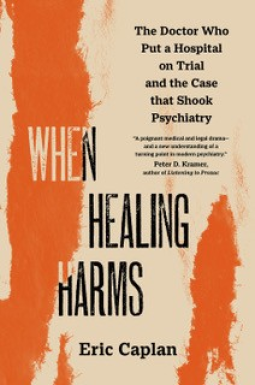
When Healing Harms
The Doctor Who Put a Hospital on Trial—and the Case That Shook Psychiatry
Sign In or Register Now to see if this title is available for request.
Buy on Amazon Buy on Bookshop.org Buy on WaterstonesSend NetGalley books directly to your Kindle or Kindle app
1
To read on a Kindle or Kindle app, please add kindle@netgalley.com as an approved email address to receive files in your Amazon account. Click here for step-by-step instructions.
2
Also find your Kindle email address within your Amazon account, and enter it here.
Pub Date 6 Oct 2026 | Archive Date 28 Feb 2027
Talking about this book? Use #WhenHealingHarms #NetGalley. More hashtag tips!
Description
In 1979, Dr. Raphael Osheroff admitted himself to Chestnut Lodge, a prestigious psychiatric hospital, expecting world-class care for his severe depression. Instead, he was confined to a locked ward, denied medication, and subjected to seven months of talk therapy. The experience rendered him physically frail and emotionally devastated before his parents secured his transfer to a hospital willing to prescribe the antidepressants he desperately needed. But the damage was done: his marriage, his practice, and his reputation all lay in tatters.
Then he did something unprecedented. He sued Chestnut Lodge.
When Healing Harms excavates the long-buried story behind one of the most consequential—and most misunderstood—malpractice cases in modern psychiatry and surfaces its impact that persists to this day.
"Eric Caplan's fascinating medical history book When Healing Harms recounts a pivotal case of psychiatric malpractice and its consequences… a revealing exposé of medical malpractice that reconstitutes the long-silenced voice of a psychiatric patient." ― Foreword Reviews
“In a book that is Shakespearean in its tragedy, as intriguing as a legal thriller, and as incisive as a political exposé, Caplan chronicles the story of Raphael "Ray" Osheroff—a physician functionally sentenced to a Bedlam-like mental institution—and his three-decades-long effort to gain both justice and vindication.” ― The US Review of Books
Advance Praise
Peter Kramer, MD
Clinical Professor of Psychiatry and Human Behavior, Brown University; bestselling author of Listening to Prozac
“In When Healing Harms, Eric Caplan reexamines one of the most influential legal cases in the history of American psychiatry. Osheroff v. Chestnut Lodge has been written about before but never with the care and thoroughness that Caplan brings to the story. What emerges from his research is a poignant medical and legal drama—and a new understanding of a turning point in modern psychiatry and the patient who brought it about.”
Paul Appelbaum, MD
Elizabeth K. Dollard Professor of Psychiatry, Medicine & Law, Columbia University; Director, Division of Law, Ethics, and Psychiatry; past President of the American Psychiatric Association; past President of the American Academy of Psychiatry and the Law; past President of the American Association for Bioethics and Humanities; past President of the American Board of Forensic Psychiatry
“When Healing Harms is a fascinating dive into the world of Raphael Osheroff, whose lawsuit over his inept treatment at a famed psychiatric hospital sealed the fate of psychoanalytic models of care for serious mental disorders. Eric Caplan has produced an engrossing account that humanizes the person behind the lawsuit, illuminating his suffering and vividly portraying the end of an era in psychiatry.”
Andrew Scull, PhD
Distinguished Professor Emeritus, University of California, San Diego.
“Eric Caplan has done a masterful job of showing that previous interpretations of the famous Osheroff case are sharply at odds with its real significance. Written with verve and style, and using a dazzling array of novel source material, he documents a striking but often misunderstood example of psychiatric malpractice”
Becca Levy, PhD
Professor of Epidemiology at the Yale School of Public Health and Professor of Psychology at Yale University; internationally recognized expert on the psychology of aging; bestselling author of Breaking the Age Code, translated into multiple languages; pioneer in research demonstrating how positive age beliefs can improve health and longevity; recipient of numerous awards, including the American Psychological Association’s Award for Lifetime Contributions to Psychology.
“When Healing Harms by Dr. Eric Caplan is a must-read! This book masterfully explores the landmark Osheroff v. Chestnut Lodge case that transformed American psychiatry. Through rigorous research and compassionate storytelling, Dr. Caplan reveals how ideological battles and professional disputes shaped modern psychiatric care. This compelling account not only uncovers the historical significance of the case but also provides essential insights into the enduring dilemmas of mental health treatment. Dr. Caplan's work is an invaluable resource for professionals and laypersons alike.”
David Healy, FRC Psych, Professor of psychiatry at Bangor University in the United Kingdom. Author of 20 books, including The Antidepressant Era, The Creation of Psychopharmacology, The Psychopharmacologists Volumes 1–3, Let Them Eat Prozac and Mania: A Short History of Bipolar Disorder
“Raphael Osheroff’s treatment at and subsequent legal action against Chestnut Lodge are seminal events in the history of modern clinical medicine, not just mental health. With comprehensive access to the medical and legal records and correspondence between the key players, in When Healing Harms Eric Caplan offers the definitive account of the interplay of factors before, during and after the headline events that have shaped – sometimes misleadingly – our perceptions of what was and still is at stake.”
Holly Prigerson, PhD
Irving Sherwood Wright Professor of Geriatrics, Weill Cornell Medicine; Co-Director, Cornell Center for Research on End-of-Life Care
“Eric Caplan's masterful exploration of the Osheroff case offers an urgent meditation on psychiatry's enduring dilemmas. Through meticulous research, he reveals how even well-intentioned practitioners can inflict profound harm when ideology overshadows evidence and certainty substitutes for curiosity. By illuminating the patterns in Osheroff's ordeal—therapeutic dogma, a penchant for abstraction, professional turf wars, and the human cost of theoretical rigidity—Caplan provides essential insights for contemporary mental health care. This is more than historical documentation; it's a roadmap for transcending the destructive binaries that have long prevented truly integrated, humane treatment.”
Andrew Scull, PhD
Distinguished Professor Emeritus, University of California, San Diego.
“Eric Caplan has done a masterful job of showing that previous interpretations of the famous Osheroff case are sharply at odds with its real significance. Written with verve and style, and using a dazzling array of novel source material, he documents a striking but often misunderstood example of psychiatric malpractice”
Robert Whitaker
American journalist and author of, Mad in America and Anatomy of an Epidemic
“The legal case of Osheroff v. Chestnut Lodge occupies a pivotal moment in American psychiatry, as it ultimately pushed psychiatrists to prescribe antidepressants to depressed patients, lest failure to do so—particularly over an extended period—would be seen an medical negligence. In When Healing Harms, Eric Caplan provides a compelling exploration of all aspects of this story, legal and personal, and perhaps the most memorable is that it provides an in-depth biography of nephrologist Ray Osheroff, telling of how his life was upended by depression and his subsequent legal battles with Chestnut Lodge.”
Available Editions
| EDITION | Hardcover |
| ISBN | 9780520409163 |
| PRICE | $28.95 (USD) |
| PAGES | 360 |
Available on NetGalley
Available to Buy
Buy on Amazon Buy on Bookshop.org Buy on WaterstonesAverage rating from 5 members
Featured Reviews
 Janine S, Reviewer
Fascinating book exploring a pivotal case of psychiatric malpractice and its consequences. It was a five star read for me for many of the points I raise below. I especially appreciate authors who when they come across an obscure reference follow it up and write to reveal something from the past that has importance in the present.
Raphael “Ray” Osheroff, a successful nephrologist, suffered from depression throughout this life. During a stressful moment when it appeared his second wife was going to divorce him and his two sons by his first marriage were going to spend some time with their mother in Luxembourg, he signed himself voluntarily into a Chestnut Lodge, a prestigious psychoanalytic hospital. Focusing on non- medication therapy, the Lodge worked on changing the person through abusive talk therapy and other techniques including holding him with schizophrenics and pedophiles. This only exacerbated his condition to where he was pacing constantly. Then the diagnosis was a narcissistic disorder - which at the time he was inpatient wasn’t a diagnosis in the extent DSM manual. His concerned parents were able to get him transferred to another institution, Silver Hill Hospital where he was out on medication in addition to talk therapy and was able to leave recovered only to find out that the lucrative practice he had left behind was taken over by one of his partners and he had to fight to regain his hospital privileges and to whom he could sell his practice. I will leave the summary to the above to say the book covers what happens and how his psychiatric case changed how psychiatry saw itself and waft good practice should consist of.
The book’s importance lies in its use of primary sources - primary documents, medical files, videos, legal archives and the like - to bright back to light a forgotten case. As the author notes several times in the telling other books written about the case didn’t use full source reviews often using interviews with individuals peripheral to the case. The author painstaking shows how doctors failed him and then misrepresented what they did - isn’t that how it goes: deny, don’t apologize, stonewall and stay silent. It was aggravating after reading about Osheroff’s treatment to read about what was said during the trial. I think also the perfidy and betrayal of his partner who he trusted to care for his practice was also grating.
As a former social worker I know how important it is to treat people with honesty, kindness and respect as you work with them and Osheroff certainly wasn’t treated well at Chestnut. The author I must note strives to give Osheroff a fair and even portrait of a complex but driven man overwhelmed by burdens he didn’t know how to prioritize. But as those psychiatrists with their infuriating diagnosis even I could see was wrong made my hackles rise. We should be thankful to Osheroff for bringing this case so the psychiatry specialty could make treatment changes.
My thanks to NetGalley and the University of California Press for granting me access to this ARC.
 Reviewer 1809679
Some books entertain, some inform, and a rare few prompt deep reflection long after the final page is turned. For me, When Healing Harms was decidedly the latter.
As a current doctoral candidate in Psychology, I found this book profoundly intriguing. The exploration of psychiatry’s history, the ethical complexities of treatment, and the tension between prevailing clinical ideologies and individual patient needs immediately captured my attention. I knew I had to engage with this work—and I am grateful that I did.
In 1979, Dr. Raphael “Ray” Osheroff—a successful physician struggling with severe depression—admitted himself to Chestnut Lodge, a renowned psychiatric hospital. Instead of receiving medication, he underwent seven months of intensive talk therapy as his condition worsened significantly. After transferring to another hospital and beginning antidepressant treatment, Osheroff experienced substantial recovery, but the repercussions of his initial experience were profound. He subsequently sued Chestnut Lodge, initiating a landmark malpractice case that challenged established psychiatric practices and compelled the field to reconsider how serious mental illness should be addressed.
What impressed me most was Eric Caplan’s ability to transform what could have been a dense historical account into a deeply human narrative. This is not merely a book about a lawsuit or a shift in psychiatric practice—it is the story of an individual seeking help, and the consequences when institutional philosophy takes precedence over patient-centered care.
I particularly valued the exploration of conflict between therapeutic ideology and evidence-based care. The narrative raises questions that remain strikingly relevant: When does a treatment philosophy become rigid? What are the consequences when clinicians become so invested in a particular approach that they cease to question its efficacy? Most importantly, how do we discern when “do no harm” becomes a justification for insufficient intervention?
Caplan’s extensive research is also noteworthy. The book draws from thousands of pages of records, legal documents, correspondence, interviews, and over 120 hours of hearing footage, lending the narrative remarkable depth.
I also appreciated that Osheroff is portrayed as more than merely a patient at the center of a legal case. Caplan offers a nuanced portrait of the individual behind the lawsuit, rendering the consequences of his experience deeply personal and meaningful.
My primary criticism is that the wealth of detail occasionally disrupted the narrative’s momentum. Some sections—particularly those covering legal proceedings, expert testimony, and historical context—felt repetitive at times. While I recognize the importance of this information in establishing the case’s significance, I occasionally wished for a brisker narrative pace.
That said, readers with a particular interest in psychology, psychiatry, medical ethics, or the history of mental health treatment are likely to appreciate the depth and detail more than the average nonfiction reader.
When Healing Harms lingered in my thoughts long after I finished reading. It offers a fascinating examination of a pivotal moment in psychiatric history, but more importantly, serves as a reminder that medicine is not simply a matter of selecting a treatment—it is an ongoing process of questioning whether that treatment truly serves the individual before you.
For me, this was a particularly meaningful read as I continue my doctoral journey in psychology. It challenged me to think beyond theory, diagnosis, and treatment modalities, prompting deeper consideration of the ethical responsibilities inherent in mental health practice.
I am genuinely grateful to have read this book—and I fully intend to purchase a finished copy for my personal library. This is a work I anticipate revisiting, especially as my academic and professional journey continues.
Many thanks to NetGalley, Eric Caplan, and the publisher for providing me with an early release copy of When Healing Harms in exchange for my honest review. All opinions expressed are entirely my own.
 Hilary M, Educator
When Healing Harms is well-researched, thorough, and utterly fascinating. Caplan went through mountains of primary sources in order to properly tell Ray Osheroff's story, and that work pays off in an account that is both clear and compelling. A must read for anyone interested in psychiatry or mental health more generally!
Reviewer 2169416
When Healing Harms unravels a long-buried story behind one of the most consequential—and most misunderstood—malpractice cases in modern psychiatry. Author Eric Caplan revisits the admission of a well-known doctor into one of the nation’s top psychiatric facilities, where he was confined to lockdown, neglected, and mistreated. When Healing Harms dives deep into a case from 1979, but considers how similar issues persist to this day. It’s deeply-reported using primary sources like medical documents, case files, and legal archives, yet remains highly accessible non-fiction that’s equal parts tragedy, thriller, and political expose. A true mental-health page turner.
Thank you to NetGalley and the publisher for the advance reader copy.
Readers who liked this book also liked:
Dr. Gareth Moore; Laura Jayne Ayres
Crafts & Hobbies, Entertainment & Pop Culture, Mystery & Thrillers
Amy Irvine
Biographies & Memoirs, Outdoors & Nature, Parenting, Families, Relationships


Ben Devlin
Literary Fiction, Mystery & Thrillers, True Crime
Céline Fitzmaurice
Biographies & Memoirs, Mystery & Thrillers, True Crime