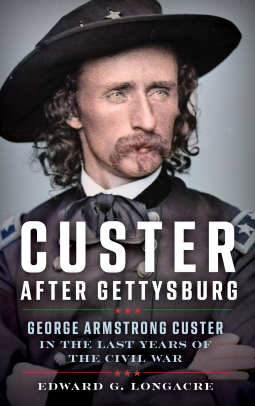
Custer After Gettysburg
George Armstrong Custer in the Last Years of the Civil War
Sign In or Register Now to see if this title is available for request.
Buy on Bookshop.org Buy on WaterstonesSend NetGalley books directly to your Kindle or Kindle app
1
To read on a Kindle or Kindle app, please add kindle@netgalley.com as an approved email address to receive files in your Amazon account. Click here for step-by-step instructions.
2
Also find your Kindle email address within your Amazon account, and enter it here.
Pub Date 20 Apr 2027 | Archive Date 1 Feb 2027
Globe Pequot | Stackpole Books
Talking about this book? Use #CusterAfterGettysburg #NetGalley. More hashtag tips!
Description
History remembers George Armstrong Custer for his ignominious defeat at the Battle of the Little Bighorn, but before that, he rose like a meteor—and flashed as brilliantly—during the American Civil War, from last in his class at West Point to hard-charging cavalry leader, major general, and division commander—all within the span of four years, before the age of twenty-six. Custer After Gettysburg, the new book from Civil War cavalry expert Edward G. Longacre. follows the general through the final nineteen months of the war as the young cavalryman became one of the most celebrated soldiers in the country.
The story begins after Custer’s success at Gettysburg, where his brigade of Michigan Wolverines stopped Jeb Stuart’s Confederate horsemen in July 1863. The victorious cavalryman returned south to Virginia, where Ulysses Grant would soon begin the Civil War’s bloody endgame with Robert E. Lee. A trusted lieutenant to Union cavalry commander Philip Sheridan, Custer raided in support of Grant’s offensive in the Wilderness and a month later fought at Trevilian Station, the war’s largest all-cavalry battle. He then followed Sheridan west into the Shenandoah Valley, where they waged a scorched-earth campaign that culminated in victory at Cedar Creek, which ended the Confederate threat in the Valley and helped seal President Lincoln’s reelection in 1864. Custer rejoined the main army around Richmond and joined the final pursuit of Lee’s battered army to Appomattox. During these months of skirmishes, raids, charges, and battles, Custer was constantly in the thick of the fight, taking calculated risks that usually paid off and putting his own life on the line (a dozen horses were shot from under him).
Never again would Custer burn as brightly as during these remarkable months when he charged his way to victory and celebrity. Impeccably researched and dramatically told, Custer After Gettysburg thrusts readers into the saddle for an unforgettable ride with an American soldier—a hell-for-leather cavalryman, a flamboyant daredevil, a battlefield gambler—at the height of his success.
[Includes 30 B&W Photographs, 10 B&W Maps]
Marketing Plan
Positioning Statement
Before Little Bighorn, there was a different Custer—one who won. Custer After Gettysburg restores the full arc of one of the Civil War's most electrifying cavalry commanders, following the "Boy General" through nineteen months of relentless fighting—from Gettysburg to Appomattox—that made George Armstrong Custer a national celebrity before he turned twenty-six. Award-winning historian Edward G. Longacre, one of the foremost authorities on Civil War cavalry, delivers an impeccably researched, grippingly told account of Custer at the absolute apex of his powers: a hell-for-leather risk-taker whose calculated daring helped seal the Union's victory and shaped the legend history would later turn upside down.
Market
Market Opportunity and Audience
Perfect for readers of Ron Chernow's Grant, James McPherson's Battle Cry of Freedom, and S.C. Gwynne's Empire of the Summer Moon—narrative military history with a larger-than-life protagonist at its center
Civil War reading market remains robust: Civil War titles consistently generate strong backlist sales, with the genre representing one of the most loyal and repeat-buying segments in American history publishing
Custer brand recognition is unparalleled: surveys consistently show Custer ranks among the most recognizable names in American military history—his fame (and infamy) creates immediate reader curiosity and built-in discoverability
"The other side of Custer" hook: 160 years of Little Bighorn mythology have almost completely eclipsed his extraordinary Civil War career—this book corrects a genuine gap in popular historical awareness, a proven driver of sales
Civil War sesquicentennial legacy audience: the 2011–2015 commemoration generated a new generation of engaged Civil War readers now hungry for fresh narrative treatments of key campaigns and commanders
Military history market: the U.S. military history category generates hundreds of millions in annual book sales; cavalry and command biography are perennially strong sub-niches
Shenandoah Valley campaign resurgence: renewed scholarly and popular interest in Sheridan's Valley Campaign of 1864, the election of 1864, and the Union's hard-war strategy creates timely context for Custer's role
West Point and military academy audience: Custer's story (last in his class to brigadier general in two years) is a staple of military leadership discussion—strong adoption potential in military education channels
Battle re-enactment and heritage community: an estimated 30,000+ Civil War re-enactors in the U.S. plus millions of heritage tourism visitors to battlefield sites represent a dedicated and high-spending niche audience
"Revisionist" biography trend: books that complicate or reclaim historical reputations (Grant, Sherman, Stonewall Jackson) are performing strongly—Longacre's reframing of Custer fits squarely in this commercially successful category
Author Credentials
Edward G. Longacre is among the most prolific and decorated active historians of Civil War cavalry, with more than 30 books and numerous articles published over a career spanning more than fifty years
Winner of the Moncado Prize from the Society for Military History—the field's leading professional organization, with approximately 2,000 members internationally
Winner of the Fletcher Pratt Award, the Douglas Southall Freeman History Award, and the James I. Robertson Jr. Literary Prize—among the most prestigious recognitions in Civil War historiography
Author of the classic cavalry study of Gettysburg and biographies of major Civil War cavalry commanders including Jeb Stuart, Alfred Pleasonton, and others—establishing deep subject-matter authority directly relevant to this book
Based in Newport News, Virginia—in the heart of Civil War country, near major battlefield sites, museums, and the military history community of the Hampton Roads region
Established relationships with Civil War Round Tables, battlefield preservation organizations, and academic military history networks that translate into direct promotional reach
Publicity
Print, Broadcast & Major Media
Major trade reviewers: Publishers Weekly, Kirkus Reviews, Library Journal, and Booklist among others—essential for library sales and early-adopter readers; Civil War titles typically receive strong coverage in all four
National/regional newspapers: The New York Times (Book Review, Sunday), The Wall Street Journal (strong military history readership), USA Today, The Guardian (U.S. edition), The Montgomery Advertiser, and others (with resonance in the South)
History & culture magazines: Smithsonian Magazine (~7 million monthly readers), American Heritage, American History Magazine, Lapham's Quarterly, MHQ: The Quarterly Journal of Military History, Civil War Times, America's Civil War, Historynet.com
General interest magazines: TIME, Newsweek, The Atlantic, The New Yorker ("Briefly Noted" and longer consideration), The Weekly Standard alumni readership now dispersed to outlets like The Dispatch and The Bulwark
Military & veterans publications: Military History, Armchair General, Vietnam Magazine (crossover readership), VFW Magazine (~1.5 million subscribers), American Legion Magazine (~2 million subscribers)
Southern & regional press: The Richmond Times-Dispatch, The Roanoke Times, The Virginia Gazette, The Shenandoah Valley papers, Lexington (VA) papers—all covering the core geography of Custer's campaigns
Michigan media: The Detroit Free Press, Michigan Radio, MLive—Custer's Michigan Wolverines brigade creates strong regional hook; Custer's hometown of Monroe, Michigan has an active Custer memorial and museum
NPR: Fresh Air, All Things Considered, Morning Edition, 1A, On Point, Weekend Edition—pitch the "before the fall" Custer narrative as a story of American myth-making and military genius
Broadcast: C-SPAN Book TV (essential for serious history titles; strong crossover to library and academic buyers), PBS NewsHour weekend segments on history, potential outreach (content rights offerings) to Ken Burns-adjacent documentary producers
Op-ed strategy: Bylined pieces by or about Longacre in major newspapers timed to the Appomattox 160th anniversary (April 2025), and pitching the "What Custer's Civil War victories tell us about leadership and risk" angle to business and leadership media
Podcasts
History & Military: Revolutions (Mike Duncan), American History Tellers, Backstory with American History Guys, The Civil War (1865 Podcast), American Battlefield Trust podcasts, We're History, American Chronicles, History Extra (BBC), The History of the United States, Wonders of the World, Not Just the Tudors
Books & Narrative Nonfiction: Bookworm (KCRW), The Book Review (NYT podcast), Lit Hub Radio, New Books in History, Talking History, The Historian's Craft
Military & Leadership: The Art of Manliness (~14 million monthly downloads, strong military history content), Modern War Institute Podcast (West Point), The Dead Prussian, Conflicted, History Hit Military, War Stories with Oliver North, Martial Matters
General Interest/Crossover: Malcolm Gladwell's Revisionist History (strong fit for myth-busting Custer narrative), Hardcore History (Dan Carlin—pitch as expert guest), American Scandal, American History Tellers, You're Wrong About
Social Media & Digital Marketing
Author Platform & Built-in Demand
Longacre's five-decade career and 30+ books have created a loyal readership in the Civil War history community—his byline is a brand signal to dedicated buyers in this niche
Publisher social media: target history-focused audiences on Facebook (largest platform for 45+ history enthusiasts), Instagram (BookStagram community with active #civilwarbooks and #militaryhistory tags), and X/Twitter (active community of historians, journalists, and history enthusiasts)
Historynet.com and Civil War Times digital communities: Historynet reaches over 3 million unique visitors monthly across its history properties; Civil War Times has an active subscriber base and social following
American Battlefield Trust digital reach: ABT's email list exceeds 500,000 subscribers and its social media followings are among the largest in the Civil War space—partnership content (excerpts, author Q&A, battlefield-focused features) would reach deeply engaged readers
BookTok and BookStagram: while the core audience skews older, #historybooktok and #militaryhistory communities are active and growing—target history-focused creators with followings of 10,000–500,000 for ARC copies and review outreach
Goodreads: Civil War history is among the most-tracked categories; early Goodreads presence, author Q&A, and advance reader copies to top Civil War shelf curators will drive discoverability
Newsletter outreach: pitch to history-focused newsletters including Today in History, JSTOR Daily, The History Reader (St. Martin's Press newsletter, 50,000+ subscribers), Smithsonian Magazine newsletter, and independent history Substack content creators with engaged followings
Available Editions
| EDITION | Hardcover |
| ISBN | 9780811778916 |
| PRICE | $39.95 (USD) |
| PAGES | 396 |