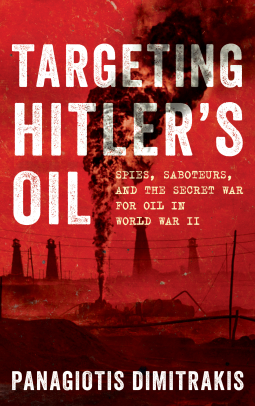
Targeting Hitler's Oil
Spies, Saboteurs, and the Secret War for Oil in World War II
Sign In or Register Now to see if this title is available for request.
Buy on Bookshop.org Buy on WaterstonesSend NetGalley books directly to your Kindle or Kindle app
1
To read on a Kindle or Kindle app, please add kindle@netgalley.com as an approved email address to receive files in your Amazon account. Click here for step-by-step instructions.
2
Also find your Kindle email address within your Amazon account, and enter it here.
Pub Date 20 Apr 2027 | Archive Date 3 Feb 2027
Globe Pequot | Stackpole Books
Talking about this book? Use #TargetingHitlersOil #NetGalley. More hashtag tips!
Description
Romania was ground zero in this secret battle for oil. Within the war’s first year—while Romania was still neutral—German agents roamed the country’s vast oil facilities to protect them from the Allied operatives who were already quietly gathering intelligence and planning their sabotage campaign. After Romania joined the Axis and Germany took over its oil, the Allies sprang into action in earnest, beginning a dangerous game of Allied move and German countermove that unfolded in the streets of Bucharest, in the shadows of the giant refineries of Ploesti, amidst the derricks of central Romania, among the piers of Black Sea ports. Until Allied bombers could reach southeastern Europe starting in 1943, disrupting Germany’s fuel supplies would depend on these secret operations targeting oil fields, storage facilities, refineries, railways, and ports. Would Allied saboteurs get the job done and slow the supply of oil to the Third Reich’s war machine?
[INCLUDES 13 B&W PHOTOGRAPHS]
Marketing Plan
Positioning Statement
A pulse-pounding work of narrative intelligence history that exposes the clandestine Allied campaign to strangle Hitler’s war machine at its most vulnerable point: oil. Written by King’s College London–trained War Studies scholar Panagiotis Dimitrakis, Targeting Hitler’s Oil reveals how spies, saboteurs, and underground operatives from Bucharest to Ploesti waged a secret war that shaped the outcome of World War II—proving that the battle for petroleum was every bit as decisive as the battles fought on the front lines. A natural read-alike for readers of Operation Mincemeat, The Spy Who Loved, and The Monuments Men.
Market
Market Opportunity and Audience
• Read-alike positioning: Comparable to The Spy and the Traitor (Ben Macintyre, ~500,000 copies sold), Operation Mincemeat (Ben Macintyre), and The Saboteur (Paul Kix)—all bestsellers bridging spy thriller narrative with rigorous history
• Military history is a perennial powerhouse: Military history accounts for approximately 10% of all nonfiction sales; WWII titles alone represent the single largest subcategory, with perennial bestseller lists dominated by titles like Band of Brothers, Unbroken, and Killing Patton. The category generates over $600 million in annual U.S. book revenue
• Intelligence history surging: Post-Operation Mincemeat (Netflix, 2022) and The Spy Who Loved (BBC, 2023), consumer appetite for WWII espionage is at a multi-decade high; intelligence history is among the fastest-growing military nonfiction subgenres
• Oil geopolitics: enduring relevance: With ongoing global energy crises, OPEC+ tensions, the Russia-Ukraine war’s impact on European energy supply, and debates over energy security, a book about resource warfare resonates powerfully with current events. The U.S. Energy Information Administration estimates that petroleum remains the world’s largest energy source, supplying ~31% of global energy—underscoring why oil was worth fighting and dying for in 1939–45
• Romania and Eastern Europe angle: Ploesti’s oil fields supplied roughly 35% of Germany’s petroleum during the war—a fact little known to general audiences. The 1943 Operation Tidal Wave (low-level B-24 bombing raid on Ploesti) remains one of the most decorated single missions in USAAF history, with five Medals of Honor awarded. Yet the covert ground campaign has never received a full popular treatment—a clear gap this book fills
• Untold story appeal: Readers and reviewers consistently reward books that uncover a hidden chapter of familiar history. Dimitrakis’s scholarly access to primary sources in multiple languages positions this as the authoritative account of a story that deserves the spotlight
• Gift and holiday market: Military history and WWII titles are among the top gift-book categories for Father’s Day and Christmas; the format and subject matter make this a natural seasonal title
• Academic and library market: Strong adoption potential in university courses on WWII, intelligence history, and energy geopolitics; library sales bolstered by author’s King’s College London credentials
• International co-edition potential: Romanian, Greek, German, and UK publishers will find strong natural audiences; the Ploesti raids are legendary in Romanian national memory
Author Credentials
• Doctorate in War Studies, King’s College London: KCL’s War Studies department is ranked among the top three globally, lending immediate scholarly credibility
• Expert in intelligence and military history: Dimitrakis has published extensively on intelligence, covert operations, and geopolitical history in the Middle East and Balkans—giving him unique access to archival sources across multiple languages and countries
• Previous books: Author of Failed Alliances of the Cold War, Military Intelligence in Cyprus, The Secret War in Afghanistan, and Pakistan: The Eagle and the Lion—establishing a track record of rigorous, readable scholarship on covert operations and intelligence history
• Athens-based perspective: As a Greek national and resident, Dimitrakis brings a Southeastern European lens rarely seen in Anglophone WWII histories, with direct cultural and linguistic ties to the region where much of this story unfolded
• Media-ready expert: Available for commentary on WWII intelligence history, energy geopolitics, and contemporary parallels to resource warfare—timely given ongoing global energy tensions
Publicity
Print, Broadcast & Major Media
• Major trade reviewers: Publishers Weekly, Kirkus Reviews, Library Journal, Booklist, Foreword Reviews
• National newspapers: The New York Times Book Review, Wall Street Journal, USA Today, Los Angeles Times, The Guardian (UK)
• Military/history press: Military History magazine, World War II magazine, Historynet.com, The National Interest, War on the Rocks, Task & Purpose, The Strategy Bridge
• Intelligence/security: Cipher Brief, Lawfare, Politico National Security Daily, Defense One, Foreign Policy, Foreign Affairs
• Energy/geopolitics: Foreign Affairs, The Economist, Energy Intelligence, S&P Global Commodity Insights, Oil Price.com, Reuters Energy, Bloomberg Energy
• General interest: The Atlantic, Smithsonian Magazine, Lapham’s Quarterly, American Heritage, Military Times, The Week
• International: UK: Times Literary Supplement, The Spectator, BBC History Magazine; Romania: Digi24, Adevarul; Greece: Kathimerini English Edition
• NPR: Fresh Air, Weekend Edition, All Things Considered, To the Best of Our Knowledge, Here & Now
• Broadcast: PBS NewsHour, C-SPAN Book TV, History Channel documentary tie-in potential, CNN History specials, National Geographic, Smithsonian Channel
• Op-ed strategy: Bylined pieces pitched to Washington Post, Wall Street Journal, and Foreign Policy on covert resource warfare and its contemporary parallels (Strait of Hormuz, Russian energy weaponization, Venezuelan oil sanctions)
Podcasts
• Military & WWII History: Hardcore History (Dan Carlin; ~1.5M subscribers), The World War II Podcast, Battleground, History Hit, American History Tellers, Witness History (BBC), We Have Ways of Making You Talk
• Intelligence & Espionage: SpyCast (International Spy Museum; ~150K subscribers), The Tradecraft Podcast, Intelligence Matters (CBS News/Michael Morell), The Black Vault, Spycast, True Spies (Spyscape)
• Geopolitics & Energy: The Energy Gang, Geopolitics Decanted, The Eurasia Group Podcast, Jaw-Jaw, World Affairs, Rational Security
• General History & Narrative Nonfiction: Throughline (NPR), Revisionist History (Malcolm Gladwell), You’re Wrong About, The Rest Is History, Decoder Ring, No Such Thing as a Fish
Social Media & Digital Marketing
Author Platform & Built-In Demand
• Dimitrakis’s academic publications and prior books have generated citation networks in intelligence studies and military history communities—organic discovery by engaged nonfiction readers
• King’s College London War Studies alumni and faculty networks: KCL has 35,000+ LinkedIn followers and an active global alumni community; department social channels reach scholars and enthusiasts worldwide
• Publisher social media: Promote across @stackpolebooks and parent company channels (social reach to be leveraged with military history audience)
Content Marketing Strategy
• Long-form excerpt placement: Pitch a 2,000–3,000-word adapted excerpt to The Atlantic, Smithsonian Magazine, or Foreign Policy tying the Ploesti sabotage campaign to contemporary energy security
• Short-form video: Author explainer reels on “Why Hitler Needed Romanian Oil” and “The Most Dangerous Mission of WWII” for YouTube Shorts, Instagram Reels, and TikTok—optimized for the #BookTok military history community (over 2.1 billion views on #WWII TikTok content)
• Infographic campaigns: Visual assets showing oil supply chains, sabotage maps of Ploesti, and statistics on fuel consumption by the Wehrmacht—high shareability on Pinterest, Instagram, and Reddit military history communities (r/ww2 has 700,000+ subscribers; r/history has 18M+)
• Goodreads strategy: Author Q&A, giveaway campaign (500–1,000 digital copies to Goodreads military history lists), and active engagement with WWII shelf communities
• Email/newsletter outreach: Partner with Historynet.com newsletter (700,000+ subscribers), War on the Rocks mailing list, and The Cipher Brief newsletter (national security community) for sponsored content or editorial placement
• BookTok and Bookstagram: Target military history BookTok creators with 50K–500K followers; the #WWIIbooks and #militaryhistory communities are underserved but highly engaged. Seed galleys with 10–15 targeted creators
Available Editions
| EDITION | Hardcover |
| ISBN | 9780811779050 |
| PRICE | $34.95 (USD) |
| PAGES | 278 |