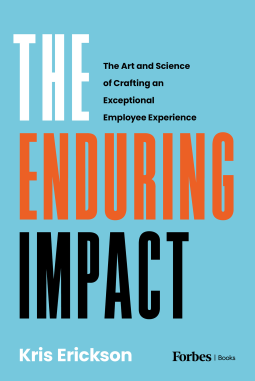
The Enduring Impact
The Art and Science of Crafting an Exceptional Employee Experience
This title was previously available on NetGalley and is now archived.
Send NetGalley books directly to your Kindle or Kindle app
1
To read on a Kindle or Kindle app, please add kindle@netgalley.com as an approved email address to receive files in your Amazon account. Click here for step-by-step instructions.
2
Also find your Kindle email address within your Amazon account, and enter it here.
Pub Date 31 Mar 2026 | Archive Date 31 Mar 2026
Talking about this book? Use #TheEnduringImpact #NetGalley. More hashtag tips!
Description
The Enduring Impact by Kris Erickson is a practical guide for leaders seeking to create lasting organizational change through the employee experience. Drawing from one of the world’s largest databases of employee feedback, this book offers a data-driven framework for building workplaces where people feel engaged, fulfilled, and inspired to do their best work.
Kris Erickson, cofounder of Workforce Science Associates, reveals six core drivers that consistently shape employee engagement across industries and cultures: Mission, Trust, Communication, Appreciation, Support, and Growth. These Six Tenets provide a clear blueprint for leaders to align daily experiences with long-term business goals.
This is not a book about perks or performance bonuses. It’s about designing meaningful experiences that connect people to purpose, foster trust, and drive performance from the inside out. With compelling stories, actionable strategies, and research-backed insights, The Enduring Impact helps you identify what really matters to employees—and how to act on it.
Through clear, practical steps, readers will learn how to use employee feedback effectively, lead with authenticity, and build cultures where people thrive. Whether you're a senior executive, frontline manager, or HR professional, you’ll find valuable tools to increase engagement, improve retention, and strengthen your organization from within.
In an era of rapid change and rising expectations, The Enduring Impact equips leaders to meet the moment—not just with strategy, but with empathy, clarity, and conviction.
Every experience shapes your culture. This book shows how to make those experiences matter—for your people and your business.
Advance Praise
"Erickson expertly illustrates how the employee experience forms the foundation for remarkable customer experiences and plays a direct role in driving overall business success."
― Sarah Teten-Kanter
Founder & CEO, Positive Caregiving
“In today’s competitive landscape, bridging the gap between employee engagement and business results is crucial for all organizations. Kris Erickson stands out as a leader in this field, blending robust theoretical insights grounded in research with practical, hands-on experience from collaborating with Fortune 500 companies. This book offers real-world examples that resonate with the current business and social climate, equipping you with actionable strategies to enhance employee engagement and drive your organization’s success. With Kris's guidance, you’ll discover effective ways to harness the power of engaged employees to propel your business forward.”
― Karen Kwan
Chief People & Culture Officer, ARITZIA
“The Enduring Impact conveys the simple truth that no matter your business, people make or break your bottom line. Kris articulately lays out the art and science behind the business of people. This book is more than a read―it’s a reminder that people don’t create the experience, they are the experience.”
― Jeremy Bellman
Founder, Think Socio
“Leading a team in turbulent and changing times is difficult. The Enduring Impact is a refreshingly easy guide on how to do it well. This is a must read for any manager.”
― Marcia M.
Engagement Practitioner
“In The Enduring Impact, Kris Erickson combines her research, experience, and real-life stories into a practical guide for creating an exceptional employee experience. This book fills in essential elements for cultivating a thriving workforce―I loved it!”
― Kristen Hussey
Sr. Director of Global Employee Engagement and Culture, Driscoll’s Berries
Available Editions
| EDITION | Other Format |
| ISBN | 9798887504728 |
| PRICE | $27.99 (USD) |
| PAGES | 144 |
Available on NetGalley
Available to Buy
Buy on Amazon Buy on Bookshop.org Buy on WaterstonesAverage rating from 5 members
Featured Reviews
 Demetris P, Reviewer
The Six Experiences We Remember Forever at Work: A Review of “The Enduring Impact” and the Quiet Architecture of Fulfillment
By Demetris Papadimitropoulos | February 20th, 2026
Watercolor Piece by Demetris Papadimitropoulos
There is a particular kind of business book that arrives like a laminated card you might hang beside a printer: tidy, reassuring, engineered for use. Kris Erickson’s “The Enduring Impact” wants to be that card – and then, to its credit, refuses to stay laminated. It keeps tearing a corner, letting lived weather in.
It opens not with a framework but with a moment of scarcity so specific it feels like a splinter you can’t stop touching: a morning commute in Omaha, 1998, payday finally here, and the author scraping together eighty-five cents in coins for “a few squirts of gas” just to reach work and cash the check. In leadership publishing, hardship can be a genre tic – a preface that politely clears its throat before the charts. Erickson’s anecdote does something else. It behaves like mission does in real life: it arrives uninvited, sets up camp, and keeps rewriting your definition of “enough.”
From that scene forward, “The Enduring Impact” argues for a simple proposition with unusually high stakes: employee experience is not a vibe, not a perk menu, not a quarterly pulse survey that gets summarized in a deck. It is the sum of the experiences people carry home, the ones that change how they speak to their children and whether they sleep, and whether their work begins to feel like a sentence or a life. Erickson structures that argument through six tenets – mission, trust, communication, appreciation, support, and growth – each treated as a discrete “experience” that can be designed, neglected, reinforced, or accidentally sabotaged.
The book’s style mirrors its thesis. The chapters move like casework: a location and year stamped at the top, a story you can picture, then a short pivot into principle, and finally a “Prepare for Impact” section that reads like a field manual for managers who have been promised culture but handed calendars. It is a narrative rhythm that makes the framework memorable, but it also reveals Erickson’s faith: that a well-told story can do what a policy cannot, and that a leader’s job is to translate – again and again – from abstraction to human meaning.
That translation is the book’s most convincing contribution, and it is also its most contemporary one. In an era of return-to-office friction, algorithmic performance management, and the quiet loneliness that can haunt even a full Slack channel, the book insists on a stubbornly analog truth: people want to know where we are headed, why it matters, and what it means to them. Erickson borrows Jack Welch’s triad not as nostalgia, but as a corrective to the current tendency to mistake strategy for speech. “Strategic alignment,” she writes, is a jigsaw puzzle: each employee wants to hold up their piece and say, This is me, and I know where I fit. Without that clarity, people make up narratives, and those narratives are rarely kind.
Erickson’s insistence on experience is paired with an equal insistence on measurement. The text is laced with WSAdata – ranked predictors, “best survey items,” and engagement odds ratios delivered with the crispness of someone who has sat through too many executive meetings where feelings are dismissed unless they can be graphed. These numbers do useful rhetorical work: they make the case that culture is not an “HR thing” but a performance variable. They also raise a question the book only partly answers: what happens when leaders treat people as probabilities? Erickson’s best counterargument is her narrative habit – she refuses to let the data float free of the bodies it describes.
That refusal matters most in her treatment of trust, the tenet she frames as both precondition and consequence. Trust is built, she suggests, through competence (accountability and consistency), benevolence (empathy that reads as real), and integrity (transparency and authenticity). Without trust, mission sounds like propaganda, communication sounds like spin, and appreciation starts to feel like manipulation. Her examples are deliberately scalable – the volunteer track coach and the CEO of a rocket-ship manufacturer live on the same continuum – because the behaviors are portable even when the stakes are not.
The portability is part of what makes the book feel built for the present. “Employee experience” now sits at the intersection of burnout, public layoff scripts, mental-health disclosures, and the strange intimacy of hybrid teams who see one another’s kitchens but not their lives. Erickson writes into that reality with old-fashioned tools: clarity, timeliness, empathy, consistency, listening. Against a workplace increasingly mediated by systems that optimize speed, her argument is for practices that optimize understanding.
Communication, for Erickson, is not the polished newsletter or the quarterly town hall. It is the one thing you can’t not do, so do it well. Her most affecting scene is medical, not managerial: her son Conor’s ruptured septic appendix, and a pediatrician named Brad who offers the kind of communication every crisis demands and so few leaders provide – clear and honest, timely, empathetic, consistent, and attentive enough to let frightened people become capable decision-makers. The chapter’s point arrives without ceremony: in crisis, bad communication is not merely awkward; it is dangerous. In daily work, it is corrosive.
If communication is the book’s emotional center, appreciation may be its most quietly radical chapter. Erickson is careful – almost pedantic, and rightly so – about the difference between appreciation and recognition. Recognition, she notes, can become a gold-watch theater; appreciation is the daily feeling of being valued for the work you do and the person you are. She offers three questions that function like a keyring: What would you like to be recognized for? How would you like to be recognized? Who should be involved? The elegance here is not originality – “The 5 Languages of Appreciation in the Workplace” and “Drive” have been having adjacent conversations for years – but operationalization. Erickson makes the personalization of gratitude feel like a managerial responsibility, not a personality trait.
Her stories keep the book from drifting into the generic. Don Clifton, then Gallup’s CEO, staging a dinner that honors Erickson’s mother for fostering her love of teaching; a maternity-leave desk move that becomes a tiny cruelty with outsized meaning; a mentoring program that flips a retailer’s bottom-quartile managers into top performers. These scenes are not decoration. They demonstrate what the book keeps saying: experiences endure because they are specific, because someone noticed, because someone took the time to translate “good job” into something that actually meets a person.
Support, too, is rendered through specificity: Nashville, 2006, a vice president of HR arriving to find she has been hired without consensus, and the social punishment that follows – the colleagues steering clear, the “Bless your heart” that is not a blessing. Erickson’s account is sharpest when she resists the temptation to turn isolation into grit. She admits what most professional narratives hide: that loneliness at work is not merely unpleasant; it corrodes your sense of self. Her later story of a karaoke bar – acceptance turning a room of mismatched strangers into a temporary community – risks becoming a parable, but it captures a truth managers underestimate: belonging is often created by the first person willing to clap.
Growth, the book’s final tenet, returns to Gallup and to a mentor named Larry who throws a young Erickson into the deep end: run the exercise, facilitate the room, see if you can swim. The book’s growth argument is not about ladder-climbing; it is about capacity, about becoming more capable and then more aware of what you are capable of. Erickson is at her best when she complicates the usual development storyline, insisting that not everyone wants to manage people, and that lateral mastery can be as meaningful as promotion. Her example of an employee designing a subject-matter-expert path instead of a client-facing managerial track feels especially resonant now, when careers are increasingly modular and skills are expected to refresh like software.
The book is, to be clear, not skeptical. Its data points – engagement multipliers, ranked predictors, survey items that sound like scripture for modern HR – are presented with confidence and without much methodological friction. That will delight readers who want evidence, and irritate those who want to interrogate how evidence gets made. Erickson’s research lineage – the organizational trust literature, Paul Zak’s neuroeconomics of trust, Carol Dweck’s growth mindset, the “Harvard Business Review” chorus on belonging and internal communications – gives the framework credibility. Yet the book rarely lingers on the hard cases: mission statements that mask exploitation, appreciation programs that turn into performance theater, “support” that becomes surveillance. In other words, it believes, perhaps a bit too readily, that the right behaviors will be rewarded by the system.
Erickson’s voice is the voice of a seminar leader who knows ideas stick only when they can be repeated on a Monday. She writes in plain lines, favors short lists, and ends sections with “Prepare for Impact” prompts that feel less like homework than permission – an invitation to practice leadership where it counts, every day.
And still, it would be unfair to score the book by the standards of a cynicism it does not aspire to. Erickson is writing a manual for leaders who want to do better and do not know where to start. In that sense, her optimism is part of the utility. The “Prepare for Impact” sections are not filler; they translate philosophy into repeatable practice. The listening questions are good enough to steal. The dos and don’ts, while sometimes familiar, have a stabilizing effect – like guardrails on a road you didn’t realize you were drifting off.
Even so, “The Enduring Impact” cannot entirely avoid the modern leadership book’s temptation: to imply that better behavior can substitute for better structures. Erickson does acknowledge that pay can become a major demotivator, and she is careful to separate compensation from appreciation. Still, the text tends to assume leaders have the latitude to do the right thing once they know what the right thing is. Many do not. A manager who wants to create growth paths may be constrained by headcount freezes; a leader who wants to communicate transparently may be bound by legal scripts; a supervisor who wants to show appreciation may be managing two extra roles after a “reorg.” These constraints do not negate Erickson’s framework, but they complicate the neatness of the “dos and don’ts.” A chapter on what to do when the system punishes human leadership would have made a strong book braver.
What makes “The Enduring Impact” more than a competent management book is the way it keeps returning to the life outside the office. Erickson’s concluding portrait of her father – a phone company lineman turned area manager, proud of connecting people, devoted to charities and churches, choosing a clinical trial not only for himself but to help others – is not there to sentimentalize. It is there to argue that meaningful work produces meaningful people, and that meaningful people carry their meaning into communities. In a moment when work is being renegotiated in public – from layoff cycles to the moral unease of automation and the psychic fatigue of permanent change – that argument feels less like inspiration and more like a reminder.
The book’s closest relatives are not the shiny CEO memoirs that trade in conquest. They are the quieter, sturdier texts that treat culture as something built in sentences and habits: “Dare to Lead,” “The Fearless Organization,” “The Culture Code,” “Drive,” and even, in its insistence on the dignity of the individual employee, “Work Rules!” Erickson’s difference is her insistence on experience as the unit of analysis. Culture is what we say we value; experience is what it feels like to work here on a Tuesday when your child is sick, your desk has been moved, your manager remembers your name, and a leader explains – clearly – why the factory closed.
If the book has a flaw, it is the one that haunts most frameworks: it can feel like a set of compartments, each tenet neatly labeled, each chapter providing its story and its steps. Life, of course, is messier. Mission collapses when trust is broken. Appreciation curdles when pay is inequitable. Growth becomes a taunt when support is absent. Erickson knows this – she says, in effect, that these experiences are interlocking – but the book’s structure sometimes makes them feel more separable than they are.
Yet the structure is also why the book works. It gives readers language they can carry into conversation: not “engagement,” which has begun to sound like a metric you impose on others, but mission, trust, communication, appreciation, support, growth – experiences you can ask about, design for, and repair when you’ve broken them. The book’s best gift is that it makes the invisible visible. It teaches managers to look for the moments people will remember forever, and to understand that those moments are rarely the ones leaders plan.
“The Enduring Impact” earns its authority not by claiming novelty, but by making the familiar feel urgent again. Its counsel is, finally, simple: be clear about where you’re headed; speak with honesty; listen until you understand; notice what is right; make room for belonging; throw people into the deep end with a hand nearby. If that reads like a moral code, it is because Erickson believes the workplace is one of the last mass institutions capable of shaping daily human experience. The book’s conviction is bracing, and – in a time when many workers feel like interchangeable parts in a system optimized for everything but them – it is also, quietly, an act of defiance.
Rating: 86/100.
 Katie L, Educator
When teams are feeling stretched thin, leaders often want to help, but they aren’t always sure where to start.
I recently read The Enduring Impact by Kris Erickson (publishing March 31) and I appreciated how the book offers a clear roadmap for employee engagement, with explicit data-informed examples of how individuals experience their work and workplace.
In this book, Erickson explores six areas that shape employee engagement: trust, mission, communication, appreciation, support, and growth. What I liked most about the book is how the author consistently emphasizes that engagement cannot be approached as a one-size-fits-all solution. Instead, the most meaningful engagement strategies are individualized and personalized, recognizing that employees bring different motivations, needs, and experiences to their work.
I immediately thought how useful it would be to read this book with frontline managers and to brainstorm different forms of engagement that could be used within different team environments.
Erickson also brings these concepts to life through personal stories drawn from her career as a consultant and HR leader, as well as reflections from her experiences as a mother. The book also incorporates data drawn from engagement surveys across a range of industries, which adds helpful context and credibility to the discussion. I found the combination of data and storytelling to be really effective.
I'm always looking for more ways to be intentional about building and sustaining engagement within my teams, and I was able to walk away with several concrete strategies after reading this.
 Reviewer 1363492
his book focuses on leadership legacy and long term organizational influence. The central idea is that impact is not about short term wins but about systems and culture that outlast you. Erickson uses corporate case studies and personal anecdotes to illustrate what sustainable leadership looks like in practice.
The strongest sections dig into how leaders unintentionally shape culture through small decisions. There is a practical emphasis on communication, mentorship, and structural thinking. That said, parts of it felt familiar if you read a lot of leadership literature. It leans more inspirational than radically new.
I think this would resonate most with mid career professionals thinking about their long term footprint rather than early career readers looking for tactical steps.
 Helen H, Reviewer
This is a concise read but very useful for leaders, managers and those interested in self-management. It has everything you need in one place and is a good reminder on how to get the best out of people. There are also very good pointers for development conversations. Thanks to Forbes Books and NetGalley for the ARC.
 Florence R, Reviewer
Copy of my review on GoodReads
A short and useful manual about employee experience. This book will be useful mostly for managers and people in HR positions, as well as business school students.
I liked the summaries / lists that are straight to the point and can double up as a reminder whenever the reader wants to go back to a specific problem. The real life examples added depth to the book, making the broader concepts easier to grasp.
Overall, this is a good introduction to employee experience and retention strategies. The author writes clearly, using language that is accessible and concise. The short chapters are perfect for commuting or short breaks (a chapter will require only 10 minutes of your time).
Thank you to NetGalley, Kris Erikson and Forbes Books for sending me an early version of the book in exchange for an honest review.
Readers who liked this book also liked:







Alec Litowitz
Business, Leadership, Finance, Nonfiction (Adult), Self-Help
Ryan Dewey Smith
Business, Leadership, Finance, Nonfiction (Adult), Professional & Technical
Michele Jolin
Business, Leadership, Finance, Nonfiction (Adult), Politics & Current Affairs