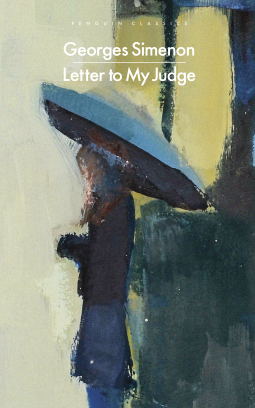
Letter to My Judge
Sign In or Register Now to see if this title is available for request.
Buy on Bookshop.org Buy on WaterstonesSend NetGalley books directly to your Kindle or Kindle app
1
To read on a Kindle or Kindle app, please add kindle@netgalley.com as an approved email address to receive files in your Amazon account. Click here for step-by-step instructions.
2
Also find your Kindle email address within your Amazon account, and enter it here.
Pub Date 14 May 2026 | Archive Date 10 Nov 2026
Penguin Press UK – Allen Lane, Particular, Pelican, Penguin Classics | Penguin Classics
Talking about this book? Use #LettertoMyJudge #NetGalley. More hashtag tips!
Description
A dark, psychological tale of deadly obsession, in a masterful new translation
'My dear Judge, I would like one man, just one, to understand me. And I really hope that man can be you.'
In a small town in western France, Dr Charles Alavoine seems to lead the perfect life: his own medical practice, two beautiful children, a new wife and a doting mother. Yet as each quiet day of bourgeois conformity passes, Alavoine begins to feel a sharp sense of futility. Then, one rainy day in December, he meets a mysterious young woman on a station platform. Fascinated by her innocence and the scars of her past, Alavoine’s passion soon gives way to a dangerous obsession, ending in a terrible act that will forever change the course of his life.
First published in 1947, Letter to My Judge is a masterful exploration of the darkest corners of the human soul, and a harrowing exorcism of Simenon’s phantoms.
Available Editions
| EDITION | Other Format |
| ISBN | 9780241808092 |
| PRICE | £14.99 (GBP) |
| PAGES | 208 |
Available on NetGalley
Available to Buy
Buy on Bookshop.org Buy on WaterstonesAverage rating from 32 members
Featured Reviews
 Kat M, Bookseller
Originally published in 1946 under the name Act of Passion, Letter to My Judge is the story of a doctor, Charles Alavoine, who writes to the magistrate that presided over his trial to clarify that his crime was not unpremeditated and asks for understanding, if nothing else.
Taking the unusual approach of revealing the killer first, before finally revealing the victim by the novella’s end — which is unlikely to be a massive revelation for those paying attention — Letter to My Judge is mainly told in the form of a letter, with the exception of the final few pages of the book.
This novella follows a truly unremarkable, self-centred, and loathsome man. He is incapable of empathy and can only view women through a twisted Madonna/Whore lens. Upon his second marriage to the stunning Armande, a woman he cannot fit into his worldview or dominate as he did his first wife, he retreats into a shell of outward respectability, entering a kind of self-imposed hibernation. It is then that he meets someone who releases him from this slumber, allowing him to fully embrace his true nature.
This was an odd one for me, and while I enjoyed the journey, I was also pleased by the novella’s length, so I didn’t have to spend any more time with Alavoine than was necessary. I suppose Simenon should be applauded for creating such a memorable, unlikable weasel of a character.
Definitely worth a look.
With thanks to Penguin for the ARC.
 Michael J, Educator
I decided a while ago to read any of Simenon's romans durs that I came across and I haven't regretted that yet. Letter to My Judge refutes any daft claims people might make about fictional characters needing to be relatable. Taking the form of a long letter from convicted murderer, Charles Alvavoine, to his judge, explaining (or not) the circumstances of his crime. Alvavoine himself is a fascinating character - narcissistic, vain, brutal and somehow bemused by his predicament: "Everything I've said is both true and false". It's a book about images and delusions and Simenon's achievement is to keep you reading even as the events described become more and more unpleasant. Thanks to Penguin for publishing this translation.
 Megan B, Reviewer
A dark but engrossing work from the famed Belgian novelist Georges Simenon. This novel does not feature his most famous creation, Inspector Maigret, but rather presents a first-person account of a convicted murderer.
Jim S, Reviewer
This is a new translation of a French classic by the ‘Maigret’ writer but it is very different from those detective stories and much darker in tone.
The central character, Doctor Charles Alavoine, lives a respectable life with his wife and children but views it all as a bourgeois sham. So, when he meets Martine, he is suddenly and passionately obsessed with her. The events which follow from that meeting lead to Charles writing this book, a letter to the investigating magistrate evaluating the evidence of serious crime.
Simenon is not the first writer to explore what might be termed crimes of passion but what is fascinating about this book is the connection to his own life as a confirmed ‘sexaholic’ and his lifelong obsession with prostitutes and casual relationships. Read in this light, the book is an endeavour to explain himself and to be understood.
The ending is not unexpected but the book makes for grim reading as it explores the impossibility of fully possessing another person so that all relationships, even the most passionate, somehow fall short.
Its a superb story but that’s a sad conclusion!
(Letter to my Judge is published by Penguin Classics. Thanks to the publishers and to NetGalley for an advance copy.)
 Fiona M, Reviewer
I read this with the same morbid fascination as I read Emile Zola’s Thérèse Raquin and Simenon’s The Cat. This is not a pleasant read either.
The judge of the title is an examining magistrate who is responsible for interviewing the suspect and witnesses to prepare a case for trial. We know from the outset that Dr Charles Alavoine, a family practitioner, is in prison having been found guilty of a serious crime. He feels the need to explain himself and his relationship with Martine, his mistress, to find someone to understand properly what happened between them. This is a story about obsession, about the objectification and possession of women by men, and about domestic abuse. There is nothing likeable about Charles. There is nothing particularly likeable about Martine but the reader has to keep remembering that the letter has been written by her abuser, a man who professes to have loved her. Was this love?
I keep being surprised by Simenon. What inspired him to write this distasteful story? Why did I find it such a compelling read? Despite the unpleasantness, I have to admire his writing and his ability to hold my attention to the bitter - the very bitter in this case - end.
With thanks to NetGalley and Penguin Modern Classics for a review copy.
Tracy S, Librarian
Written in 1947 , this is written as a confessional letter from prison.
We follow Doctor Charles Alavoine as he explains to the examining magistrate why he strangled the woman he loved.
The Doctor has an ordinary life: a domineering mother who shaped his choices, a dutiful marriage, a respectable career—and then the arrival of Martine, a free-spirited woman who briefly awakens passion and jealousy in him.
This soon spirals into obsession and violence.
This is a story beautifully written and superbly told. The author never sensationalizes the crime; instead, he lets the Doctor tell his story in a calm, almost clinical self-justification and reveals the quiet horrors beneath a "normal" existence.
It is at times unsettling and we see how ordinary people can harbor destructive impulses.
I would have loved to learn more of Martine, I am sure her story would be rather different but the psychological depth evokes sympathy for the murderer but never lets him off the hook.
This is a great read, I found it short, gripping and a brilliant insight into human darkness.
Kerry H, Educator
Brilliant in every way. I am, though, a huge Simenon fan. This novel, having been written in 1947, and tackling obsession, is still relevant today, and, to me, represents exquisitely written prose, superb characterisation, and a theme that is transferrable. Highly recommended. My grateful thanks to NetGalley for the ARC
 Nemra N, Reviewer
The novel is presented as a confession written by a man awaiting judgment, recounting his relationship with a woman that leads to a crime. The narrative focuses on his psychological state, examining obsession, control, and emotional dependency. It reads like a man trying to explain himself rather than justify himself. Written as a letter from prison, it follows a doctor who recounts his relationship with a woman and the events that led to murder. What stands out is how calm and matter-of-fact his voice remains, even as he reveals something deeply unsettling.
Simenon keeps the focus tightly on the narrator’s mind, his need for control, his version of love, and the way he reshapes events to fit his own logic. There’s very little action; instead, the tension comes from how the story is told and what it suggests beneath the surface.
It’s a quiet, unsettling book that works more as a psychological portrait than a traditional crime story.
 j g, Bookseller
One of Simenon's darkest novels looks into the mind of a older man who becomes obsessed with a young woman who he has met by chance. Written in the form of a letter (it's all in the title) to the magistrate who oversaw his trial you know that a terrible tale is going to be revealed. I've read alot of Simenon and this to date is his darkest novel it leaves you wanting the woman's side of the tale. It deals with obsession, jealousy and violence, the women in the novel have no voice so are unheard we only hear the Doctor's story. The writing as always with Simenon is outstanding only he could produce this dark tale.
 Reviewer 1730437
“The hunger to explain yourself and to explain the other person, because you're so awestruck, you see, so aware of a miracle, so afraid of losing the thing you'd never hoped for, which fate didn't owe you, which it may have given you distractedly, that you constantly feel the need to reassure yourself and, in order to reassure yourself, to understand.”
.
Lately I’ve been waking up before the sun rises in a haze of anxiety, stemming from dreams that, while relatively innocuous, leave a faint trace of something darkly oppressive. Perhaps it stems from the two books I’ve been reading, one the dark inside of a murderer’s mind and the dream hunters of Corsica.
.
Mercifully this is a short book. I say mercifully, not because it’s a terrible book, but Simenon thrusts us into the dark recesses of a man who, on the face of it, appears as a regular country doctor, with a regular country wife. Yet he has another face. A face that looks upon women as a means to release the tension that is within him. The letter is starkly frank and open; we know he has committed a heinous crime. A trial ensues, and this is his rationale.
.
There are no really likeable characters here, but the writing is compact, tense, offering a bleak view of humanity. As the reader, it feels like he is speaking to you. Do we have a small bit of this darkness in all of us? Despite him being an abuser and murderer there were aspects of his anxieties that felt relatable. Anyway, another really excellent Simenon book.
 Robin P, Reviewer
"You can't judge a book by its cover...", but in the case of several recent Penguin Classics I have found the contents just as sumptuous as the covers.
Critics often turn their noses up at prolific authors but despite the huge volume of his output Georges Simenon never short changed his readers.
Simenon was a master of describing the human condition and his characters often, as here with Charles and Martine, were unpleasant and unlikeable, but still made his novels compelling reading.
This truly is an unpleasant story and not an easy read but it is still an important novel within the Simenon canon. It perhaps contains some of his most autobiographical work. When you read it you will realise what a disturbing thought that is!
Readers who liked this book also liked:

Dave Hunter
Entertainment & Pop Culture, Nonfiction (Adult), Outdoors & Nature






Lee Chia-Ying
General Fiction (Adult), Historical Fiction, New Adult

We Are Bookish
General Fiction (Adult), Mystery & Thrillers, Sci Fi & Fantasy