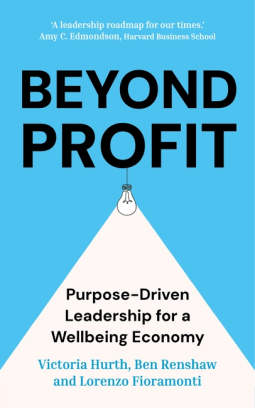
Beyond Profit
Purpose-Driven Leadership for a Wellbeing Economy
This title was previously available on NetGalley and is now archived.
Send NetGalley books directly to your Kindle or Kindle app
1
To read on a Kindle or Kindle app, please add kindle@netgalley.com as an approved email address to receive files in your Amazon account. Click here for step-by-step instructions.
2
Also find your Kindle email address within your Amazon account, and enter it here.
Pub Date 10 Mar 2026 | Archive Date 25 Mar 2026
John Murray Press US | John Murray Business
Talking about this book? Use #BeyondProfit #NetGalley. More hashtag tips!
Description
Beyond Profit brings together the latest academic research on Purpose-Driven Leadership and Organizations to show how leaders can create a Wellbeing Economy that is aligned with a sustainable future where we innovate and protect collective long-term wellbeing through governance that works. It is a must read for all leaders wanting to implement a coherent roadmap to meet the needs of the world we want - it will help you ask critical questions, learn from inspirational stories, and be armed with an innovative approach to find answers that will lead to a better tomorrow.
Leaders make decisions with real consequences that are not just local but national and even global - they impact matters of intense importance; decisions with environmental, economic, societal and moral implications. The reality of leadership in times of uncertainty and risk places an unprecedented challenge at the door of today's generation of leaders.
As a leader, you may often feel locked into pursuing sustained growth and endless increases in financial returns - while held back by less resources and more challenges around employees, customers, and new technologies.
Perhaps you feel overwhelmed and weighed down by responsibility - troubled by the legacy you are leaving behind. It doesn't have to be this way.
Advance Praise
"A leadership roadmap for our times." - Amy C. Edmondson, Harvard Business School
"Reminds us that compassion, responsibility, and ethics must power the engine of our economy, not stand on the sidelines." - Paul Polman, Author, Philanthropist, & Activist; Former CEO, Unilever
"For too long we have been playing at the edges-geting lost in the noise...Beyond Profit helps us see the common ground and lead for radical change." - Hunter Lovins, President and Founder of Natural Capitalism Solutions
"Transformative." - Richard E. Boyatzis, PhD. author of 'The Science of Change'
"Foundational." - John Elkington, Founder and Recaller of the Triple Bottom Line
Available Editions
| EDITION | Hardcover |
| ISBN | 9781399822480 |
| PRICE | $29.99 (USD) |
| PAGES | 368 |
Available on NetGalley
Available to Buy
Buy on Amazon Buy on Bookshop.org Buy on WaterstonesAverage rating from 2 members
Featured Reviews
 Demetris P, Reviewer
From Profit as a Goal to Profit as a Tool: Reading “Beyond Profit” as a Field Guide for Rebuilding Organizations Around Long-Term Wellbeing for All
By Demetris Papadimitropoulos | February 18th, 2026
Watercolor Piece by Demetris Papadimitropoulos
“Beyond Profit” arrives with the kind of calm urgency that usually belongs to emergency signage: plain type, unarguable arrows, a refusal to decorate the exit. Its subtitle – “Purpose-Driven Leadership for a Wellbeing Economy” – reads like a promise and a provocation. The promise is that the familiar corporate vocabulary of purpose, culture, ESG, stakeholder value, even “leadership” itself, can be rescued from their recent inflation. The provocation is that the rescue will require an act of naming: the authors’ insistence that modern institutions operate inside a “governance box” whose invisible walls are built from one dominant motive, short-term financial self-interest.
Victoria Hurth, Ben Renshaw, and Lorenzo Fioramonti want you to see those walls the way you might suddenly see a fish tank – not as “the world,” but as a container. Their argument is blunt in the best way: we keep trying to solve twenty-first-century crises with decision rules designed for twentieth-century scoreboards. We keep calling the damage “externalities,” as if the planet, the body, and the social fabric were optional accessories. We keep treating the symptoms – reputational risk, employee disengagement, carbon intensity – while leaving untouched the governing logic that selects which problems are legible and which are, conveniently, “out of scope.”
The book’s structural genius is its refusal to let the reader choose a single arena in which to hide. You cannot stay safely macro, talking about GDP and national accounts as if you have never run a meeting. You cannot stay safely meso, redesigning a corporate strategy deck as if politics and extraction were someone else’s business. You cannot stay safely micro, meditating your way to meaning while your organization quietly optimizes for quarterly targets. “Beyond Profit” is built as a three-level walk-through – MACRO (the economy), MESO (organizations), MICRO (the self) – and then tightened into a three-part cadence: Rethink, Retool, Realise. The rhythm is didactic, yes, but also strangely consoling: in a time when everything feels connected and therefore impossible, the book offers connection without paralysis.
At the center is the trilogy of logics. Logic 1 is the default operating system: profit maximization and the short-term incentives that follow from it. Logic 2 is the reformist patch: “enlightened self-interest,” the world of ESG frameworks, stakeholder capitalism, and risk-based restraint – useful, the authors concede, but ultimately constrained because it still filters reality through financial return. Logic 3 is the proposed rewrite: governance beyond profit, where the highest-order goal becomes “long-term wellbeing for all,” with profit treated as a tool rather than a telos. It is a big claim, and the authors make it bigger by insisting that governance is the lever that scales – the lock-and-key mechanism that shapes culture, strategy, and what a system is permitted to notice.
There are books that have argued adjacent points with more lyrical rage. Donella Meadows’s “Thinking in Systems” remains the pocket-sized skeleton key. Kate Raworth’s “Doughnut Economics” gives the moral geometry. Tim Jackson’s “Prosperity Without Growth” offers a sober counterweight to growth’s romance. Fioramonti himself has made the case against GDP’s monopoly in “Wellbeing Economy” and “The World After GDP.” “Beyond Profit” stands apart by bringing governance standards – not just values – to the front of the stage. Its affection for frameworks is not a corporate tic; it is, in the authors’ telling, the only way out of fragmentation. If you cannot specify how decisions get made, “purpose” is just a mood board.
That insistence on specification produces some of the book’s most memorable pages. The authors borrow the “Iceberg Model” to show how what we call problems – siloed teams, lack of collaboration, shallow meetings – are often merely the visible tip. Beneath lie patterns, system structures, and mental models: the “us vs. them” language that hardens into identity; the lazy assumption of ill intent; the quiet belief in one function’s superiority. In a case study of an operations leader, Warun, the authors trace how naming these submerged drivers turns a complaint into a shared diagnosis – and then, crucially, into commitments that can be observed. There is a subtle moral here that feels particularly contemporary: transparency is not a confession, it is a strategy. In an era of brittle trust – between departments, between citizens and institutions, between workers and the platforms that manage them – the book argues that the first act of governance is to make the invisible discussable.
This is where “Beyond Profit” begins to sound, at times, like a companion volume to Peter Senge’s “The Fifth Discipline,” which the authors invoke explicitly. Senge’s five disciplines – systems thinking, personal mastery, mental models, shared vision, team learning – are treated less as management lore than as spiritual hygiene for complex systems. But Hurth, Renshaw, and Fioramonti add a twenty-twenty-four twist: purpose-driven leadership is not just about learning; it is about survival inside a “polycrisis,” that overlapping web of climate shocks, health strains, inequality, political volatility, and chemical saturation that makes the future feel less like a horizon than a weather pattern.
The MICRO chapter, in particular, tries to rescue “leadership” from its usual muscular clichés. The authors argue that the move from Logic 1 to Logic 3 is not primarily a skills upgrade; it is a conversion of attention. Money to Meaning. Doing to Being. Me to We. These phrases risk sloganhood, but the book works hard to keep them from floating away. It connects purpose to the body – to energy, to burnout, to the way a life without meaning can hollow out even high-achieving professionals. A story of Johan, a disengaged regional CFO, becomes a miniature of the book’s bet: finance, reframed, can be a driver of wellbeing rather than a referee of austerity. The authors quote research linking burnout to low “purpose in life,” and they are careful to include the counterwarning from Geoff McDonald of Unilever: purpose without boundaries can become its own addiction. The point is not to romanticize meaning; it is to govern it.
What makes these sections convincing is the authors’ unusual willingness to speak about love without blushing. “Lead with Love,” they insist, is not sentimentality; it is psychological safety operationalized. Here the book brushes against Amy Edmondson’s work (she writes the foreword) and the broader post-pandemic reckoning with cultures of fear. If the last several years have taught leaders anything, it is that compliance is not resilience. The book’s claim is sharper: you cannot build a system oriented to long-term wellbeing for all while treating people as expendable variables. The governance box will simply reassert itself.
And yet, the book is not naïve about the seductions of the box. It understands that Logic 1 is not only profitable; it is cognitively efficient. It gives you a single scoreboard, a clear hierarchy of ends, a way to translate messy life into neat numbers. To leave it is to choose complexity – and to choose being accountable to what cannot be reduced without loss. The authors are right to identify the temptation of Logic 2: it allows institutions to keep the scoreboard while adding a second screen. A metric for carbon here, a pledge for diversity there, an “impact” narrative in the annual report. The book’s critique is that this is still filtration, still a governance system that treats wellbeing as a constraint rather than a goal. It is a bracing argument in a moment when many companies are quietly rolling back commitments under political pressure, litigation risk, or simple fatigue – not because the problems have vanished, but because the incentives never truly changed.
If “Beyond Profit” has a weakness, it is the one shared by most serious framework books: the compulsion to prove itself by accumulation. Case studies, quotations, standards, acronyms – they arrive in steady waves, each one earnest, each one relevant, and yet the cumulative effect can flatten the reading experience. The prose is clean and often elegantly firm, but it rarely surprises at the level of sentence. You feel the authors’ desire to build a handbook, a field guide, a tool you can hand to an executive committee without alarming them. That pragmatism is admirable. It also means the book sometimes underplays the tragic dimension of its own premise: that systems do not give up power because we have found better words.
Still, there are moments when the book’s moral imagination flashes. In the conclusion, the authors quote Chief Arvol Looking Horse: “Each of us is put here in this time and in this place to personally decide the future of humankind.” It is the kind of line that can feel imported, a high note borrowed from elsewhere. But within the book’s architecture, it lands as a challenge: if governance is nested and replicated – in governments, organizations, and selves – then responsibility is also nested. You cannot outsource your role as citizen. You cannot outsource your role as leader. You cannot outsource your role as a human being whose daily decisions train a system to notice some things and ignore others.
One of the book’s most persuasive moves is to treat governance literacy as a civic skill. We are, the authors argue, “the ultimate governing body of the economy,” whether we like it or not. This is a quietly radical claim in an era when many people feel governed by forces too large to name: algorithmic platforms, supply chains, financial markets, geopolitical shocks. “Beyond Profit” does not pretend that a new logic will be easy. But it insists that the alternative is not stasis; it is drift. Systems are always changing. The only question is whether the change is conscious.
One practical section I kept returning to is the authors’ treatment of marketing, where they argue that narrative without governance becomes, at best, “purpose-washing” and, at worst, a sophisticated way to keep extraction socially acceptable. Their “Evolved Value Framework” is not a slogan generator; it is an attempt to re-anchor value creation in the lived experience of stakeholders, so that claims about contribution can be tested against the routines of procurement, product design, pricing, and people systems. Read against the backdrop of recent “greenhushing” and the noisy backlash to ESG – the sudden discovery, by some boardrooms, that values are controversial – this insistence feels less like idealism than risk management of the deepest sort: reputational risk is merely the surface ripple of a legitimacy crisis. If trust is the scarce resource of our time, governance is how you earn the right to tell a story.
Readers who come to “Beyond Profit” hoping for a single silver-bullet policy – a new tax, a new disclosure rule, a new corporate form – may find the book simultaneously more frustrating and more honest. Its project is not to prescribe one instrument, but to change the instrument panel. It wants to replace GDP as a goal with wellbeing as the point; to treat organizational strategy as downstream of governance; to move from market response to market making. These are large shifts, and the authors’ faith in standards like “ISO 37000” and the forthcoming “ISO 37011” will strike some as technocratic optimism. Standards are not salvation; they are scaffolding. But scaffolding matters. Anyone who has watched a well-intentioned initiative collapse under the weight of incentives knows that without structure, purpose becomes performance.
Perhaps the most valuable thing the book offers is language that does not merely describe the world, but redesigns what can be said inside institutions. Logic 1, Logic 2, Logic 3. Rethink, Retool, Realise. Macro, Meso, Micro. Energy, Flow, Impact. These triads and tiers could be dismissed as consulting architecture. In practice, they function as a kind of shared grammar, a way to stop arguing about symptoms and begin talking about systems. In meeting rooms where people are trained to sound certain, a shared grammar can be the beginning of humility – and humility, in complex times, is a competitive advantage.
The authors’ own written style is everywhere in this insistence on disciplined hope. They do not ask you to believe in goodness abstractly. They ask you to govern for it. They argue that purpose is not an add-on but a determinant of behavior – and that it is a leader’s job to bring perspective to what purpose is doing to the system. That line could be the book’s thesis sentence, and it is also its quiet rebuke to the era’s louder temptations: the temptation to cynicism, to performative outrage, to the kind of doom that becomes an excuse for inertia.
There is also, threaded through the book, a gentle insistence that meaning is not merely personal. In recent years, the language of wellbeing has been absorbed into self-care industries and corporate perks, as if burnout were a problem of individual resilience rather than institutional design. “Beyond Profit” pushes back. It argues that wellbeing is the outcome an economy is supposed to produce, and that without governance aligned to that outcome, both people and planet become collateral. In that sense, the book belongs on the shelf beside “Net Positive,” “The Value of Everything,” and “Reinventing Organizations,” but it also has the chastened tone of post-crisis literature: a sense that the old promises – growth will lift all boats, efficiency is virtue, disruption is progress – have run out of oxygen.
My own response to “Beyond Profit” was shaped by its refusal to let the reader keep “purpose” in the realm of aspiration. The authors keep returning to the same hard point: what you measure, what you reward, what you punish, what you legalize, what you normalize – these are the true sermons of a system. And if those sermons still preach short-term self-interest, no amount of branding will save us.
The book is not perfect. It could be leaner. It could risk more stylistic abrasion, more confrontation with the political economy of transition, more acknowledgment that some institutions will fight to the end to preserve Logic 1. But as a work of applied moral reasoning – a handbook that treats governance as culture’s skeleton and purpose as the muscle that moves it – it is unusually coherent, unusually actionable, and unusually timed.
“Beyond Profit” is, finally, less a book about organizations than a book about adulthood: the moment when you realize that the rules you inherited were designed for a different game, and that continuing to play by them is itself a choice. The authors invite the reader into a closing triad of questions, ancient in their simplicity: “If not this, what? If not now, when? If not you, who?” It is a line that could easily tip into motivational cliché. Here it reads, instead, like governance stripped to its essence: a decision, repeated, that becomes a system.
Rating: 88/100.