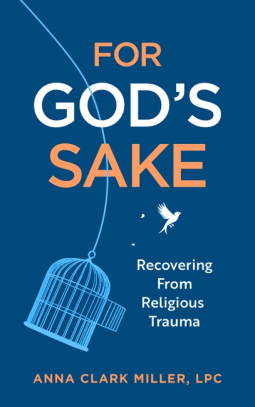
For God's Sake
Recovering from Religious Trauma
This title was previously available on NetGalley and is now archived.
Send NetGalley books directly to your Kindle or Kindle app
1
To read on a Kindle or Kindle app, please add kindle@netgalley.com as an approved email address to receive files in your Amazon account. Click here for step-by-step instructions.
2
Also find your Kindle email address within your Amazon account, and enter it here.
Pub Date 7 May 2026 | Archive Date 20 May 2026
John Murray Press US | Sheldon Press
Talking about this book? Use #ForGodsSake #NetGalley. More hashtag tips!
Description
"I feel guilty all the time, even when I'm not doing anything wrong..."
Are you navigating fear, shame, and isolation in the aftermath of harmful experiences in religion? Are you so used to suppressing your own needs and emotions, that you don't know how to express them anymore?
Author, therapist, and religious trauma survivor, Anna Clark Miller has been where you are. The descendant of two generations of missionaries, Anna grew up feeling spiritually inadequate, terrified of unseen threats, and ashamed of her discontent as a missionary kid. When, in adulthood, she started reckoning with the religious harm she'd experienced, it was terrifying at first. But instead of experiencing deeper suffering, she found incredible restoration.
For God's Sake: Recovering from Religious Trauma offers language to help you understand what you've experienced, process your hurt and anger, and start healing on your own terms. You'll learn how to turn your self-judgement into curiosity, and your shame into self-compassion. Each chapter includes multiple inventories, checklists, and personal reflection prompts to help you connect more deeply with yourself and gain insight into how religious trauma has impacted you.
Grounded in research and counseling experience, Miller takes a religiously neutral approach to healing. She knows from experience that many religious trauma survivors are understandably anxious about perceived hidden agendas, particularly those tied to religion and spirituality. So whether you're looking to leave religion completely or seek a new, healthier relationship with your faith, For God's Sake can help you recover and explore who you are beyond religious trauma.
Available Editions
| EDITION | Other Format |
| ISBN | 9781399828413 |
| PRICE | £16.99 (GBP) |
| PAGES | 240 |
Available on NetGalley
Average rating from 5 members
Featured Reviews
 Michelle H, Educator
The title of this book caught my eye: "For God's Sake: Recovering from Religious Trauma" because I can relate to it. Its author, Anna Clark Miller, is a therapist and grew up the child of missionaries. Miller talks about how her parent's involvement in the ministry was more important to them than their actual children. She was very transparent with her feelings, sharing as follows: " That meant the needs of my siblings and I were an obvious second priority to the gospel. I spent much of my childhood feeling ignored, abandoned, and uncared for as I watched my parents give their time and energy to people who needed it more. I felt profound shame about my discontent as a missionary kid, fearing that it indicated that I was spiritually flawed an inadequate." She talks about emerging from fundamentalism and finding restoration, which was a surprise to her since she had always been told that only darkness was "on the other side of the door." She goes on to refer to all the characteristics of trauma and the one that caught my attention most was scrupulosity, which is a type of religious OCD.
Each of Miller's chapters end with reflection questions and actions to take. I related to a lot of what I read in the book and think it will be very helpful to others coming out of fundamentalism. Thanks to NetGalley for the ARC. All opinions are my own.
 Reviewer 1948672
Former missionary kid, now therapist Anna Clark Miller, writes an evidence-based, trauma-informed, gentle and informative book for people healing from religious trauma.
-
I'm glad this book exists. I think it will truly help people. I found it well-researched and well-written. I thought it covered a lot of important topics with a feeling of gentleness and safety throughout.
The main change that I would make to this book is to put the final chapter regarding therapy and what to look for or look out for, closer to the beginning. It is incredibly good and important information, and I think it would be better to introduce up front. My reasoning is that a lot of people facing religious trauma likely need that external professional support to even properly delve into the topics that this book covers. The author is correct that doing this healing work requires both a real and a felt sense of safety, and I think that reading and working on this book's topics completely independently could likely be highly triggering and feel intensely unsafe. I would recommend the therapy angle sooner.
The first half of the book covered a lot of important information, and I viewed it as a sort of centralized primer for those emerging from abusive and/or high control religion. A lot of the material had to do with examining various facets of what those groups tend to teach and inflict and utilize as tactics.
This part wasn't quite as striking for me, personally, given that I'm years out from my initial deconstruction journey and have already gone through a lot of this information during that time. I personally sought out online resources that were less about solely sharing information, and more about survivors finding community. I discovered various podcasts and their accompanying Facebook groups, as well as various Instagram accounts, which both delved into a lot of these topics with a critical thinking lens, and encouraged all types of different people to chime in and share their experiences and perspectives. That common humanity was crucial for me in that time.
Part 2 is absolutely invaluable trauma work, and it is really tough. Despite my deconstruction occurring years before, I'm only now healing from my trauma. I've both seen and personally experienced the techniques in this book really work for treatment. That said, it is really tough, and is why I think the therapy chapter needs to be earlier. With that support though, this material is so relevant and helpful.
Some more general notes - I think this book likely works better as a physical copy than as an ebook. The checklists and diagrams don't really come across digitally.
While the reflection prompts are good, and I think it's important for this type of book to encourage physical journaling, they're very dense with so many questions each. I didn't work on these prompts because I was already currently working through Marlene Winell's book on the same topic; however, even just reading through the prompts felt really overwhelming to me. I wonder if it may help to break up some of the prompt questions and scatter them to the applicable portions, asking the reader to jot down a few bullet points for those, and then doing a slightly deeper reflection prompt alongside the checklist at the end.
This is a tough read, and also an important read. I'm really glad this author did the tough work herself, is helping people in her job now, and is extending that help even further with this book.
Reviewer 938573
For God’s Sake is a thoughtful and compassionate guide that speaks directly to the experience of healing after religious trauma 💛🌿
Anna Clark Miller draws from both professional counseling experience and her own background to help readers make sense of fear, shame, and emotional suppression that can come from harmful religious environments. The book gently explores what it means to untangle identity from imposed beliefs, and it offers tools for recognizing patterns of self judgement while slowly replacing them with curiosity and self compassion. Through reflection prompts, checklists, and grounding insights, it creates space for readers to process their experiences at their own pace.
What I loved about this book is how steady and validating it feels without being prescriptive or pushing a single path forward. It respects the complexity of healing and allows room for both questioning and rebuilding, whether someone is stepping away from faith entirely or redefining it in a healthier way. It feels supportive, clear, and deeply human in its approach to recovery 🌱✨
Readers who liked this book also liked:

Kalan Chapman Lloyd
General Fiction (Adult), Literary Fiction, Women's Fiction









Hani Marouf
Business, Leadership, Finance, Nonfiction (Adult), Politics & Current Affairs