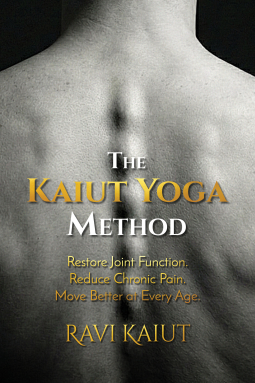
The Kaiut Yoga Method
Restore Joint Function, Reduce Chronic pain, Move better at Every Age
You must sign in to see if this title is available for request. Sign In or Register Now
Send NetGalley books directly to your Kindle or Kindle app
1
To read on a Kindle or Kindle app, please add kindle@netgalley.com as an approved email address to receive files in your Amazon account. Click here for step-by-step instructions.
2
Also find your Kindle email address within your Amazon account, and enter it here.
Pub Date 1 May 2026 | Archive Date 15 Sep 2026
Talking about this book? Use #kaiutyoga #NetGalley. More hashtag tips!
Description
5 STARS AND MUST READ ON REEDSY DISCOVERY
"An approachable and intriguing yoga method"
Kirkus Review
Ravi Kaiut's THE KAIUT YOGA METHOD: Restore Joint Function, Reduce Chronic Pain, Move Better at Every Age is an interesting book that skillfully adapts traditional yoga practices to the needs of contemporary society.
Indie Reader
Your body was not designed to become stiff, fragile, and painful with age.
What most people call aging is often something else entirely:
the gradual loss of adaptability and mobility inside the body.
As joints lose movement, circulation decreases.
The nervous system shifts into protection.
Compensatory movements slowly become your life.
Pain begins to feel normal.
But decline is not inevitable.
In The Kaiut Yoga Method, I introduce a radically different way of understanding movement, pain, and long-term health.
Instead of chasing strength, flexibility, or performance, this book focuses on something far more fundamental: restoring the conditions that allow the body to thrive again.
When joints regain movement, the nervous system reorganizes.
Circulation improves.
Pain patterns begin to dissolve.
The trajectory of aging can change.
Why Choose This Book?
A Different Way to Understand Pain and Aging
Most books about movement focus on stretching routines, workouts, or performance.
This book focuses on something far more fundamental: restoring the conditions that allow the body to adapt again.
Instead of pushing the body harder, I will Instead, present a precise mechanical approach designed to restore
joint integrity as the foundation of long-term health.
A Method Built for Real Bodies
The Kaiut Yoga Method was developed by Francisco Kaiut (my father) in Brazil through decades of observation and practice. Now present in Brazil, Usa and Europe the method shows how the body can actually adapt across a lifetime — including injury, chronic pain, stress, and aging.
Inside this book, I will guide you through the logic that already helped thousands of people recover their joint health:
• why joint function is central to pain, aging, and nervous system health
• how stiffness develops and spreads through the body
• the role of the ankles, pelvis, and shoulders as gateways of adaptability
• how mobility influences circulation, stress regulation, and recovery
• why many exercise and stretching fail to solve chronic pain
The goal is not to push the body harder.
The goal is to restore the internal conditions that allow the body to reorganize itself.
A Practice You Can Begin Today
This book does not stop at theory.
In the book you will find the practical foundation of the Kaiut Method, including:
• the ten foundational positions of the method
• two complete illustrated practice sequences and QRcode for the video sequences
• guidance for beginning a sustainable mobility practice
• adaptations that make the work accessible at any age or physical condition
These positions are designed to stimulate the joints, circulation, and nervous system in a precise and intelligent way.
You do not need to be flexible.
You do not need to be athletic.
You do not need prior yoga experience.
You only need curiosity and patience.
More Than Exercise
Beyond movement, this book offers a broader perspective on how the body, the nervous system, and daily habits shape our long-term health.
Advance Praise
"An approachable and intriguing yoga method"
Kirkus Review
Ravi Kaiut's THE KAIUT YOGA METHOD: Restore Joint Function, Reduce Chronic Pain, Move Better at Every Age is an interesting book that skillfully adapts traditional yoga practices to the needs of contemporary society.
Indie Reader
Marketing Plan
Marketing Plan
This title is supported by an active international audience and a structured launch strategy designed to generate early visibility and high-quality reviews.
Digital Presence
The book will be promoted through the global Kaiut Yoga network, including direct communication with students, teachers, and licensed schools.
Content campaigns across Instagram, YouTube, and LinkedIn will introduce key concepts from the book, driving awareness and encouraging early reader engagement and reviews.
Community Activation
An established international community across the U.S., Brazil, and Europe will be mobilized to support the launch.
Early readers will be invited to access the book through NetGalley and contribute thoughtful reviews, helping build credibility from within a highly engaged audience.
Events & Launch
The launch includes in-person events in St. Louis, Austin, and Boulder, supported by workshops and live classes connected to the book’s core themes.
These events are designed to create real-world engagement that translates into online visibility and reviews.
Media & Credibility
The book’s positioning will be reinforced through targeted outreach to podcasts, wellness platforms, and media focused on health, longevity, and functional movement.
Recognition from Kirkus Reviews and Indie Reader will be leveraged in promotional efforts.
Review Strategy
The focus is on generating high-quality, meaningful reviews from engaged readers and professionals.
Priority will be given to reviewers with established platforms such as Amazon, Goodreads, and specialized blogs.
Available Editions
| EDITION | Ebook |
| ISBN | 9786588595701 |
| PRICE | $9.99 (USD) |
| PAGES | 248 |
Links
Available on NetGalley
Average rating from 7 members
Featured Reviews
 Reviewer 2063299
As a teacher of the Kaiut Yoga Method, I approached this book with both familiarity and curiosity about how an experiential practice would translate to the page. Overall, it provides a clear and thoughtful introduction to a method centered on joint health, nervous system regulation, and sustainable movement.
One of the book’s strengths is its explanation of how modern lifestyles contribute to stiffness and chronic discomfort, along with a compelling argument for addressing these issues through small, intentional movements. Kaiut’s integration of neuroscience and biomechanics is accessible and helps ground the method in a broader understanding of the body.
The inclusion of personal insights and student experiences adds a relatable dimension. While the conceptual framework is strong, the practical application may be challenging for readers without prior exposure. The instructions and visuals are somewhat limited, making it difficult to fully grasp the subtleties of the movements. Definitely utilize the included links to video classes and seek out a teacher for online or in person classes.
Even with these limitations, the book serves as a solid foundation for understanding the Kaiut Yoga Method and will likely resonate with readers interested in therapeutic approaches to movement and chronic pain.
 Alicia S, Reviewer
This book truly left me in tears of hope.
As described in this book, I am the person who has lived with chronic stress and then developed early spinal degeneration, where my strength was built on tension and rigidity. Thinking that my ability to be super flexible was truly just my joints lacking stability. Not knowing that pushing my limits and joints, I was just overworking my system and causing more damage, leaving my nervous system on constant alert, trying to protect me from myself. All of which was clearly explained and easily understandable in this book that went so much more beyond just sharing a different form of yoga.
Even as a certified yoga teacher, Kaiut Yoga is completely new to me, yet I'm fully intrigued now. The physical practice uses long holds under gentle pressure to "teach the nervous system to recruit the appropriate amount of tone, where strength becomes fluid--serving motion rather than resisting it." It focuses on control, helping the nervous system re-learn that it can move freely within range without losing integrity.
It asks us to look at pain differently and ask "what my body is protecting right now", instead of "where am I feeling this pain in my body."
Focusing on the three girdles in your body - ankle, pelvis, and shoulder, it uses repeated intentional exposure to "bits of stress" to help restore movement where it has been lost due to our bodies protecting areas that signal pain. A great example is my own pain, which is pain in my shoulder, but I know is coming from my cervical stenosis and is not actually an issue with my shoulder, yet that is where I feel the pain.
I found hope in the reminder gained from this practice - that where you are now is not your destiny - you can adapt, as the body was intended to. It teaches how to work through blockages our bodies create over time from daily routines and how they eventually can lead to pain as the body works to protect itself. You avoid something, and that avoidance leads to rigidity and eventually leads to even more movement limitations. But all of these are "learned responses, not traits," which was a beautiful reminder. Kaiut Yoga activates the nervous system, allowing it to explore the sensation and then settle into it. Providing just the right amount of stress for your body to process and then work to restructure.
After devouring this book with deep intention and hope, I found myself looking at it like traditional yoga pushes us to do more, while Kaiut Yoga does the opposite - it asks us to slow down and process. It allows our nervous system time to shift, using longer held positions, some that feel very basic, yet provide the body and nervous system exposure without urgency. Most importantly, it works for all bodies. No customization for different needs or bodies. Because the practice works to restore from within, from the nervous system, customization is just not needed, as our movements can be the same, while still having different experiences in our own bodies.
A beautiful way to practice and truly honor yourself. I learned so much from this book and look forward to my own restructuring following this amazingly restorative practice.
 Jennifer T, Librarian
The Kaiut Yoga Method gave a deep description of a yoga method that I was unfamiliar with. The book was laid out well and easy to read. Stories by devotees of the method gave insight into how this type of yoga can be helpful. I couldn't understand the figures in the appendix, but that might be user error.
 Miriam B, Educator
Rooted in the science of joint mobility and nervous system health, this book reframes what we've been conditioned to believe about aging, pain, and physical decline. Eye-opening and deeply practical, it gives you the wisdom to live with awareness and intention on and off the mat.
This is a reference to return to — informative and inspirational!
 Tove R, Reviewer
The Kaiut Yoga Method: Restore Joint Function, Reduce Chronic Pain, Move Better at Every Age offers a refreshing and thoughtful approach to pain, mobility, and yoga. As someone dealing with fascia-related issues, plantar fasciitis, and pain that seems to travel throughout the body, I’ve tried many things over the years — including yoga — with only temporary relief. This book felt different.
What resonated most with me was the focus on joints, fascia, nervous system regulation, and the interconnectedness of the body. A lot of what the author explains aligns with things I had slowly begun to understand on my own, but here they are presented in a clear and approachable way. The method makes sense, especially for people whose pain doesn’t fit neatly into one diagnosis or one body part.
I also appreciated that the book doesn’t promise quick fixes or push performance-based goals. Instead, it emphasizes patience, consistency, and restoring adaptability in the body over time. Patience has never been one of my strengths, but this book made me realize that learning patience may actually be part of the healing process.
There is quite a bit of repetition throughout the book, and it could have been more concise in places. Still, the overall message and approach were valuable enough that I didn’t mind too much.
I’m definitely interested in trying Kaiut Yoga more seriously, because this genuinely feels like an approach I’ve been waiting for.
Wendy T, Reviewer
This book is excellent especially for a yoga teacher looking to learn something new and incorporate this method in their practice and in their teachings. Great stories and explanations. There is a detailed description of the poses toward the end that I found very helpful.
Reviewer 2123298
The book begins with a good introduction to the importance of mobility, encouraging us to rethink commonly held views about flexibility, balance and strength.
As the author explains, ”Kaiut Yoga is not a physical activity but rather a hygiene practice for your body and mind.’
The book also states that “The work is joint-centred rather than muscle-driven. Instead of stretching tissues or strengthening muscles directly, the method uses body weight, gravity and support to deliver mechanical input into the joints - the places where movement choices are negotiated.”
Unlike many yoga books on the market, you are not buying page after page of yoga poses to try at home. Instead, The Kaiut Yoga Method provides a comprehensive explanation of the philosophy behind the practice and how it aims to benefit the practitioner. Only then, in the appendices, does it introduce a selection of poses to try.
This form of yoga primarily focuses on the feet, hips and shoulders, which it considers central to maintaining the structural integrity of the body and slowing down the degenerative process.
Having tried a couple of the poses, I am happy to report that I did find some relief in my ankles, right knee and hips. While I can’t claim to have practiced them extensively, the results were encouraging. Only time will tell whether the relief is temporary or whether regular practice will provide long-term benefits.
My only criticism of the book is that the exercises are illustrated with simple matchstick-style drawings. You do however get detailed accompanying instructions, nonetheless it can still be difficult to determine whether you are performing a pose correctly. It would have been nice to have had photographs to refer to, if only for guidance.
Readers who liked this book also liked:




Don Yaeger
Business, Leadership, Finance, Nonfiction (Adult), Professional & Technical