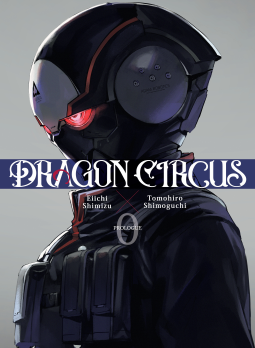
DRAGON CIRCUS 0
This title was previously available on NetGalley and is now archived.
Send NetGalley books directly to your Kindle or Kindle app
1
To read on a Kindle or Kindle app, please add kindle@netgalley.com as an approved email address to receive files in your Amazon account. Click here for step-by-step instructions.
2
Also find your Kindle email address within your Amazon account, and enter it here.
Pub Date 19 May 2026 | Archive Date 31 Aug 2026
Kodansha Comics | Vertical Comics
Talking about this book? Use #DRAGONCIRCUS0 #NetGalley. More hashtag tips!
Description
The sudden appearance of massive monsters known as "Dragons" throws the world into chaos. The New United Nations, created as a response to the threat, puts together a team known as the Dragonslayers, including (among others) a vampire, an android, a witch, the animated remains of the legendary ogre Shuten Doji, and....a little girl?! Ace pilot Momo may still be in grade school, but she just might have the skills to save humankind.
Taut action, propulsive storytelling, and sly humor take this seinen action series to new heights and unexpected places!
A dragon—the first of many—appears in the skies over Tokyo, and in an instant the world is changed forever...not least of all for Dr. Abe, who loses the woman he loves to the beast's fearsome onslaught. Decades later, a mysterious figure joins the desperate fight, coming to humanity's aid on a battlefield in the United States: model DS-08, code name Shikigami. He wears Abe's face, and his rallying cry is "Death to all dragons—!"
A Note From the Publisher
Includes scifi (including giant robots), fantasy, and elements of popular Japanese folklore like onmyoji
Shonen-style action but pitched at a more adult level
Author and artist of current Ultraman manga
World evocative of Shadowrun franchise
Rated 13+
2 volumes, on-going
Volume 0 is the first volume of the series
Available Editions
| EDITION | Other Format |
| ISBN | 9781647295714 |
| PRICE | $13.95 (USD) |
| PAGES | 218 |
Available on NetGalley
Available to Buy
Buy on Amazon Buy on Bookshop.org Buy on WaterstonesAverage rating from 93 members
Featured Reviews
 Demetris P, Reviewer
The Filing Cabinet at the End of the World
In “Dragon Circus 0,” Eiichi Shimizu and Tomohiro Shimoguchi turn dragons, grief, and myth into a strange bureaucratic war machine that can classify almost everything except the damage that built it.
By Demetris Papadimitropoulos | April 6th, 2026
Some apocalypse stories ask what will save us. “Dragon Circus 0” asks a stranger, less flattering question: what do human beings do first when the impossible arrives? They classify it. They number it. They assign it a department. Eiichi Shimizu and Tomohiro Shimoguchi’s volume is overrun with dragons, demons, robots, priests, soldiers, witches, vampires, hidden lineages, and enough command-room jargon to keep a procurement office awake after hours. Its real obsession is the bureaucratic reflex: dragonfire in, forms out.
Before it offers plot, it hands you intake paperwork. “Dragon Circus 0” is not arranged as a smooth run of chapters but as a prologue followed by “cases”: “Robot,” “Princess,” “Priestess,” “Sword,” “Demon,” “Doji,” “Dragon Slayers.” These titles arrive already sorted. Each tab adds a role, a threat, a rule, and one more problem bureaucracy will later pretend to understand. The story stacks up the way emergency paperwork does – quickly, nervously, under bad light. Before the plot has properly begun, the architecture has already declared its bias.
That architecture matters because the book’s first and deepest move is not narrative but administrative. The prologue is brief, pitiless, and usefully unwilling to console. A dragon appears over Tokyo. The attack is immediate and city-leveling. Dr. Kyosuke Abe loses the woman he loves. The city goes. The wound stays. What remains is revenge. That compression is the first administrative click after the scream. Catastrophe here does not produce revelation, noble sorrow, or moral housekeeping. It leaves behind a residue already halfway to becoming public hardware.
A few decades later, dragon war already comes with binders, support staff, and explanatory jargon. In North Carolina, human troops wait while the lethal work is increasingly handled by stranger substitutes than themselves. Then Shikigami arrives. Model DS-08, anti-dragon weapon, devastatingly efficient. His trouble is not force but legibility. He looks entirely human. His face says person; his introduction says product line. That split is where the whole book starts carrying real voltage.
Shimizu and Shimoguchi wisely refuse the lecture they have already dramatized. Humans still occupy the ceremonial posts of authority, but competence keeps sliding elsewhere – into a robot, an interface, a demon lord, a coalition no institution would have designed if desperation had not done the hiring. Ryan Jones’s appointment as commander matters for exactly this reason. It is less a triumph of merit than a reminder that organizations like a human face at the top even when the machinery underneath has become stubbornly inhuman. The machine does the lethal work; the human still gets the signature block.
From there the volume starts adding monsters and administrative headaches with enviable nerve. Princess arrives as a sharp-tongued presence and turns out to be an Adam Robotics interface. Elves exist, though not in the trinket-shop fantasy way people expect. Witches exist. Vampires exist. Onmyoji bloodlines persist beneath modern life. Shuten Doji is not an exhausted legend but preserved force. A flimsier book would lose three of those ideas before the sentence found its verb. This one holds because the CASE tabs are quietly preventing the whole contraption from shaking apart. They give each escalation its own drawer, its own tonal reset, its own temporary fantasy of order.
Why this matters is simple. Four different stories keep grabbing for the same steering wheel. “Dragon Circus 0” could be a kaiju thriller, a myth-tech spectacle, a bereavement story in tactical drag, or an ensemble war narrative about incompatible specialists forced into one ugly unit. It tries to be all of them at once, and succeeds often enough to make the strain worth watching. This is not a graceful book. Grace is not what it was built to offer. Its gift is lane discipline. Here is ritual. Here is weapons research. Here is team assembly. Here is grief. Here is the thing nobody can quite command once it has been recruited.
That is the book’s sharpest straight-faced move. Every institution in “Dragon Circus 0” shares the same paperwork reflex. The New United Nations Unified Command rises to coordinate a broken world. Adam Robotics studies dragon remains, classifies species, and builds weapons from what can be salvaged. Ancient lineages preserve older pacts, duties, and forms of knowledge. Everyone wants the threat reduced to a grid, a memo, and a deployable answer. The story keeps showing the opposite. Sensors fail. Dragons mutate. Some only watch. Lord Doji can be enlisted but not really subordinated. Shikigami can be deployed but not stably named. Abe, whose grief helps produce one of humanity’s most effective anti-dragon answers, disappears. The apparatus keeps running after grief has lost the face that first powered it.
That is why the book outthinks its pitch. Beneath the monster blood, filing tabs, and polished hardware, it is less interested in dragon-slaying than in the appetite to slap a label on what should still feel ungovernable. The CASE format does not merely describe that appetite. It enacts it. “Robot” labels the uncanny weapon. “Princess” labels designed personality. “Priestess” labels hereditary duty. “Sword” labels anti-dragon engineering. “Demon” labels grief as military origin point. “Doji” labels myth as deployable force. “Dragon Slayers” tries to label all these unstable pieces a unit. The structure is not neutral. It has caught the same filing fever it is describing.
This is also why the book’s structure counts as more than good organization. A lesser series would use these cases as efficient onboarding, then move on. “Dragon Circus 0” lets the compartments become part of the meaning. It files monsters because its world files monsters. It classifies allies because its institutions classify allies. It treats crisis as something to be named before it can be fought, even though the fighting keeps proving that the naming is partial, provisional, and sometimes comically optimistic. That feedback loop gives the book more intelligence than its premise first advertises.
The prose – or rather the verbal surface, since this is a comic and the image does so much of the atmospheric labor – favors a sentence that clicks shut. One register is technical: models, interfaces, command structures, deployments, research bureaus. One is mythic: pacts, priestesses, bloodlines, Shuten Doji, Abe no Seimei. A third is acid-dry and impatient, especially once Princess starts prodding everyone else’s solemnity. Against the odds, those voices sharpen rather than smother one another. The book’s best lines are clipped, declarative, and well-timed. In the prologue, that bluntness gives grief a ritual edge. Later, it keeps the lore from thickening into paste. The writing is not lush, and would be worse if it tried to be. Its best effects come from pressure, not perfume.
The blacks do more emotional work than the dialogue. Even in overview, the pages show their intelligence: black-heavy fields, tactical grids that suddenly open into reveal pages, monster scale rendered through contrast rather than fuss, skull imagery, human faces attached to machine labels, labels attached to things that keep behaving like myths. The pages look tooled. They do not merely illustrate the script. They keep locating the points where the script’s appetite for order starts to fray. One sees the book most clearly there: in the collision between naming and scale, between a clean label and an image too large, too jagged, or too haunted to stay inside it.
Shikigami is where “Dragon Circus 0” becomes most alive and most vulnerable. He is its sharpest device with a face: a human-faced anti-dragon weapon built in Abe’s image after the dragon killing of Abe’s fiancée. He is mourning processed into payroll and deployment. Whenever the story pauses over the split between what he looks like and what he insists he is, the book acquires a deeper and stranger pressure. He is military asset, memorial object, product line, and near-person all at once. That is not stylish ambiguity for its own sake. It is the book’s central pressure point in miniature.
It is also where the book shows its limit most clearly. “Dragon Circus 0” mechanizes grief faster than it complicates grief. The return to Abe’s fiancée – wedding preparations, ordinary anticipation, a life interrupted in mid-beginning – works because it briefly restores texture the book often compresses away. A future was not only destroyed. It had barely started furnishing itself. But the story moves quickly from grief to revenge, from revenge to mission, from mission to machinery. It knows the loss matters. It does not always let the loss become as cross-wired as the systems built from it. The result is not emotional emptiness. It is emotional compression. Sometimes that compression gives the book force. Sometimes it leaves feeling one dimension flatter than the surrounding architecture.
That pattern shapes the characterization elsewhere. Shikigami and Princess stand out because each embodies a contradiction the book genuinely cares about. Abe’s absence has force too; he lingers as inventor, mourner, and vanished source code. But other figures arrive more fully as roles than as interiors. Ryan Jones works as the visibly shaky human commander in a world increasingly run by stranger competencies. Rin works as a carrier of ritual inheritance. Both matter. Neither yet feels fully alive from within. The book designs roles more fully than it warms them.
None of this means it misses its mark. One of its best instincts is its refusal to sentimentalize response. Disaster here does not make everyone nobler or wiser. It produces agencies, prototypes, command units, pacts, dossiers, and strategic compromises. Terror becomes paperwork. Myth becomes procurement. Grief becomes hardware. The line is funny because the book has earned the right to deliver it straight. It understands that catastrophe’s afterlife is often administrative before it is philosophical. That understanding gives the whole enterprise a dry, almost bleak maturity. The apocalypse is not merely spectacle. It is staffing.
A comparison should illuminate a pressure point, not decorate a paragraph. “Neon Genesis Evangelion” by Yoshiyuki Sadamoto, based on the work by Gainax, is the clearest thematic cousin, not because “Dragon Circus 0” matches its psychological severity, which it does not, but because both understand that the machinery built to answer disaster is never emotionally innocent. “Kaiju No. 8” by Naoya Matsumoto is the nearer commercial comparison in its anti-monster infrastructure and readable pace, though Shimizu and Shimoguchi are denser, stranger, and less interested in clean heroic propulsion. There is also a faint but useful echo of “Dorohedoro” by Q Hayashida in the way conceptual excess is treated not as embarrassment but as condition. “Dragon Circus 0,” though, wants compartments where that manga wants rot. One admires the difference.
The ending is the only one this material has earned. “Dragon Slayers” brings the cast and systems into an official anti-dragon unit without pretending that official means settled. Abe is gone. Lord Doji retains his own will. The alliance works until it does not. The team exists, but mostly as a fault line for future strain. This is not an origin story that arrives at order. It is an origin story that arrives with more hardware and no cleaner future. That is a strong ending for a first volume because it sharpens the book’s argument without falsely resolving it. The systems are built. The instability remains. Perhaps that was always the point.
What keeps “Dragon Circus 0” from being near-excellent is not confusion but imbalance. Its architecture is more fully realized than its emotional life. Its ideas often run deeper than its people. The repeated tension between command and resistance remains fruitful, but not every recurrence finds a fresh dramatic shape. Even so, the volume’s strengths are real, unusual, and hard to dismiss. It is visually exacting, structurally shrewd, thematically sharper than its pitch suggests, and admirably unwilling to pretend that response comes in heroic purity. It arrives with forms, prototypes, chain of command, and a faint smell of scorched circuitry.
My final rating is 84/100, which translates to 4/5 stars on Goodreads and NetGalley. That sentence is tidier than the book, whose drag and momentum come from the same overbuilt machine. Better to end with the distance it measures so well: first a dragon in the sky, then a human-faced weapon insisting he is only a model. Nothing this story stakes its life on ever stays inside the folder.
 Felicia H, Bookseller
I really liked this! I love a good monster killing manga and this is no exception. You can always trust the formula to work and be a really good time. A lot of times the story gets deeper as the series gains traction so I can't wait to see where this goes. I love a good rag-tag band of misfits as well and these guys definitely fit that bill. I am excited to see what the next volume has to offer.
 Kara D, Media/Journalist
Surprisingly delightful sci-fantasy with a dash of humor. This first volume of DRAGON CIRCUS, which serves as an "episode zero," introduces a world where fantasy creatures abound. To fight back against very real dragons, the world creates robots - one of whom is, at least at a glance, more human than human.
The worldbuilding in this series is absolutely fascinating, alternately leaning into and shying away from fantasy tropes. Underneath it all is a story of one man's revenge. It's a great and curiosity-piquing read.
Readers who liked this book also liked:


Stephanie Williams
Comics & Graphic Novels, Entertainment & Pop Culture









Katie-Rose Fischer-Price
Children's Fiction, Health, Mind & Body, Parenting, Families, Relationships


Céline Fitzmaurice
Biographies & Memoirs, Mystery & Thrillers, True Crime