The Greywood Pantry
A Tale of Seconds, Stew and Sanctuary
This title was previously available on NetGalley and is now archived.
Send NetGalley books directly to your Kindle or Kindle app
1
To read on a Kindle or Kindle app, please add kindle@netgalley.com as an approved email address to receive files in your Amazon account. Click here for step-by-step instructions.
2
Also find your Kindle email address within your Amazon account, and enter it here.
Pub Date 1 May 2026 | Archive Date 9 May 2026
Talking about this book? Use #TheGreywoodPantry #NetGalley. More hashtag tips!
Description
**No deadlines for reviews**
The world is ending. The summoned saviour brought lunch.
No powers. No legendary weapon. No divine calling. Dragged across worlds in the tradition of isekai, he arrives in a dying land and immediately complains about the food.
The Greywood is the last living forest in a collapsing world — ancient, strange, and deeply uninterested in outsiders. Its people have survived alone for generations. Beyond the trees, a demon lord sits at the centre of everything and quietly unravels it.
This is not a story about defeating him.
It's a story about showing up. Again and again. With food. With warmth. With the stubborn belief that kindness, repeated often enough, can become its own kind of power.
The forest notices. The people notice. Even the demon lord, eventually, looks up.
Because it turns out warmth is harder to resist than armies.
The end of the world, handled one meal at a time.
A cosy low-stakes isekai fantasy told in second person — about grief, survival, strange forests, impossible hope, and the quiet work of tending what remains. With recipes.
You are the champion. You brought lunch.
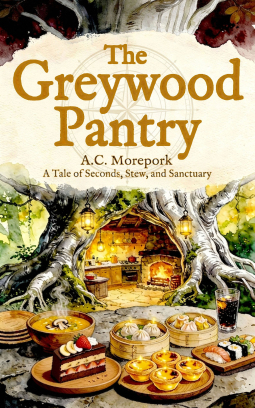
**Cover not yet final.**
Note: The 60+ watercolour illustrations were created using AI image generation tools, then extensively reworked by hand.
Available Editions
| EDITION | Ebook |
| ISBN | 9780473783419 |
| PRICE | |
Available on NetGalley
Available to Buy
Buy on Amazon Buy on Bookshop.org Buy on Kobo Buy on WaterstonesAverage rating from 5 members
Featured Reviews
 Sadie E, Reviewer
I knew this book was going to get under my skin from the author’s introductions alone. They’re so disarmingly sincere and rooted in shared human experience. This line, in particular, told me everything I needed to know:
“For everyone who has ever sat across from me. Those who tasted what I made and let their face say everything. Those who cooked for me. Those who taught me how — directly, or simply by letting me watch. However many meals we shared. However briefly the feast lasted.”
That acknowledgement is the thesis of the entire book, really: food as memory, as care, as language, as proof that someone, at some point, chose to keep you alive.
And that’s where this book excels.
There’s such a deep understanding of food here. Not just how it tastes, but how it lands. How it lingers and surprises you.
'“She laughed. Short. Surprised. Like the cake caught her off guard. Like joy sometimes does.”'
Food, in this book, is a small, unexpected light in the darkness. It's a joy that sneaks up on you, that you didn’t think you were allowed to have anymore.
And sometimes, it’s even simpler than that:
'“I feel normal.” She says quietly.'
That might be the highest compliment our Champion can receive. Not awe. Not even gratitude. Just bringing a sense of normality. For a moment, the world stops ending.
I love the human moments most of all. The small, almost ridiculous bursts of joy, like everyone collectively losing their minds over a Japanese cheesecake jiggling. Been there. Fully understood the enthusiasm.
I’m also slightly obsessed with the food descriptions (and the food paintings). They capture food in such a specific way; not just aesthetics, but texture. The steam curling up. The crunch. The softness. The feeling of eating something warm when you didn’t realise how cold you were.
I need to get this out of the way: I don’t like second-person narration. I associate it very strongly with my Quizilla fanfiction era (yes, I am ancient, thank you), where everything was (Y/N) this and (Y/N) that. It usually feels gimmicky or distancing.
But here, it works. Annoyingly well.
Because the book weaponises it.
'“You are the champion. The Greywood is waiting.”'
The narrative insists on you. It drafts you and makes you complicit in the act of showing up, over and over again, in a world that is very clearly ending.
And what do you do in a dying world?
You don’t fight. You don’t conquer. You don’t even really win.
You cook.
You gather.
You listen.
You feed people.
You comfort them.
You try, often stubbornly and irrationally, to sustain something soft in a place that has no reason to be gentle anymore.
The writing style's pretty bizarre. If you listed its traits on paper, I’d assume I’d hate this book. It breaks so many “rules” with reckless abandon:
Single-sentence paragraphs everywhere. A deliberately vague protagonist. Minimal, almost evasive descriptions. Dialogue that feels abrupt and unfinished.
But it all comes together to create this incredible effect. The best way I can describe it is: it feels like an RPG.
Not the sweeping, cinematic kind. The slightly janky, text-heavy kind.
You walk into a tavern. You click through dialogue too fast. Someone was probably about to say something important. You skipped it. And now you’re in a forest. Fetching ingredients. Again.
There’s something both unsettling and cosy about that rhythm. Conversations feel truncated, like meaning's always just slightly out of reach. It creates this sense that the world's bigger than what you’re allowed to fully understand, and that maybe understanding isn’t the point.
Because the point is repetition. The point is ritual. The point is doing small, kind things again and again and again, even when they feel insignificant.
Especially when they feel insignificant.
Because you are the Champion of Good Food.
This is where the book’s themes really dig in. It’s about resistance, but not the loud, heroic kind. It’s about the refusal to let care disappear. About choosing nourishment, both literal and emotional, in a landscape defined by decay.
There’s something almost radical in how small the stakes feel on the surface. You’re not saving the world in any traditional sense. You won’t find grand victories here. But the book keeps asking: What if sustaining even one person, even one moment longer, IS a kind of victory? What if making buns by a campfire in the middle of the apocalypse is itself an act of defiance?
And I loved that.
I loved the slowness and the cosiness. I loved how it feels like sitting with a slightly ragtag group of companions, sharing food while something vast and unknowable looms just beyond the trees, but that’s tomorrow’s problem, because tonight we have stew to eat and mead to drink.
I adored the characters. Especially Serath and how she slowly opens up, and the relationship with Deva was so tender and sweet. But then there's Pip.
I really, really don’t like Pip. Pip, who speaks in all caps and is practically vibrating at any given moment. "It SMELLS BAD. BUT TASTES GOOD. CAST IT SMELLS BAD — AND TASTES GOOD — HOW. HOW DOES THAT WORK.”
And yet, I would still sit at the table with Pip. I'd let Pip dip bread in my cream of mushroom soup and hand them a spoon to shatter my creme brulee topping.
Because Pip, and everyone else, is like an annoying sibling. I maybe don't like them all the time, but there is genuine love there.
And that's what this book does so well. It's got that found family energy turned up to 11. It slowly builds until suddenly you realise you'd do anything for this group of misfits. And just like a family, sometimes you need some space and for Pip to use their indoor voice.
I also found myself occasionally questioning the world in a very specific way. Like, why, in the middle of the Greywood forest, is there doubanjiang? Logically, I should have wanted more explanation. But I accepted it. Quite happily.
Because the book isn’t really concerned with how these things exist. It cares about what they do and what they mean when they’re shared.
And that brings me to something that really settled into my bones while reading: I felt this book in my soul. The joy of feeding people and the quiet satisfaction when they enjoy it. Anyone who loves cooking will understand this instinctively. The stinky tofu section in particular was so well done. We’ve all been there. Making something that looks or smells questionable, trying to convince people to just try it, and then sitting back as their expression changes. That moment of vindication.
'“The warlord understanding the strategy of a meal.”' Yes, exactly that.
Also, small moment of personal shame: I did try to peek at the recipes early. I just can't help myself! And then the book hit me with this:
'“Reading them before you finish the book will tell you things. Who recorded them. When. What they were eating. Who was there. These are not small things. The Greywood recommends finishing the book first. The Greywood has been here a very long time. It knows how stories work. It is patient. The recipes will still be here. So will the food.”'
I've never been scolded so gently in my life.
So I went straight back to my place with my tail between my legs and carried on.
And I’m glad I did, because even the recipes are part of the story. They’re reconstructed from notes and tied to specific meals, specific people, specific moments. The recipes aren’t cute extras, they’re echoes. Like little preserved fragments of connection. And they're good! I can't wait to make them (I'll update my review when I make some of the recipes).
Also: the cover. Love it. It’s gorgeous. And the very last painting! There's something so beautiful and hopeful about it. I'm sure some people will take issue with the images being created originally using AI, but AI keeps me in a job and puts food on my table, so there's no judgement here.
The entire book can be summed up in this:
'“A champion arrived,” she says. “With no powers.”
“And said we have terrible food.”'
Maybe my favourite (slightly humbling) takeaway: this is exactly who I would be in a fantasy world.
I wouldn't be the sword-wielding hero or the ice-storm-summoning mage. I’d be the one sitting by the cooking pot day after day, foraging for mushrooms and herbs, making sure everyone eats and hoping that that counts for something.
I want to go to The Greywood. I want to sit with the Champion, Serath, Jorin, Cast, and even Pip, eating mapo tofu, garlic bread, and pork belly. Just existing there for a while.
 Liz T, Reviewer
I was thoroughly invested in this book and was super curious to know how everything turned out. The characters are lovely and it was a super cozy and uplifting book to read. Pip was definitely my favorite.
The writing style was unlike any I have read before. With some books, I lean towards wanting less descriptive words. BUT THIS BOOK was written mainly is short sentences/statements/thoughts. So it was kinda the other end of the spectrum with (sometimes) less detail than I wanted. It was different... but in a good way. It was fun reading a very different writing style and kinda right up my alley!
And without spoilers - I totally did not expect Mal's background story! That was surprising and just perfect.
Serath's character pivoting from war to mercy, realizing that everything was not what she thought. The author giving her time to really wrestle with that internally and come to terms with it. Beautiful part of the story!
My takeaways-
-When in doubt, just keep showing up
-Show up even when you're scared and it's awkward
-When in doubt sit down over good food
-Never assume someone else's story
-Find joy in the little things
-Invite others in
There are a few things that I just didn't "get" and wished there was a bit more explanation. But maybe that was just crazy me wanting explanation of how things work, but not excessive detail in other things.
I wonder if the author is a chef or a foodie? And/or is Aaron (The Champion) a chef from where he came from? At a certain point I wasn't as invested in the food creation parts of the book. I'm less of a foodie myself and more into the people at dinner. But I was always invested in the forest, the world, and Mal's story. Mal is probably my second favorite character.
 Librarian 431790
A cozy fantasy which is both a sensory experience and a delightful read. There's a cute story, likeable characters, and the magic that comes from food and cooking.
There's a lot of food for thought and a story to enjoy
Recommended. Many thanks for this digital copy, all opinions are mine
Readers who liked this book also liked:



Sarah Dunnakey
Crafts & Hobbies, Entertainment & Pop Culture, Mystery & Thrillers