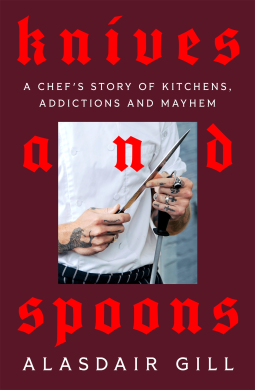
Knives and Spoons
A memoir of addiction, grief and the roots of family
This title was previously available on NetGalley and is now archived.
Send NetGalley books directly to your Kindle or Kindle app
1
To read on a Kindle or Kindle app, please add kindle@netgalley.com as an approved email address to receive files in your Amazon account. Click here for step-by-step instructions.
2
Also find your Kindle email address within your Amazon account, and enter it here.
Pub Date 9 Jul 2026 | Archive Date 9 Jul 2026
Pan Macmillan | Macmillan
Talking about this book? Use #KnivesandSpoons #NetGalley. More hashtag tips!
Description
'. . . dive straight into this tasting menu of bleak, savage and yet wonderfully funny and tender tales of grief, belonging and finding a reason to live. This is a memoir you want to savour, but is so compelling you can’t help but gobble down' – Independent
'Gill writes very well. Brilliantly actually. He is better than his father . . . Knives And Spoons is less about food than addiction, psychological heebie-jeebie . . . Gill has horrifying personal knowledge of what it is like being on a knife's edge' – Daily Mail
'A vital new voice who speaks so powerfully about addiction' – Bryony Gordon, journalist
From working in some of London’s most prestigious restaurants to scrubbing fat from kitchen floors, Alasdair Gill’s life as a chef has been a series of exhilarating highs and harrowing lows. But so too has his private life. Taking readers behind the swinging kitchen doors of London’s dining scene, he shows us the major contradictions in his life, from crossing paths with Anthony Bourdain and preparing dishes for the ultra wealthy to hiding in drug-fuelled kitchen dens and a wake-up call that nearly ended his life.
Knives and Spoons is a raw and honest look at the chaotic and often toxic world of professional kitchens, filled with fierce and unforgiving moments, but also a testament to the power of finding one’s craft and the long road to recovery.
For readers of Kitchen Confidential and Tart, this is a candid insider account of life on the frontlines of London's food scene.
'It'll show all those who love The Bear how to really tear up a kitchen' – Camilla Long, journalist
'Gill's funny, eye-opening and lyrical kitchen memoir is a must' – Stylist
'Magnificent, brutally honest and very funny . . . I never wanted it to stop' – Jon Spiteri, restaurateur
'Ali gives a proper insight into not only how he has worked, but into how he has thought . . . Do learn from him' – Jeremy King, restaurateur
'A story of hope, love, cooking and redemption. Brilliant' – Tom Parker-Bowles, food writer and critic
Available Editions
| EDITION | Other Format |
| ISBN | 9781037401435 |
| PRICE | £20.00 (GBP) |
| PAGES | 336 |
Available on NetGalley
Available to Buy
Buy on Amazon Buy on Bookshop.org Buy on WaterstonesAverage rating from 11 members

Featured Reviews
 Sadie E, Reviewer
This is what happens when someone throws Kitchen Confidential, a mountain of cocaine, unresolved trauma, chef whites soaked in fryer oil, and the world’s most hostile dinner service into a blender and hits purée.
I mean that as the highest compliment.
This book grabbed me by the throat from page one and screamed “YES CHEF” directly into my nervous system. It’s chaotic, filthy, self-destructive, hilarious, heartbreaking, and so aggressively accurate that I think every ex-hospitality worker will have at least three stress flashbacks while reading it.
The kitchen food chain section at the start BROKE me. Absolutely destroyed me. The fake Latin taxonomy of kitchen staff? I was wheezing as I remembered everyone I’d ever worked with and how accurately it described them.
The breakfast chef (scramblius maximus) whose weakness is being “likely to be a serial killer.” The pastry chef (precisis sugarbitch) who’s “the neurodivergent cousin of the chef de partie” (bigdickus disgruntlus). The floor manager (cuntus wankertits) thriving in their natural habitat of “drinking at the bar” while suffering from “limited allies.”
It’s so viciously specific that you instantly know these are real people the author’s absolutely fought in a walk-in fridge at 2am.
And if you’ve ever worked in a kitchen, you KNOW this is documentary-level realism.
It felt like I was there. Right there in the kitchen. Oil soaked through my uniform, four separate cuts bleeding profusely from my knuckles, pots clattering all around me, grinding my teeth while checking the clock until my next cigarette break, while someone screams in the walk-in and another chef is one minor inconvenience away from a complete psychological collapse.
I was having actual flashbacks. Like that time we all got drunk after dinner service and decided we didn’t want to be trapped in a car on the way back to the shared flat, so naturally the logical solution was travelling ON TOP of the car like a group of sleep-deprived raccoons in chef whites. Or that time I moved a plate approximately 0.2mm and the head chef Lost. His. Shit. Started throwing plates at my head while screaming that I was a failure and he wanted to strangle me.
Ah yes. Hospitality.
The best of times. The blurst of times.
It doesn’t feel polished or sanitised or like someone carefully curated their Bad Boy Chef Stories™ for publication. It feels like being cornered outside a pub by a chef holding a cigarette and multiple catastrophic life decisions while they tell you things that should stay between them and their therapist.
It’s aggressive. Blunt. Self-deprecating. Funny in the way only profoundly broken people can be funny. One minute you’re laughing at kitchen warfare and feral chef behaviour, and the next it casually guts you with the reality of addiction, burnout, self-loathing, and trying to survive an industry that eats people alive for sport.
Oh, and there are recipes???
Under all the screaming and chaos though, there’s real vulnerability here. The author never glamourises addiction or kitchen culture, even when he’s making it hilarious and making you pine for the good old days. The book understands that kitchens are simultaneously addictive, toxic, exhilarating, cruel, life-affirming, and totally incapable of producing emotionally stable adults.
 Annette J, Reviewer
Knives and Spoons by Alasdair Gill is a raw and unflinching story of cooking and addiction, two things that have clearly had a huge influence on the author's life. The author grew up hearing about food and cooking from a young age, as the son of food writer A.A. Gill he was exposed to a variety of cuisines and met many chefs and food personalities. As well as being a writer A.A. Gill was also an alcoholic in recovery, and his son Alasdair unfortunately inherited that genetic predisposition. The author is very open about some of the lowest moments of his life, and some of the stories he tells of active addiction are gut wrenching, but he also speaks about his sobriety, and there is a more optimistic tone , especially in the latter part of the book that left me feeling hopeful. Of course the book also recounts Gill's time spent in some of the best (and some rather less salubrious ) kitchens in London, and how that lifestyle contributed to his addiction. Scattered through out the books are illustrated notes of recipes that look to have been lifted directly from the chef's notebook, so I was glad to see that the recipes were collected and included at the back of the book.
I found myself compulsively reading this book, I genuinely did not want to put it down so immersed was I in the kitchen chaos that the author so effectively brings to life on the page , and there was a darkly humorous streak throughout that I really enjoyed - the opening chapter had me wheezing at the descriptions of the various members of the kitchen brigade.
Dark, brave and brilliant this is a book to devour.
I read an ARC courtesy of NetGalley and the publisher, all opinions are my own.
Alan M, Reviewer
While some will be familiar with food critic AA Gill’s writing for The Times, fewer likely know of the two chefs in his immediate family; brother Nick and son Alisdair. Alisdair’s book may seem to be about the culinary arts, anchored by his journey from Kitchen Porter to Head Chef. Indeed there are many recipes (actually, for me, too many). However, the main course (sorry…) here is really family, relationships and the shadow cast over them by addiction.
There’s no shortage of books about addiction and recovery. Indeed, Gill senior wrote one of the better ones, “Pour Me”. Alasdair wastes no time introducing us to his own drink and drug dependencies. Aged 26 working with a small number of other barely functional addicts at a restaurant called the Plum Gate in London’s east end, his constant need for drink and drugs has to be funded somehow, and restaurant kitchens are one of the few places an addict can do both. His description of daily kitchen service is visceral with a side of dark humour.
Gill’s masterful turn of words elevates what could easy be just another sordid treaty in self-pity into something genuinely engaging. He’s unrelenting in acknowledging his bad choices and terrible behaviour, but slowly the focus moves from junkie porn to his friends, family and how he managed to get sober.
After falling out of education – “like closing a book I’d never read” – with no idea what to do with his life, his real education comes in substance abuse living in a squat in Kensington Gardens. By a “miracle” (his words) he gets a job washing dishes at The Delaunay in Covent Garde. The only thing that matters in his life is his next fix, but the relentless hours and demands of the job bring “it’s own quiet ecstasy” and a lifelong relationship is formed. Addiction costs him jobs but also forces him to find new once in a line of work chock full of people just passing through.
After explaining how he gave up vegetarianism after eating too many sausages “to grant myself another meaty mulligan” he changes tack and devotes a chapter to his Uncle Nick. Nick Gill was an early celebrity chef feted by the Roux brothers, Charles and Diana and even Delia Smith whose stratospheric success was followed by a terrible collapse that culminated in a prison sentence, drug use (both voluntary and involuntary) and ultimately a disappearance which remains unresolved 30 years later. Gill admits he can’t fathom why he’s still there but Nick isn’t – the chef he admires “whose food I never tasted”, “the family I miss, without ever meeting”.
Gill goes on to describe his father and the impact his death from cancer in 2016, and his own slow, unsteady steps into sobriety, facilitated by his mother (former Home Secretary Amber Rudd) and unexpectedly influenced by his father. Gill discovers that addiction and dyslexia have hereditary elements, his father gifting him an “unwanted heirloom”.
The book closes with an unflinching insight to the recovery process and quite chillingly, how virtually all of those alongside him in that process lapsed and died. Gill remains candid in his self assessment, facing the identity crisis that confronts most recovering addicts like “an adult toddler”, understanding that whilst his identify as a drunk was “a shit one… I kind of knew what it was”.
By the end, Gill is facing responsibility – “it doesn’t give you wind in your sails; it gives you the anchor”. There’s fatherhood, and a superb story of having to list his former addictions to a midwife. He’s also running a successful private catering firm and best of all employing his step brother so that he too can become a chef. His sobriety is something his dad barely saw – “He missed it. It’s fucking classic of him”. But the resurrection is underway, and that’s what matters most.https://theafterword.co.uk/knives-and-spoons/
 Kiley D, Reviewer
I’m a sucker for a cooking memoir and this really hit the spot, no pun intended. The language is so sensory and delicious, and Gill is a talented writer.
Readers who liked this book also liked:
Jess Mills
Biographies & Memoirs, Nonfiction (Adult), Parenting, Families, Relationships

Céline Fitzmaurice
Biographies & Memoirs, Mystery & Thrillers, True Crime