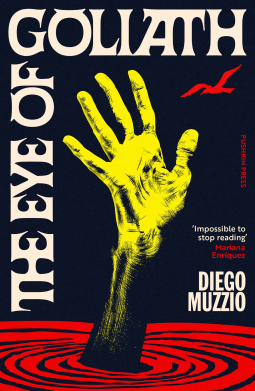
The Eye of Goliath
with Rahul Bery (Translator)
This title was previously available on NetGalley and is now archived.
Send NetGalley books directly to your Kindle or Kindle app
1
To read on a Kindle or Kindle app, please add kindle@netgalley.com as an approved email address to receive files in your Amazon account. Click here for step-by-step instructions.
2
Also find your Kindle email address within your Amazon account, and enter it here.
Pub Date 1 Sep 2026 | Archive Date 11 Sep 2026
Description
A dark, propulsive literary gothic novel that puts a modern twist on Stevenson and Poe, from a thrilling new voice in Latin American horror.
“Impossible to stop reading. It has all the fascinating tension of great literature.” — Mariana Enríquez, author of Our Share of Night
In this deliriously inventive twist on The Strange Case of Dr. Jekyll and Mr. Hyde, Argentine powerhouse Diego Muzzio conjures a haunting story of shattering war trauma and the disturbing proximity of sanity and madness in his English-language debut.
In 1920s Edinburgh, war veteran Dr. Edward Pierce develops experimental therapies to treat mentally ill patients whose cases have been rejected by conventional psychiatry. One night, he receives a visitor who asks him to take on an unusual new patient: David Bradley, an engineer who was sent to inspect the conditions of a lighthouse on a remote island in southern Argentina. The sojourn was a disaster, and he returned completely mute, his body overwhelmed by a single compulsion: to swim and swim, in any environment, to the point of total exhaustion.
Bradley’s fragmentary diary reveals how this rational, disciplined man became the deranged individual brought to the sanatorium. Full of bizarre details and echoes of macabre events, it guides Pierce in his studies of his patients, propelling him into scientific terrain that grows increasingly grotesque.
With an ingenious structure that creates doubling and uncertainty at every turn, The Eye of Goliath is a masterfully tense novel that unites classic gothic atmospheres with disturbingly modern psychological horror.
Available Editions
| EDITION | Other Format |
| ISBN | 9781805680369 |
| PRICE | $17.95 (USD) |
| PAGES | 192 |
Available on NetGalley
Available to Buy
Buy on Bookshop.org Buy on WaterstonesAverage rating from 11 members
Featured Reviews
 Reviewer 1600053
⭐⭐⭐⭐½ — 4.5 Stars
**The Eye of Goliath by Diego Muzzio, translated by Rahul Bery**
This was such a wonderfully strange and unsettling read. **The Eye of Goliath** takes the familiar gothic foundations of *Jekyll and Hyde* and transforms them into something much darker, more atmospheric, and psychologically disturbing. I went into this expecting a creepy gothic mystery, but what I got was a deeply unnerving exploration of obsession, trauma, madness, and the fragile boundary between doctor and patient.
The setting immediately pulled me in. The old sanatorium on the outskirts of Edinburgh is the perfect backdrop for this story, with its isolation and gloomy atmosphere creating a constant feeling that something is deeply wrong. There’s a wonderful sense of claustrophobia throughout the book, even when the characters aren't physically trapped. Everything feels cold, damp, secretive and increasingly detached from reality.
I was particularly fascinated by **David Bradley's** story. His transformation from a rational, disciplined engineer into a man completely consumed by the compulsion to swim is bizarre in the best possible way. It's such a simple concept, but the more we learn about what happened to him, the more disturbing it becomes. His diary entries were some of my favourite parts because they allowed us to slowly watch his mind unravel while still leaving enough mystery around what was actually happening.
Dr Edward Pierce was also a really interesting character to follow. His fascination with Bradley gradually becomes something much more obsessive, and I loved watching the boundaries between physician and patient become increasingly blurred. The more Pierce tries to understand Bradley, the more he seems to become entangled in the very thing he's investigating. There’s a constant question of who is actually studying whom, and I thought that was incredibly effective.
The horror here is much more **psychological and atmospheric** than outright terrifying, but there are some genuinely disturbing moments. Muzzio creates this creeping sense of dread where you know something is going to go horribly wrong, but you’re never quite sure how. The lighthouse, the sea, Bradley's compulsions and the strange medical experiments all contribute to an increasingly nightmarish atmosphere.
I also really appreciated how the story plays with ideas of **trauma and the aftermath of war**. The First World War isn't simply background scenery; its effects are woven into the characters and the treatments being explored. There’s an interesting tension between the desire to understand and cure psychological suffering and the dangerous lengths people might go to in pursuit of that understanding.
The writing is beautifully atmospheric without losing the momentum of the story. Rahul Bery's translation also deserves credit for preserving that unsettling, gothic quality. There are moments that feel almost dreamlike, followed immediately by something cold and disturbing, which made the whole reading experience feel slightly surreal.
My only reason for not giving this a full five stars is that there were moments where the story became a little more abstract and detached than I personally preferred. Some of the psychological elements are deliberately ambiguous, and while I enjoyed that overall, there were a few points where I wanted just a little more clarity or connection between certain ideas.
Still, this is a **really memorable piece of gothic psychological horror**. It feels familiar enough to draw you in but strange enough to keep you constantly questioning what you're reading. If you enjoy atmospheric literary horror, unreliable narrators, medical gothic stories, or books that slowly descend into madness, I think this is definitely worth picking up.
**Dark, eerie, beautifully strange and genuinely compelling.** *The Eye of Goliath* left me with the distinct feeling that I had just read something I wasn't entirely supposed to understand—and honestly, I think that's part of what made it so effective. Definitely a book that will stick with me.
Readers who liked this book also liked: