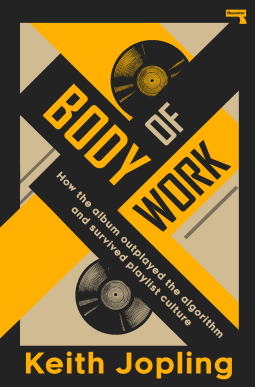
Body of Work
How the album outplayed the algorithm and survived playlist culture
This title was previously available on NetGalley and is now archived.
Send NetGalley books directly to your Kindle or Kindle app
1
To read on a Kindle or Kindle app, please add kindle@netgalley.com as an approved email address to receive files in your Amazon account. Click here for step-by-step instructions.
2
Also find your Kindle email address within your Amazon account, and enter it here.
Pub Date 10 Feb 2026 | Archive Date 10 Feb 2026
Repeater Books | Repeater
Talking about this book? Use #BodyofWork #NetGalley. More hashtag tips!
Description
Since 1999, the album has been declared dead more times than we can count—yet it refuses to disappear. Body of Work traces its turbulent journey through the digital era and asks why listening in forty-minute chunks still matters.
Weaving insider accounts with cultural history and personal reflection Jopling tells the story of the album’s unlikely survival. From bloated CD culture to Napster’s atomization, from Apple’s unbundling to Spotify’s shuffle wars (and Adele’s famous intervention), the album has not only endured, it has re-emerged stronger than ever.
Body of Work makes the case that the album remains the perfect vessel for the art of song—the format every artist aspires to, even after decades of digital disruption. As producer and artist Jack Antonoff (Bleachers) put it: “the album is God.” It is the defining artform of popular music, and it always will be.
Available Editions
| EDITION | Other Format |
| ISBN | 9781917516334 |
| PRICE | $14.95 (USD) |
| PAGES | 176 |
Available on NetGalley
Available to Buy
Buy on Amazon Buy on Bookshop.org Buy on WaterstonesAverage rating from 4 members
Featured Reviews
 Michael J, Educator
Body of Work is an engaging and informed exploration of how the album has resisted the threat of streaming and digital ubiquity. It author has long experience of working in the music business, but more importantly draws on his experience of presenting the podcast, The Art of Longevity, where he has interviewed an impressive range of musicians. Many quotes from the podcast appear in the book, along with stats and key moments such as Adele's defiance of Spotify's default shuffle feature. It is full of interesting observations like "Individual songs, untethered from albums, just weren't that interesting" and it is undeniable that there is something about the vinyl-length album which is remarkably enduring. I would have liked more focus on individual albums and what makes them appeal to the author personally, which is saved for the brief discussion of 25 albums that helped the album survive and new albums by older bands at the end of the book, which are a little bland in places. But this is a really enjoyable overview of what remains to me an important topic.
 Mae B, Reviewer
This was an interesting read that I devoured pretty quickly. It examines the album and the way it is consumed as well as well as its place in the future. I liked reading about music history and how the format of music ( vinyl, tapes, cds and streaming) progressed. I appreciated learning about how these different formats led to new challenges.. I wish there was more info on how listeners consume music but it highlighted how listeners have changed and what that means moving forward. Also liked the list at the end of albums. Although it really should have started in the 90’s. (No Lauryn Hill or Alanis?) Come on. This was a solid book on a fascinating topic that I wish was discussed more.
Readers who liked this book also liked:


Valeria Luiselli
General Fiction (Adult), Multicultural Interest, Women's Fiction
Kenneth Womack; Scott Freiman
Entertainment & Pop Culture, Nonfiction (Adult)