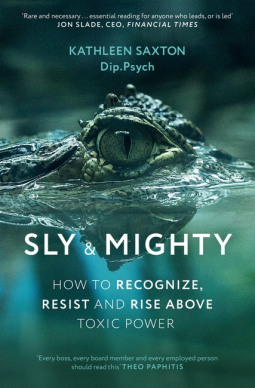
Sly and Mighty
How to Recognize, Resist and Rise Above Toxic Power
Sign In or Register Now to see if this title is available for request.
Buy on Bookshop.org Buy on WaterstonesSend NetGalley books directly to your Kindle or Kindle app
1
To read on a Kindle or Kindle app, please add kindle@netgalley.com as an approved email address to receive files in your Amazon account. Click here for step-by-step instructions.
2
Also find your Kindle email address within your Amazon account, and enter it here.
Pub Date 24 Sep 2026 | Archive Date 9 Oct 2026
John Murray Press US | Sheldon Press
Talking about this book? Use #SlyandMighty #NetGalley. More hashtag tips!
Description
The groundbreaking new book which exposes the psychology of destructive leadership and how to rise above it
'Rare and necessary... essential reading for anyone who leads, or is led.' ⭐⭐⭐⭐⭐ - Jon Slade, CEO, Financial Times
'Every boss, every board member and every employed person should read this.' ⭐⭐⭐⭐⭐ - Theo Paphitis, Dragon, Entrepreneur and Retail Champion
'An essential guide to power, politics and personality at work." ⭐⭐⭐⭐⭐ - Anna Jones, CEO, The Telegraph
'Indispensable... I will be recommending it.' ⭐⭐⭐⭐⭐ - Prof. Andrew Stephen, Saïd Business School, Oxford
We are all, at times, awakened by the courage of another.
Great leadership expands us: possibility, conviction, a sense of what we might become.
But where there is light, there is also shadow.
Across boardrooms, staffrooms and communities, a corrosive style of leadership has taken hold, rooted in narcissism and Dark Triad traits, low in empathy, high in control and quietly destructive. It erodes confidence, silences dissent and leaves lasting harm.
'Sly and Mighty' names it, and shows you what to do next.
Drawing on an extraordinary triple perspective as a global board-level executive, leadership headhunter and acclaimed psychotherapist, Kathleen Saxton brings a uniquely full-spectrum lens to how toxic power operates, and why it is so often allowed.
Combining high-stakes case studies with the latest research on narcissism and workplace dynamics, this book helps you to:
🐊 Spot the warning signs early
🐊 Stop enabling what you know is wrong
🐊Decide how to challenge, navigate or leave
🐊 Reclaim your confidence and assert your agency
'Sly and Mighty' bears witness to recognition, resistance and recovery - because leadership should never diminish you, or anyone else.
Advance Praise
'Rare and necessary... essential reading for anyone who leads, or is led.' ⭐⭐⭐⭐⭐ - Jon Slade, CEO, Financial Times
'Every boss, every board member and every employed person should read this.' ⭐⭐⭐⭐⭐ - Theo Paphitis, Dragon, Entrepreneur and Retail Champion
'An essential guide to power, politics and personality at work." ⭐⭐⭐⭐⭐ - Anna Jones, CEO, The Telegraph
'Indispensable... I will be recommending it.' ⭐⭐⭐⭐⭐ - Prof. Andrew Stephen, Saïd Business School, Oxford
Available Editions
| EDITION | Other Format |
| ISBN | 9781399836876 |
| PRICE | £16.99 (GBP) |
| PAGES | 256 |
Available on NetGalley
Available to Buy
Buy on Bookshop.org Buy on WaterstonesAverage rating from 4 members
Featured Reviews
 Demetris P, Reviewer
Champagne on Sunday, Fired on Monday: Kathleen Saxton’s Guide to the Two Faces of Workplace Power
“Sly and Mighty” begins with charismatic leaders and ends somewhere more interesting: with the people beneath them learning that they do not need the boss’s permission to believe their own experience.
By Demetris Papadimitropoulos | August 28th, 2026
During a Sunday at Wimbledon, Greg drinks champagne with Robert, the chief executive he has worked with for six years. They laugh in the summer sun, stay late in the VIP tent and speak as if nothing is wrong. On Monday morning, Greg walks into a room where HR is waiting. Robert arrives cold, almost unrecognizable, and dismisses him. Kathleen Saxton recounts the episode in “Sly and Mighty: How to Recognize, Resist and Rise Above Toxic Power” as more than workplace betrayal. What keeps disturbing Greg is the twelve-hour gap between Sunday’s warmth and Monday’s erasure. Which Robert was real? Inside an organization, the more consequential question is who gets to write the answer into the record.
Even before Saxton begins naming narcissistic traits, manipulation or coercion, that question is already humming beneath the book. “Sly and Mighty” is ostensibly about toxic bosses, but its deeper contest is over interpretive authority: the moment a leader’s account of an employee starts to outrank the employee’s memory, competence, judgment or sense of proportion. Cruelty becomes “standards,” isolation “performance management,” volatility “passion,” retaliation “fit.” HR can convert injury into process; colleagues can become careful; a personnel file can acquire the confidence its subject has lost. Eventually the employee may begin performing the institution’s argument internally, rereading emails and wondering whether the problem was ever a problem at all.
Much of the book tries to arrest that handover. Drawing on her experience as an executive, C-suite headhunter and psychotherapist, Saxton moves from our attraction to confident leaders through charisma, narcissistic and Machiavellian traits, psychopathy, attachment, belonging, silence, bullying, self-doubt, recovery and institutional accountability. The itinerary is crowded. Its logic, though, is clear: destructive leadership is rarely only a personality problem. It takes shape between a person and a hierarchy, then travels through appraisal systems, reputational networks, economic dependence and the body’s response to threat. Saxton’s widest claim is that a bad boss becomes something larger when an organization keeps supplying cover.
Early chapters explain why the trap can feel like opportunity. Human beings, Saxton argues, do not approach leaders as detached evaluators. We want steadiness, recognition, protection and membership. The charming executive therefore arrives not as a warning but as an answer. Praise feels like recognition. Attention feels like sponsorship. Certainty feels like safety. Withdrawal acquires force because these things once mattered. Saxton is especially sharp on intermittent warmth: the boss who wounds, then rewards; freezes someone out, then suddenly includes them; makes approval scarce enough that an employee starts working for the return of a relationship that may never have been as secure as it seemed.
The book becomes most exact when it leaves spectacular villains behind and attends to acts an organization has trouble recording. Chapter 6, “The silence of the sly,” contains its finest analysis. Meeting invitations stop arriving. Emails go unanswered. Information appears late or not at all. Ideas circulate without their author’s name. A manager withholds acknowledgment rather than issuing an overt threat. None of this leaves a satisfying bruise for the file. There may be no sentence clean enough for a grievance form. Yet silence from someone who controls access, reputation and opportunity can punish without paperwork. Saxton understands the bureaucratic advantage of harm that looks, one incident at a time, like nothing much.
Repeated across a group, that silence acquires weight. Colleagues who once chatted become guarded. Witnesses decide that solidarity is expensive. The isolated employee now has two problems: the treatment itself and the disappearance of corroboration. Robin Stern’s “The Gaslight Effect” is a useful cousin in its attention to destabilized perception, while Jean Lipman-Blumen’s “The Allure of Toxic Leaders” helps explain why followers remain attached to harmful authority. Saxton changes the stakes by putting those dynamics on payroll. You cannot simply leave the room when the room controls your salary, references and future.
In Chapter 7, “The erosion of the self,” the argument reaches its psychological hinge. The toxic leader is no longer someone behaving badly out there. The employee has begun to change in here. They anticipate moods, rewrite emails, rehearse sentences, replay meetings, avoid visibility, distrust praise, absorb criticism and become fluent in self-censorship. “Erosion” is exact because there need not be a single catastrophic event. A self can be worn down by increments. Eventually someone who entered a job with ordinary confidence is devoting extraordinary intelligence to avoiding danger. Survival starts impersonating personality.
Precisely because Saxton takes that injury seriously, she resists the breezy “just leave” instruction that weakens so much workplace self-help. Chapter 9’s “stay, play, or slay” framework acknowledges that jobs come attached to mortgages, health care, visas, equity, families, reputations and markets. Sofia, one of Saxton’s clearest case studies, learns to become “strategically boring”: fewer apologies, calmer emails, decisions confirmed in writing, private ethical red lines. She also builds relationships beyond her boss’s control, creating a professional reputation capable of travelling without permission. Eighteen months later she leaves for a better role. The victory is quieter than revenge and more convincing: she can say she did not lose herself.
After seven chapters teaching the reader to study the leader, “Sly and Mighty” begins to demote that leader. Chapter 8 turns from explanation to acceptance – the recognition that the pattern is real and may not yield to one more perfectly phrased conversation. Chapter 10, “Radical rehabilitation,” asks what the reader misses about themselves: concentration, humor, courage, ease, the ability to speak without editing every clause for possible punishment. By Chapters 11 and 12, attention widens again to law, boards, whistleblowers, governance and collective action. The antagonist who once filled the frame keeps getting smaller.
Power shifts because the book’s attention shifts. “Sly and Mighty” begins by asking why destructive leaders rise and ends by asking what everyone else will do once they see clearly. The middle step matters: before Saxton can talk about recovery, she has to show how a workplace problem becomes a private reflex. That gives the later practical chapters more weight than a checklist of “red flags” would have had. Recovery begins, in Saxton’s design, when the boss is no longer the most important person in the employee’s inner life.
A Saxton sentence often wants to leave you with something portable. Explanation gives way to short emphatic units and parallel clauses; she favors mnemonic oppositions such as charisma and character, confidence and competence, survival and flourishing, understanding and excuse. The metaphors are equally handy: poison, weather, architecture, masks, spells, erosion, shrinking, rehabilitation and, finally, rockets. They make diffuse experiences legible. “Spell” is especially apt for the state in which someone suspects manipulation yet remains attached to the hope that one last adjustment will restore safety. Saxton likes to give a feeling a noun and then hand the noun back to the reader as equipment.
Declarative certainty is also where that gift starts to work against her. A writer trying to return clarity to readers made uncertain naturally prefers firm lines, and Saxton can be bracing after pages of gaslighting and corporate euphemism. But she sometimes clarifies past exactness. Narcissistic traits, narcissistic pathology, Machiavellian behavior, psychopathy, unresolved childhood trauma, coercion, bullying, bad management and criminal predation are not interchangeable categories. Saxton explicitly warns against amateur diagnosis and notes that trauma does not doom anyone to toxicity. Still, her rhetoric often places these ideas so close together that the caveats have to work overtime to keep their borders intact.
If Saxton’s categories blur anywhere, they blur most visibly in the public examples. Larry Nassar, Harold Shipman, Bernie Madoff and Harvey Weinstein demonstrate how charm, authority and institutional protection can shelter devastation. Saxton says plainly that such cases are extreme. Extremity, however, has gravitational pull. Set beside an abusive executive or manipulative department head, criminal predation can lend ordinary workplace dysfunction a borrowed moral temperature. The weakness is not that Saxton takes humiliating bosses too seriously. It is that the book does not always separate cleanly the gradations of conduct it wants us to recognize. Its appetite for a comprehensive theory of toxic power can make analogy feel like continuity.
More troubling is the way the psychotherapeutic account occasionally becomes a master key. Saxton is thoughtful about childhood adversity, shame, insecure attachment and the possibility that traits rewarded as relentless ambition or control may begin as old survival strategies. Her humane point is that a wound can explain conduct without licensing it. But developmental injury is only one route into destructive leadership. Incentives, ideology, opportunism, weak governance, incompetence, status competition and plain selfishness can do plenty without a buried childhood cause. Saxton knows organizations matter, yet her clinical lens can become so absorbing that rival explanations end up as supporting actors in their own system.
If the prose sometimes overstates, it also understands why understatement has failed. Corporate language is remarkably good at laundering human experience. A person is “not resilient” rather than exhausted by arbitrary humiliation. A leader is “demanding” rather than frightening. Turnover is unfortunate, morale is soft, a complaint is complicated, and the employee who raises it may soon develop a mysteriously untidy performance record. Saxton’s refusal of those euphemisms is one reason injured readers may feel recognized. She writes as though work deserves the moral seriousness we apply elsewhere, not because every bad meeting is trauma, but because a pay cheque does not suspend the ordinary requirements of dignity.
The book does not need topical scaffolding, though it happens to have some. Saxton’s chapters on enforced silence and whistleblowing arrive amid renewed scrutiny of confidentiality agreements, retaliation and the procedures that keep workplace harm private. Economic insecurity makes her resistance to easy exit advice more persuasive as well. The deeper relevance lies in an older institutional trick: many people can know the same thing privately while each has a reason to behave as though they do not. “Sly and Mighty” is diagnostic because it understands how often power survives by making truth more expensive than silence.
Right at the end, Saxton offers her strangest and most successful formulation: “love and rockets.” Love means retaining humanity without volunteering for further injury. Rockets are the things that keep mercy from turning into permission: documentation, boundaries, consequences, governance, collective courage. The phrase initially risks sounding destined for canvas tote bags, but Saxton earns it because it resolves a tension she has carried for hundreds of pages. The damaged leader may deserve understanding. The people around that leader deserve protection. Mercy without consequence can become an elegant way of billing the less powerful person for somebody else’s pain.
Only then does the title’s “mighty” change hands. At the start, might belongs to the charismatic executive with title, access and institutional cover. By the final pages, Saxton relocates it into coalition. Evidence finds witnesses; private complaint becomes organizational concern; people trained to survive separately discover that coordinated refusal can alter what authority is permitted to do. Amy C. Edmondson’s “The Fearless Organization” offers an affirmative account of psychological safety; Saxton writes something closer to its photographic negative, showing what happens when fear becomes ordinary infrastructure and what it takes to dismantle it.
Praise should stop short of a rave. “Sly and Mighty” earns 83/100, or 4/5 Goodreads stars: often piercing, practically attentive and more formally intelligent than its self-help packaging might suggest, but held below the top tier by repetition, rhetorical heat and an explanatory system that sometimes wants jurisdiction over too much. Saxton is better at recognizing patterns than at deciding exactly where one pattern stops and another begins. In a book about environments that teach people to doubt what they see, that asymmetry is revealing rather than incidental.
One could finish “Sly and Mighty” thinking its central instruction is to identify toxic people sooner. Saxton is after something harder. The deepest freedom she imagines is not getting the harmful leader to confess, apologize, understand, reform or finally agree with your account. It is reaching the point at which their agreement is no longer required. Greg’s Monday cannot make his Sunday coherent. No HR document can reconcile those two Roberts after the fact. What can return is the faculty power taught him to mistrust: the quiet ability to look at both days, hold the contradiction without surrendering to it, and know what he saw.
 Educator 619740
Sly & Mighty is about identifying, understanding, surviving, and recovering from toxic leaders. The first part of the book discusses the psychology of these types of leaders and what structures help them not only rise to the leadership but also be supported and enabled in causing harm.
From there, the book provides strategies for determining a course of action if you are in a workplace with one or more leaders causing harm. It also provides information about the costs to one's nervous system, immune system, etc., and how to recover.
I found it hard to put down. It explained so much about what I'd experienced in a former workplace. It also gave me tools that I can use if I encounter a leader like this again. Most of all, though, it helped me feel less alone, and it helped heal me a bit to read this.
I think this is a book that many would benefit from reading. It's fascinating and--if you've experienced leaders like this--validating.
Readers who liked this book also liked:

Samantha Flynn
Biographies & Memoirs, Business, Leadership, Finance, Health, Mind & Body


Alec Litowitz
Business, Leadership, Finance, Nonfiction (Adult), Self-Help

Roger Magalhaes
Biographies & Memoirs, Business, Leadership, Finance, Nonfiction (Adult)

Michele Jolin
Business, Leadership, Finance, Nonfiction (Adult), Politics & Current Affairs