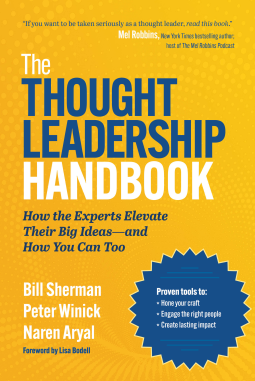
The Thought Leadership Handbook
How the Experts Elevate Their Big Ideas—and How You Can Too
This title was previously available on NetGalley and is now archived.
Send NetGalley books directly to your Kindle or Kindle app
1
To read on a Kindle or Kindle app, please add kindle@netgalley.com as an approved email address to receive files in your Amazon account. Click here for step-by-step instructions.
2
Also find your Kindle email address within your Amazon account, and enter it here.
Pub Date 21 Jul 2026 | Archive Date 26 Aug 2026
Talking about this book? Use #TheThoughtLeadershipHandbook #NetGalley. More hashtag tips!
Description
Discover the tools and traits of the leaders who shape the world’s big ideas.
Thought leadership can feel lonely because most practitioners only see their own struggles—late-night doubts, exhilarating breakthroughs, and the messy middle no one talks about.
The Thought Leadership Handbook pulls back the curtain on a discipline that often feels like improvisation to bring clarity and a common vernacular that will help define the industry going forward. It’s a groundbreaking work for the executives, speakers, visionaries, and above all, thinkers across industries who dedicate their lives to making a lasting difference.
Bill Sherman and Peter Winick of Thought Leadership Leverage have guided hundreds of clients to amplifying their messages. Their more than 700 conversations on their award-winning podcast Leveraging Thought Leadership form the backbone of this handbook, as they skip the predictable “expert questions” and instead explored the lived journey of being a thought leader. Along with publishing industry expert Naren Aryal, they translate those vulnerable conversations into a practical, deeply insightful field guide. Across thousands of stories, patterns emerged, leading to five thought leadership avatars—Growth-Minded CEOs, Impact and Legacy Executives, Thought Leaders on the Run, In-House Experts, and Hall of Fame Thinkers—that provide context to help you elevate your goals and strategies in this dynamic sphere of influence.
The Thought Leadership Handbook reveals the patterns you can’t see alone. With candid case studies, proven frameworks, and hands-on tools, you’ll identify your path, sharpen your strategy, and take confident steps forward—whether you’re seeking sustainability, scale, or a legacy of impact.
Advance Praise
“If you want to be taken seriously as a thought leader, read this book.”
—Mel Robbins, New York Times bestselling author; host of The Mel Robbins Podcast
“If you’re an expert eager to share your insights with a wider audience, buy this book, use it, and watch your influence grow! Bill Sherman, Peter Winick, and Naren Aryal have been guiding leadership experts for decades. Their book is the most comprehensive, practical, and inspiring resource I’ve seen on sharing your message with the world.”
—Ken Blanchard, coauthor, The One Minute Manager and The Secret: What Great Leaders Know and Do
“Many books celebrate ideas; far fewer show how to steward them responsibly into the world. The Thought Leadership Handbook stands out for the clarity, rigor, and real-world wisdom it brings to scaling meaningful ideas while honoring their integrity. It is an exceptional and timely guide for anyone serious about moving ideas from insight to enterprise, and from aspiration to lasting impact and meaningful contribution.”
—Stephen M. R. Covey, New York Times and #1 Wall Street Journal bestselling author, The Speed of Trust and Trust and Inspire
“You don’t need more followers. You need more impact. I’ve seen brilliant minds stall out because they never built systems to spread their ideas. This book hands you the tools to build reach, relevance, and revenue without wasting time.”
—Keith Ferrazzi, founder, chairman, and CEO, Ferrazzi Greenlight; New York Times bestselling author, Never Eat Alone, Who’s Got Your Back, and Never Lead Alone
“Every thought leader asks two questions: Are my ideas good enough? How can I create more impact? The Thought Leadership Handbook gives you the frameworks and tools you need to answer both. Sherman, Winick, and Aryal show you how to strengthen your ideas and multiply your reach.”
—Deanna Mulligan, CEO, Ceres Life Insurance; former president, CEO, and board chair, Guardian Life Insurance of America
“It’s never been harder to be heard as a thought leader. This book gives you the tools to find your audience and scale your impact.”
—Michael Bungay Stanier, author, The Coaching Habit
“Your expertise only creates value when you share it. You owe it to others to get this right. This book teaches you how better than anything I’ve read. Bill, Peter, and Naren have written the landmark book on thought leadership. Read it.”
—Marshall Goldsmith, author, What Got You Here Won’t Get You There; Thinkers50 Hall of Fame; founder, 100 Coaches
Available Editions
| EDITION | Hardcover |
| ISBN | 9798891385320 |
| PRICE | $30.00 (USD) |
| PAGES | 304 |
Links
Available on NetGalley
Available to Buy
Buy on Bookshop.org Buy on WaterstonesAverage rating from 7 members
Featured Reviews
 Melanie G, Reviewer
As someone who works in content marketing and spends a lot of time helping subject matter experts turn their knowledge into articles, white papers, presentations, and other content, I found plenty to appreciate in The Thought Leadership Handbook. The authors break down what thought leadership actually is, how it differs from self-promotion, and why credibility and expertise matter. I liked that the book treats thought leadership as a long-term practice built on sharing valuable ideas rather than chasing visibility for its own sake. While some concepts were familiar to me from my own work, I still found useful frameworks and examples throughout. I came away with a few new ideas and a renewed appreciation for the work involved in developing and communicating expertise effectively.
 Demetris P, Reviewer
The Custody of Ideas
How “The Thought Leadership Handbook” recasts influence as stewardship, structure, and the art of becoming less necessary
By Demetris Papadimitropoulos | June 11th, 2026
Don’t ask whether “The Thought Leadership Handbook” will make you a thought leader. That is the dull question, the one the book keeps nudging toward the conference-hotel recycling bin with the spent lanyards, cracked badge holders, and emergency granola bars. Bill Sherman, Peter Winick, and Naren Aryal are after a harder bargain. What happens when expertise has to leave the flattering air around the expert and become clear enough, durable enough, and applicable enough for someone else to carry? Their book is certainly about influence, but its better instinct is sterner than promotion. An idea that cannot travel without you may be precious, lucrative, even beloved, but it is not yet work others can use without ceremony.
Eduardo Briceño’s blackout opens the book with almost suspicious neatness. He wakes in Santa Fe shortly after midnight, ninety-five minutes before a virtual keynote for senior partners at Boston Consulting Group, and discovers that his house, neighborhood, and carefully prepared setup have gone dark. His fix is both absurd and exact: a driveway desk, two cars angled so their headlights can replace studio lighting, a phone hotspot, an external battery pack, and a speaker about learning while performing forced to do precisely that. The scene is the book’s first test. Expertise under stress is not what you say when the slides advance and the Wi-Fi purrs. It is what still works when the room goes black.
Most of the book turns such scenes into equipment: small enough to carry, sturdy enough to reuse. Sherman and Winick bring two decades of consulting through Thought Leadership Leverage and more than seven hundred conversations on the “Leveraging Thought Leadership” podcast; Aryal brings the publishing vantage of Amplify Publishing Group. Together they try to rescue a term polished nearly smooth by overuse by giving it parts one can actually inspect: Hobbyist, Practice Owner, Business Builder; Core Ideas, Content Library, Market Offerings, Platform Identity; Impact Equation; personal velocity; system velocity; audience share. Readers allergic to capital-letter frameworks may feel trapped in a seminar room where the dry-erase markers have begun reproducing in secret. Readers who have tried to move a serious insight through a noisy market may feel the slightly humbling relief of being named.
Even the book’s most market-facing terms are animated by the fear of miscast success. Keith Ferrazzi becomes the sharpest warning. After an “Inc.” article frames him as a master networker, the world decides what it wants from him before he has fully decided what he wants to give. “Never Eat Alone” becomes a huge success, but the market-bought label sticks too tightly. Ferrazzi wants to talk about meaningful relationships, vulnerability, and high-performing teams; the market wants “the networking guy.” The book understands what a shinier handbook might miss: success can be a cage with very good lighting. Sometimes the spotlight is also the lock.
This is prose written for uptake. Its sentences are mostly medium-length, orderly, and consultant-clear: they set up a problem, move through a case, name the pattern, and hand the pattern back to the reader as a tool. Chapter openings often have narrative snap – a blackout, a failed workshop, an identity trap, an aging thinker confronting mortality – and then the prose shifts into explanation. It rarely surprises as language. It does not loiter or brood. Still, its plainness has a purpose, and plainness is no small virtue in a book about people who too often mistake a diagram for an argument and a keynote for a calling.
Rather than imitate the aphoristic compression of “The Coaching Habit” by Michael Bungay Stanier or the slow-burn strategy of “The Long Game” by Dorie Clark, this book belongs closer to “The Business of Expertise” by David C. Baker, though Sherman, Winick, and Aryal are warmer, more anecdotal, and more invested in books, platforms, and late-career transmission than in advisory-firm discipline alone. That is the shelf where the book most naturally sits: not inspiration, not pure marketing, but the business of making knowledge portable. Expertise becomes language; language becomes offerings; offerings become repeatable practice; practice, if the scaffolding holds, outlives the practitioner’s calendar.
Its arrangement matters. Section One establishes the operating parts: what kind of practice one is building, which elements are missing, how usefulness compounds. Section Two sorts practitioners not by job title but by motive: Growth-Minded CEOs, Impact and Legacy Executives, Thought Leaders on the Run, In-House Experts, Hall of Fame Thinkers. Section Three steps back to argue that the field owes more to the knowledge commons, especially around publishing. Section Four becomes a workbook. Anecdote becomes method; method becomes self-diagnosis; self-diagnosis, with business-book inevitability, becomes homework. The design says, with only slightly better manners, that an idea is unfinished until someone else can use it without asking you to fly in and explain it again at 8:00 a.m. in Ballroom C.
Public expertise has a body, and the book keeps noticing the body. In cheaper treatments, thought leadership is all gleam: the book deal, the viral clip, the standing ovation, the branded framework ready for laminated immortality. Here, the authors keep returning to the toll. Speakers’ calendars become distribution channels. Executives watch authority evaporate with their titles. In-house experts must speak as both company representative and independent mind. Older figures wonder whether their best work will survive them. The chapter on Hall of Fame Thinkers is the most charged because it shifts the question from “How do I become more visible?” to “How do I become less necessary?” That reversal gives the book a surprising ache.
As a handbook, it is generous with handles. Lisa Bodell’s “Kill the Company” exercise shows how improvisation can reveal a core offering. Stephen M. R. Covey’s work on trust illustrates how simplicity and relevance allow an idea to move beyond a single room. Dorie Clark’s digital diversification demonstrates system velocity. Marshall Goldsmith’s 100 Coaches turns generosity into transmission through community rather than possession. The examples are sometimes compressed until a career’s rough weather becomes a neat lapel badge, but the compression is not careless. It is the price the book pays for teachability.
Problems start when the distillation grows too pleased with itself. The book often follows a reliable pattern: introduce a practitioner, identify a problem, reveal a framework, extract a lesson. This is satisfying, and occasionally too satisfying. Human complication is invited into the room, but only if it agrees to wear a name tag and sit near its assigned concept. The Five Avatars are useful, but anyone who has lived near ambition knows that motives rarely stay in separate cubbies. A CEO may also be a legacy builder, a runner, an institutional voice, and a private anxious person wondering whether anyone will remember the work after the applause has been folded away with the chairs.
A contradiction sits right on the invoice. The book wants to distinguish usefulness from attention, stewardship from ego, service from self-promotion. It does so sincerely and often persuasively. Yet it also teaches readers how to sharpen market offerings, build platform identity, increase velocity, grow audience share, pitch book ideas, and turn expertise into revenue. That tension is not hypocrisy. Sherman, Winick, and Aryal are writing from within the ecosystem they are trying to reform: speakers, consultants, publishers, executives, authors, blurbers, clients, podcast guests, coaches, and specialists in the art of making specialists legible. The book is cleanest when it admits this. It is weakest when its ethical vocabulary sounds as though it has fully purified the revenue apparatus humming beneath it.
Despite that pressure, the authors have heard the groan that follows the phrase they are trying to rescue. Chapter 12, “The Duty to Speak,” is the boldest turn: confession, manifesto, and defense of a term with a reputation problem large enough to require its own ballroom. The authors acknowledge that too much of their knowledge has sat behind consulting fees. Their response is not to pretend money has disappeared from the room, but to argue for a knowledge commons in which useful, imperfect insights are shared responsibly rather than hoarded until some impossible standard of completion is met. The chapter asks what experts owe the world when noise is cheap, certainty is performative, and silence can be a luxury disguised as rigor.
Ideas now move through a crowded public square where nearly everyone can publish, post, brand, and broadcast. The book does not need to shout about the newest tool heap to feel current; the pressure is already in the walls. Its answer is not more volume, and it is not monkish withdrawal. It argues for better custody: clarify the idea, test whether anyone can apply it, know the audience, build the machinery, and accept responsibility for how the idea moves. Its seriousness does not glitter, but it has checked the map.
More skeptical readers may still balk at “thought leadership,” a phrase that can make even worthwhile insights sound trapped in a LinkedIn carousel. The authors have anticipated the wince. Their book insists, often and sometimes too often, that thought leadership is not volume, persona, polish, or mere expertise. It is the practice of shaping knowledge so others can act on it. The insistence is necessary, but the repetition shows. At times the book seems to be arguing with a heckler it has brought along for the tour.
It helps that the book’s least flattering insight is aimed at experts themselves. Knowing something deeply does not mean knowing how to teach it, scale it, publish it, protect it from distortion, or let it evolve outside one’s presence. This is the book’s most useful humility. The expert is not treated as a genius waiting to be amplified, but as bottleneck, carrier, translator, and sometimes obstacle. The ego may come hoping for a coronation; the book hands it a process map and asks where the content library is.
The publishing chapters are revealing because they turn the book toward its own medium. Aryal’s account of Mascot Books and Amplify gives the section a personal through-line, while the discussion of traditional, hybrid, and self-publishing brings in the practical realities of authority, cost, control, and reach. The book makes a strong case for long-form publishing not as a vanity milestone but as a vessel for sustained argument. Against the drip-feed of posts, pages, clips, and talks, a book can still ask whether an idea bears weight for longer than twenty minutes.
Readers looking for sentence-level glamour – unruly music, formal daring, a voice that makes its own weather – will not find much of it here. Its craft lives less in the sentence than in the scaffolding. The book’s recurring motifs are designed to be remembered: darkness and light, mirrors, velocity, bottlenecks, ideas traveling without their originator. These images are not ornamental; they are memory devices. “The Uncomfortable Mirror” is both a chapter title and a method. “Illuminating the Darkness” is both Eduardo Briceño’s emergency workaround and the book’s vision of public expertise. The book packages experience so it can move, which is both its method and its tell.
Occasionally, that package rounds the blade. A failed keynote becomes a lesson in non-transferable charisma. A career shift becomes a model. Mortality becomes succession planning. This is not false, but it is tidier than life. The book’s briskness can make pain look as if it arrived early for the workshop. Still, one should not punish a handbook for being a handbook. Its job is to help the reader build the roof and label the tools, not to stand in the rain admiring the storm.
Precisely because of that practicality, the book is most useful to readers already within its weather: consultants, executives, speakers, coaches, business authors, in-house specialists, and founders trying to make hard-won knowledge travel farther than their calendars can carry. General readers may find the machinery too trade-facing. But the intended audience will recognize the anxieties: the idea that lands but does not scale, the keynote that works only when the founder delivers it, the book proposal that mistakes subject for argument, the platform that grows while the core idea remains cloudy, the public identity that starts helping and then quietly becomes a trap.
On the evidence of the whole book, 76/100 and 3/5 stars on Goodreads feels right for “The Thought Leadership Handbook.” The temperature is deliberate: this is a strong, favorable, high-3-star business book, not a transcendent one. It is too usable, coherent, and alert to the emotional costs of public expertise to dismiss; it is too embedded in its own industry, too reliant on framework compression, and too repetitive in its self-defense to feel broadly exceptional. It is best at diagnosis. It gives names to problems many experts already have, which is not the same as solving them, but is often the beginning of relief.
Under the avatars and equations sits the book’s best test: can anyone actually use this when the expert is gone? The authors return to that question because it keeps the enterprise from floating away into prestige fog. Be applicable before you try to be admired. Be clear before you scale. Build the thing that allows the insight to keep working when you are tired, misquoted, booked elsewhere, retired, replaced, or gone. That ethic gives the book its finest seriousness. It is not asking experts to disappear; it is asking them to build with enough generosity that disappearance is no longer fatal to the work.
Like many books about influence, “The Thought Leadership Handbook” is partly a map of ambition. Unlike many, it is unusually interested in ambition’s afterlife. What happens after the ovation, the bestseller, the consulting spike, the founder story, the carefully titled model? What remains when the expert is no longer in the room? The book’s answer is both practical and quietly chastening: the content library, the trained community, the book, the offering, the language others can repeat without mangling, the idea simple enough to remember but strong enough to matter.
Ownership is the wrong word for the book’s deeper subject; custody is closer. Who holds an idea? Who improves it? Who carries it when the originator cannot? Who has permission to teach it, adapt it, or send it farther down the road? These are better questions than the usual platform questions, and the book deserves credit for asking them from inside a field that too often confuses amplification with meaning. If some passages still sound like the industry drawing its own charter on very good stationery, the charter at least tries to include obligations, not only privileges.
So the lasting image is not the expert at the podium, though there are plenty of podiums here. It is Briceño in the driveway, headlights cutting through the dark, making the smallest possible stage because the idea still has to be delivered. The scene is almost too tidy, but it holds. “The Thought Leadership Handbook” is best understood as a book about building those headlights before the blackout: not so the expert can be more brightly seen, but so the work can keep finding its way when the expert is no longer the main source of light.
 Mike M, Media/Journalist
Everybody knows you can force a man's back to work, but what about his mind? This book will show the reader how to lead their thoughts as well.
 Marta E, Reviewer
The opening story is the one that stuck with me: a consultant waking up ninety minutes before a virtual keynote to discover his entire neighborhood has lost power, and improvising a driveway desk lit by car headlights to deliver the talk anyway. It's such a perfect encapsulation of what this book is actually about, expertise isn't what you say when everything is working, it's what still holds up when it isn't.
The five avatars framework, sorting practitioners by motive rather than job title, is genuinely useful, and I found myself mapping people I know onto it almost immediately. The chapter on Hall of Fame Thinkers hit hardest for me, the shift from "how do I become more visible" to "how do I become less necessary" reframes the whole idea of building a legacy in a way I hadn't considered. That said, the book leans hard into consultant-speak, capital letter frameworks, equations, avatars, velocity metrics, and if that style isn't your thing, it can start to feel like sitting through a seminar. It also has a habit of introducing a person, naming their problem, revealing a framework, and moving on, which is satisfying at first but starts to feel a little formulaic by the back half, and there's an unresolved tension in a book about stewardship over self-promotion that is, at the end of the day, still teaching you how to build platform identity and grow audience share.
Best suited for consultants, speakers, and executives already living in this world rather than general readers, but for that audience, there's real, usable insight here.
 Nix C, Reviewer
An essential guide with practical, actionable tools!
The Thought Leadership Handbook by Bill Sherman, Naren Aryal, and Peter Winick is an incredibly informative and enjoyable read. If you’ve ever wondered how to transition from simply having good ideas to building a structured, high-impact presence in your field, this book provides the roadmap. As I was reading it, I was plotting how I can turn my own blog posts and LinkedIn entries into something more. How I can share my knowledge, how I can serve.
The authors do a fantastic job breaking down the strategy behind thought leadership, notably covering everything from evaluating whether you operate as a hobbyist or business builder, to deep-diving into the "Five Avatars" of thought leadership: The Growth-Minded CEO, The Impact and Legacy Executive, The Thought Leader on the Run, The In-House Expert, and The Hall of Fame Thinker.
My favourite part was Section 4. While the theoretical frameworks in the first three sections are excellent, Section 4 is where the real magic happens. The authors provide concrete resources, including worksheets, questionnaires, and links to online materials, all designed to accelerate impact. Taking the time to work through these exercises will create a clear plan of action.
Highly recommended for anyone looking to make a meaningful, strategic impact with their expertise!
Thank you to NetGalley and Amplify Publishing for providing an ARC in exchange for an honest review.
 Reviewer 2103742
I enjoyed reading this book and learning about Thought Leadership. This is not a subject matter I am all too familiar with, however, as I start to lead more diverse teams professionally, I have found this very insightful. I thought the structure of the book made it easy to dip in and out. I would recommend this book.
Readers who liked this book also liked:

Tony Castro
Biographies & Memoirs, Entertainment & Pop Culture, Nonfiction (Adult)





Sudipta Mitra
Health, Mind & Body, Science, Self-Help


Jerome Puryear, MD
Health, Mind & Body, Nonfiction (Adult), Self-Help