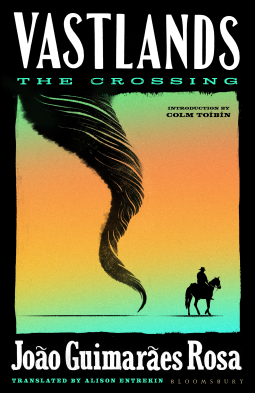
Vastlands
The Crossing
Sign In or Register Now to see if this title is available for request.
Buy on Bookshop.org Buy on WaterstonesSend NetGalley books directly to your Kindle or Kindle app
1
To read on a Kindle or Kindle app, please add kindle@netgalley.com as an approved email address to receive files in your Amazon account. Click here for step-by-step instructions.
2
Also find your Kindle email address within your Amazon account, and enter it here.
Pub Date 19 Jan 2027 | Archive Date 26 Jan 2027
Bloomsbury Publishing Plc (UK & ANZ) | Bloomsbury Publishing
Talking about this book? Use #Vastlands #NetGalley. More hashtag tips!
Description
Translated into English for the first time in over sixty years, João Guimarães Rosa’s forgotten revolutionary Brazilian epic is offered new life by multi-award-winning translator, Alison Entrekin
WITH AN INTRODUCTION BY COLM TÓIBÍN
In 1956, Brazilian author João Guimarães Rosa published what would become his magnum opus, Grande Sertao: Veredas. South American literary critics were astounded by this ground-breaking ode to the backlands of Brazil, declaring it the Brazilian Ulysses. Guimarães Rosa’s astounding work would take the Latin American literary world by storm.
Originally translated as The Devil to Pay in the Backlands in 1963, Vastlands is a single sweeping retrospective monologue from the point of view of Riobaldo, a former jagunço – a mercenary or bandit – recounting his life in the backlands of inland Brazil. Raised in poverty by a single mother, Riobaldo receives a basic education before forging his own path within the deeply embedded machismo of the backlands, buoyed by his incredible military abilities and sheer tenacity. His story is a twisting narrative of fraught longing and the flux of power in a lawless state, of old feuds and new betrayals, exiles, Faustian pacts and precarious hierarchy.
Now, over sixty years since its only English translation and seventy years since its initial publication in Portuguese, multi-award-winning literary translator Alison Entrekin renders Guimarães Rosa’s feat of linguistic engineering in kaleidoscopic prose, offering the key to this beloved yet often-overlooked masterpiece to a new generation of readers.
Advance Praise
'Dramatic, wildly colourful and continuously interesting' NEW YORK TIMES
'A veritable linguistic tour de force' MARIO VARGAS LLOSA
'Dramatic, wildly colourful and continuously interesting' NEW YORK TIMES
'A veritable linguistic tour de force' MARIO VARGAS LLOSA
Available Editions
| EDITION | Hardcover |
| ISBN | 9781526697721 |
| PRICE | £25.00 (GBP) |
| PAGES | 544 |
Available on NetGalley
Available to Buy
Buy on Bookshop.org Buy on WaterstonesAverage rating from 5 members
Featured Reviews
 Bookseller 2123564
Very difficult to read book with an actual plot behind it, Introduction helps a bit. Though it feels need much more handholding for me. Not as Joycean in this translation, i dont know whether all that efforts at pormanteu helps the reader in English. I certainly did not find it very entertaining. Still I see why this book is considered a classic, Hope this translation takes it to more people. I tried reading the Onis english translation, unlike the writers claims, there is a certain feel to that translation. I could see why the current translator thinks the original is a book on its own and not faithful to original. It raises a lot of interesting questions on what is translation
 Nemra N, Reviewer
Vastlands unfolds as the sweeping retrospective monologue of Riobaldo, a former jagunço looking back on his life in the Brazilian backlands. His memories encompass violent rivalries, shifting loyalties, battles, betrayal, and his complicated longing for Diadorim, while he wrestles with questions of fate, morality, and whether the devil truly exists.
Rosa’s linguistically inventive narrative transforms Riobaldo’s recollections into something larger than an account of life among the jagunços. The novel explores power, love, faith, violence, and the uncertain boundary between good and evil, with the sertão becoming inseparable from Riobaldo’s search for meaning. Vastlands is a searching meditation on human nature, confronting the unsettling possibility that evil lies not in forces beyond us, but within humanity itself.
 Ben D, Reviewer
João Guimarães Rosa's 1956's Brazilian epic has been, for the first time since 1963, translated into English by Alison Entrekin. First published in 1963 under the title The Devil to Pay in the Backland, that previous edition missed out much, and streamlined what is an epic, playful, violent and brilliant slice of writing at its most original into something less, only an echo of what is in the original. Now Alison Entrekin has brought this novel to shining, electric light for the English reader.
Riobaldo, a former jagunço – a mercenary or bandit – is recounting his life in the backlands of inland Brazil in this sweeping monologue - a lawless place, these Vastlands are what Ronaldo has to cross - which gives this novel it's subtitles: The Crossing. Along the way there is violence, betrayal, guess and philosophising. Vastlands has been called the Brazilian Ulysses - I can see why... Rosa is extremely playful with language in the way that Joyce is. There is innovative language that blends regional dialects with neologisms and classical references, which adds to its rich portrayal of the Brazilian vastlands.
I note that on the website Greatest Books, this is listed (at time of writing) as the 298th greatest novel of all time. I hope this new edition helps push the novel higher - it is a great novel. I also hope to see it on the International Booker longlist next year.
Thank you to Netgalley and the publishers for the ARC.
 Andy B, Reviewer
Alison Entrekin’s new English translation of João Guimarães Rosa’s Vastlands: The Crossing is nothing short of a literary event. For decades, Rosa’s work has been celebrated in Brazil for its linguistic inventiveness, emotional depth, and yet it has often been considered “untranslatable” due to his intricate wordplay, regional idioms, and neologisms. This edition proves that, while daunting, such a task can be met with both precision and artistry.
What makes this translation remarkable is its balance between fidelity and fluidity. Entrekin doesn’t simply transpose words; she recreates Rosa’s rhythm, musicality, and layered meanings in a way that feels alive in English. The prose retains its density and texture. Sentences breathe with the same strange, hypnotic cadence that Rosa’s Portuguese is known for, allowing readers to experience the flow rather than just the content.
The regional voice — a crucial element of the original — is handled with extraordinary care. Instead of flattening dialect into generic English, Entrekin finds inventive equivalents that preserve the cultural flavor without alienating the reader. This is especially impressive given Rosa’s penchant for bending grammar and inventing words; here, those linguistic experiments feel organic, not forced.
Equally impressive is how the translation preserves ambiguity and multiplicity of meaning. Rosa often writes in a way that invites several interpretations at once, and Entrekin resists the temptation to over-clarify. This trust in the reader mirrors the original’s respect for its audience, making the English version not just a translation, but a genuine literary experience in its own right.
In short, Vastlands: The Crossing in Entrekin’s hands is a triumph of literary translation — immersive, challenging, and deeply rewarding. It opens the door for English-speaking readers to finally engage with Rosa’s genius in a form that feels both authentic and accessible.
If you appreciate translations that are as much an act of creation as they are of interpretation, this is one to treasure.
Readers who liked this book also liked:



Adrian Tchaikovsky
General Fiction (Adult), Novellas & Short Stories, Sci Fi & Fantasy