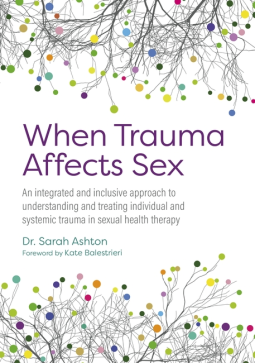
When Trauma Affects Sex
An integrated and inclusive approach to understanding and treating individual and systemic trauma in sexual health therapy
This title was previously available on NetGalley and is now archived.
Send NetGalley books directly to your Kindle or Kindle app
1
To read on a Kindle or Kindle app, please add kindle@netgalley.com as an approved email address to receive files in your Amazon account. Click here for step-by-step instructions.
2
Also find your Kindle email address within your Amazon account, and enter it here.
Pub Date 18 Jun 2026 | Archive Date 18 Jun 2026
Talking about this book? Use #WhenTraumaAffectsSex #NetGalley. More hashtag tips!
Description
What if the challenges your clients face with intimacy are rooted in trauma they can't yet name? Drawing on decades of clinical experience, Dr Sarah Ashton reviews current research and introduces a groundbreaking, easy-to-use systemic model showing how trauma shapes clients' experiences of sexual identity and sexual relationships. Through in-depth fictionalised client narratives, reflective exercises, practical strategies, and the Sexual Health Integrated Formulation and Treatment (SHIFT) model, Ashton demystifies the connections between past experiences and present challenges.
Unpacking the neurological, psychological, relational, and systemic influences on sexual functioning-and using inclusive, neuro-affirming, LGBTIQA+-friendly language-this book provides a practical roadmap for understanding the "roots" of sexual difficulties. It considers attachment history and traumas from family of origin through to minority stress and sexual trauma, guiding therapists to identify underlying patterns, recognise overlooked factors, and apply techniques that foster healing, resilience, and empowerment.
Written for psychologists, sexual-health practitioners, educators, and clinicians, this resource equips professionals to address sexual symptoms with confidence and compassion.
Available Editions
| EDITION | Other Format |
| ISBN | 9781839979262 |
| PRICE | £27.99 (GBP) |
| PAGES | 336 |
Available on NetGalley
Available to Buy
Buy on Amazon Buy on Bookshop.org Buy on WaterstonesAverage rating from 14 members
Featured Reviews
 Reviewer 1948672
This book is a deeply inclusive, compassionate, and rather longitudinal exploration into precisely its title: When Trauma Affects Sex. In every step, it takes a very comprehensive and multi-faceted approach into questioning and understanding what patients may have experienced and how it impacted them. It then introduces a wide variety of treatment techniques.
-
To start out, I am not the target audience for this book. I saw immediately that this is written for "psychologists, sexual-health practitioners, educators, and clinicians." I knew that and ultimately decided I still did want to pick it up. I am not a provider, I am a patient. I have a long trauma history, various mental health diagnoses, and sexual dysfunction as a result of those.
As expected, this is very much not a popcorn read or written to appeal to the masses. It is not heavily focused on anonymized patient stories (though it does include a few for illustrative purposes) and does not read like a story. It is informative, heavy, and tough.
For the first third of this book, I had a hard time wading through the text. It's actually not that I found it too dense, but that the text was separated by different subheader topics too often. I found it to be rather jumpy and difficult to follow a consistent through-line of a thought or idea.
In the second third, the book delved deeper into traumatic occurrences and their effects, exploring far past the most obvious sexual traumas one may think of. This was very activating for me; I took multiple breaks from reading to do grounding, self-soothing, box breathing, and brief intense exercise to tip me back into the present. As difficult as it was, I also found it very validating and found common humanity there. The prompts, ideas, and questions for mental health practitioners to consider for their patients were embedded throughout, and I found them to be very relevant. They were certainly facets of my experiences that I've had to consider and focus in on in my healing journey.
The last third was the most exciting for me to read. It contains overviews on various techniques and modalities that could be considered for patients. I finished reading this book, but I'm nowhere near finished reading - I have multiple tabs open to look further into certain techniques that piqued my interest, and I bookmarked the exercises in the appendices to try later. The book clearly repeats that it is not a substitute for real training, and I appreciate where it notes that a provider should refer out if they are not trained in a practice they believe would most benefit the patient. What I really liked about the various overviews was that in addition to how and for whom it would likely work, it also covered limitations and populations or individual traits where that method may fall short. It is very clear that healing is slow, non-linear, requires a build-up of a safe therapeutic relationship, and is never one size fits all.
While my healing certainly is not and will never be "done," I recognized in this book a lot of what has been crucial in my healing thus far. I recognized a lot of the considerations, questions, explorations, exercises, and perspective shifts that made a real difference for me. Obviously, not everything applied, nor was everything meant to. Not only do I have further reading that I'm excited to delve into, I also put down the book near the end in order to email a psychologist for an intake appointment.
This book wasn't written for me, it was a tough read, and I appreciated what I got from it.
 Kristen M, Reviewer
Let me start off by stressing that this text is meant for mental health professionals, not for the general public. It's written and formatted more like a textbook than it is a self-help book. If you're hoping this'll be something similar to any of Emily Nagoski's works, try a different book. Even though I'm also not the target audience for this book, it fed my nerdy little brain. I did my undergrad in psychology and minors in anthropology and sociology, with a special interest in social psychology and the culture around sex. I even considered becoming a sex educator at one point, so this field of study is something I'm fascinated by.
The character stories illustrate how one issue someone seeks help for can stem from a combination of numerous complex and interconnected factors, such as the culture the individual was raised in, experiences with certain stimuli, the reactions of others to that individual's exposure to said stimuli, or the individual's unique physiology, to name a few examples.
This book does a good job summarizing the models that provide the frameworks for how it analyzes human sexuality in relation to development and trauma. It also structures how clinicians can help clients through questions that prompt self-reflection and various therapy methods. It compiles related research for quick reference and delves into many aspects that affect human sexuality, focusing particularly on trauma.
Though there aren't a lot of images, the text is broken up nicely using bullet points between titled paragraphs, and character stories. Most chapters end in questions that mental health professionals can ask their clients to reflect on and key learning points that summarize the chapter.
I can't speak to how helpful an actual clinician will find this book, but to my unqualified mind, I think it succeeds in collecting research on human sexuality and trauma, presenting information to deepen understanding and empathy, and providing various methods to tailor treatment to each client.
 Mark K, Educator
I highly recommend When Trauma Affects Sex. This is a wise, compassionate, and much-needed resource for anyone seeking to understand how trauma can shape desire, arousal, safety, embodiment, and intimacy. What makes this book so valuable is its refusal to reduce sexual struggles to technique or pathology; instead, it honors the whole person, including the nervous system, relationships, identity, culture, and lived experience. Clinicians, survivors, and partners will find here a grounded and hopeful guide for moving toward sexual healing with patience, dignity, and care.
Reviewer 1170926
I’m not the audience for this as I’m not a therapist and I think this would better serve clinical professionals. I was interested as someone with sexual trauma but it didn’t necessarily provide any new insights for me.
Reviewer 1772294
As a previous reviewer has said this is not a self help book it is for trained professionals. I did not find it triggering but I’m imagining it would be for someone who doesn’t not work in this area. A well written, well researched book. Easy to read, despite the topic with straightforward language and relevant case studies. Helpful illustrations throughout and whilst relevant therapies are detailed the book also describes a specific treatment protocol. It feels like a book that would be definitely helpful for sex therapist, I’m think a quick way to update or review, but also for clinicians who work with people who have experienced trauma. Trauma therapy training has so little content about the impact on people’s sexual relationship, even their relationship with themselves let alone with others. I found this book, interesting and helped me to consider the subject further. It also gave me ideas of further reading and issues I could bring to my supervision. There are plenty of references included at the back along with relevant resources to use. Before I requested this ARC I checked the author’s website and while there are courses people could pay for there are also free resources, of good quality, which I think is always a good sign from an author. The book feels inclusive with gender, sexuality and neurodiversity taken into account.
Thank you to NetGalley for providing this book for my consideration, this is all my own rambling, honest and personal opinion.
Reviewer 2102709
Thank you to the publisher and NetGalley for providing an ARC in exchange for an honest review.
It's worth noting that this book is written primarily for mental health professionals and clinicians rather than a general audience. While I am not the target reader, I have a longstanding interest in psychology, trauma, sexuality, and mental health, which made me curious about the subject matter.
One of the book's greatest strengths is the way it illustrates how complex human sexuality can be. Rather than presenting a single explanation for sexual difficulties, it highlights the many factors that can influence a person's relationship with sex, including trauma, culture, physiology, life experiences, and individual history. The overall approach is compassionate, nuanced, and deeply respectful of the diversity of human experiences.
The book functions both as an overview of trauma's impact on sexuality and as a practical resource for clinicians. I particularly appreciated the exercises, reflection questions, and treatment considerations woven throughout the text. The emphasis on tailoring approaches to the individual rather than relying on a one-size-fits-all model felt especially valuable.
As someone outside the intended professional audience, I occasionally found sections dense and highly clinical. Some chapters read more like a textbook than a general-interest nonfiction book, which may make it a challenging read for readers without a background in psychology or mental health.
That said, I learned a great deal from this book. It expanded my understanding of the relationship between trauma and sexuality and offered insights into how clinicians can support clients in navigating these challenges. While not every section was equally relevant to me personally, I found the overall experience informative, thoughtful, and worthwhile.
I would especially recommend this book to therapists, counselors, sex educators, social workers, and other helping professionals seeking a trauma-informed perspective on sexuality and intimacy.
Cal J, Reviewer
Ashton has written an accessible, factual and with a new approach to helping people who have experienced trauma and that impacts their sex life. I found the writing clear, the explanations thorough, and the conclusions well-thought out. The way the book is broken down makes what can be a heavy topic much more approachable. Ashton is also very transparent about her position, and the limitations of her position. The way in which Ashton has blended the psychological, biological, and environmental elements of trauma survivorship enriches the text and creates a scaffolding of the SHIFT Model. The SHIFT Model seems to be a very intriguing and promising approach to use with survivors in the right place to do the work. The extensive explanation and resources provided in Part Three and the Appendixes are very helpful and enriching when it comes to trying to understand the model. I look forward to the opportunity to integrate the SHIFT Model in to my work where appropriate. While I feel like the audience for this book is clinicians, Ashton does not make the assumption that everyone reading this book will have a working knowledge of polyvagal theory and other more niche elements of trauma psychology and provides enough explanation to understand what is necessary to reach the point of the chapter, and book.
 Sax B, Reviewer
I am not the target audience for this book, as the author wrote it with clinicians and practitioners in mind, so I’m uncertain why the publisher approved my request to review it. I will say, however, that the writing is completely accessible to laypeople, and I was hooked by the time I’d finished reading the Preface.
I’ve been walking the path to healing for a very long time now, and I can tell you that in my experience therapists who operate with these principles in mind are few and far between. I can only hope that books like this one, and practitioners like Dr. Ashton, encourage their proliferation. If I had experienced even an ounce of the understanding and empathy I felt just in reading these pages, there’s no doubt in my mind that it would have made my journey far less bumpy than it has been.
That’s not to say most therapists are incompetent or have ill intentions. While I do think that some do not live up to their oaths as healers, I think that many simply are not trauma informed. And even those that are often do not have the training or experience to be able to effectively treat one who is intersectional and managing cPTSD.
This book wasn’t written for people like me to read. It was written for those meant to treat people like me. But I learned some things from it, nonetheless. Most women and gender-nonconforming people have experienced some form of sexual harassment or assault at least once. In many cases those in our inner circles have also been the target of one or the other – or both.
A skilled and empathetic trauma-informed therapist is always going to be the best first option for dealing with such issues. When Trauma Affects Sex is not a manual for how to navigate the inevitable fallout from such situations. But it provides valuable insight that can help us to understand it, and our reactions to it, and for that if nothing else it’s worth reading.
4.3⭐️
I received a copy of When Trauma Affects Sex from the publisher via NetGalley and am leaving a voluntary review.
 Zackary Ryan C, Reviewer
Thank you so much to NetGalley and the publisher for an early copy in exchange for an honest review.
Review: I would highly recommend this for therapist especially. On top of that, for other people curious about sex and intimacy and it's impacts on all of us. This book gives good perspective for the intersection of trauma and sex and recovery when needed. I would highly recommend this book.
 Akeisa A, Reviewer
This book is perfect for any mental health professional, but specifically anyone who works with individuals who have experienced sexual trauma of any kind. I love how the book consists of multiple case studies and the various modalities to consider when working with a client with a similar concern.
Melanie H, Reviewer
When Trauma Affects Sex by Sarah Ashton is a thoughtful, compassionate, and much-needed contribution to the conversation around trauma, intimacy, and sexual wellbeing. Rather than viewing sexual difficulties as isolated problems, Ashton encourages readers to understand them through a trauma-informed lens, showing how past experiences can shape present-day relationships, desire, and connection.
One of the book's greatest strengths is its ability to balance clinical depth with accessibility. Ashton draws on research, neuroscience, attachment theory, and years of therapeutic experience, while using case examples and practical strategies to make complex concepts understandable and applicable. The inclusion of reflective exercises and the SHIFT (Sexual Health Integrated Formulation and Treatment) framework provides clinicians with tools they can immediately incorporate into their practice.
The book is also refreshingly inclusive. Its neuro-affirming, LGBTQIA+-inclusive perspective acknowledges the diverse ways people experience sexuality and trauma, creating a resource that feels relevant to a broad range of practitioners and clients. Rather than offering simplistic solutions, Ashton emphasizes curiosity, compassion, and individualized care. I found it incredibly candid of Ashton to open the book with the things out of the scope of her research and to encourage people to seek additional information and research.
This is not a book of quick fixes; it is a comprehensive guide for psychologists, therapists, sex educators, and other health professionals who want to deepen their understanding of the intersection between trauma and sexuality. While the material can be emotionally challenging at times, it is handled with sensitivity and hope.
Overall, When Trauma Affects Sex is an important and timely resource that fills a significant gap in trauma-informed sexual health literature. It challenges readers to rethink long-held assumptions about sexual functioning and offers a practical, evidence-informed roadmap toward healing and more meaningful therapeutic work.
Readers who liked this book also liked:


Louise Lucas
Health, Mind & Body, Nonfiction (Adult), Professional & Technical



Created by Hayao Miyazaki
Comics & Graphic Novels, Sci Fi & Fantasy

A Film by Hayao Miyazaki
Children's Fiction, Comics & Graphic Novels

Hayao Miyazaki
Arts & Photography, Comics & Graphic Novels

Kalan Chapman Lloyd
General Fiction (Adult), Literary Fiction, Women's Fiction